The Russian soldiers never heard the robots that killed them. The five-man infiltration squad had snuck into Ukraine and taken up position in a few small buildings north of Dobropillya, in Donetsk Oblast.
They were behind enemy lines and confident that Ukraine’s forces were unaware of their presence. If the Ukrainians did know they were close by, there would be a counterattack, which would be announced by small-arms fire from nearby troops.
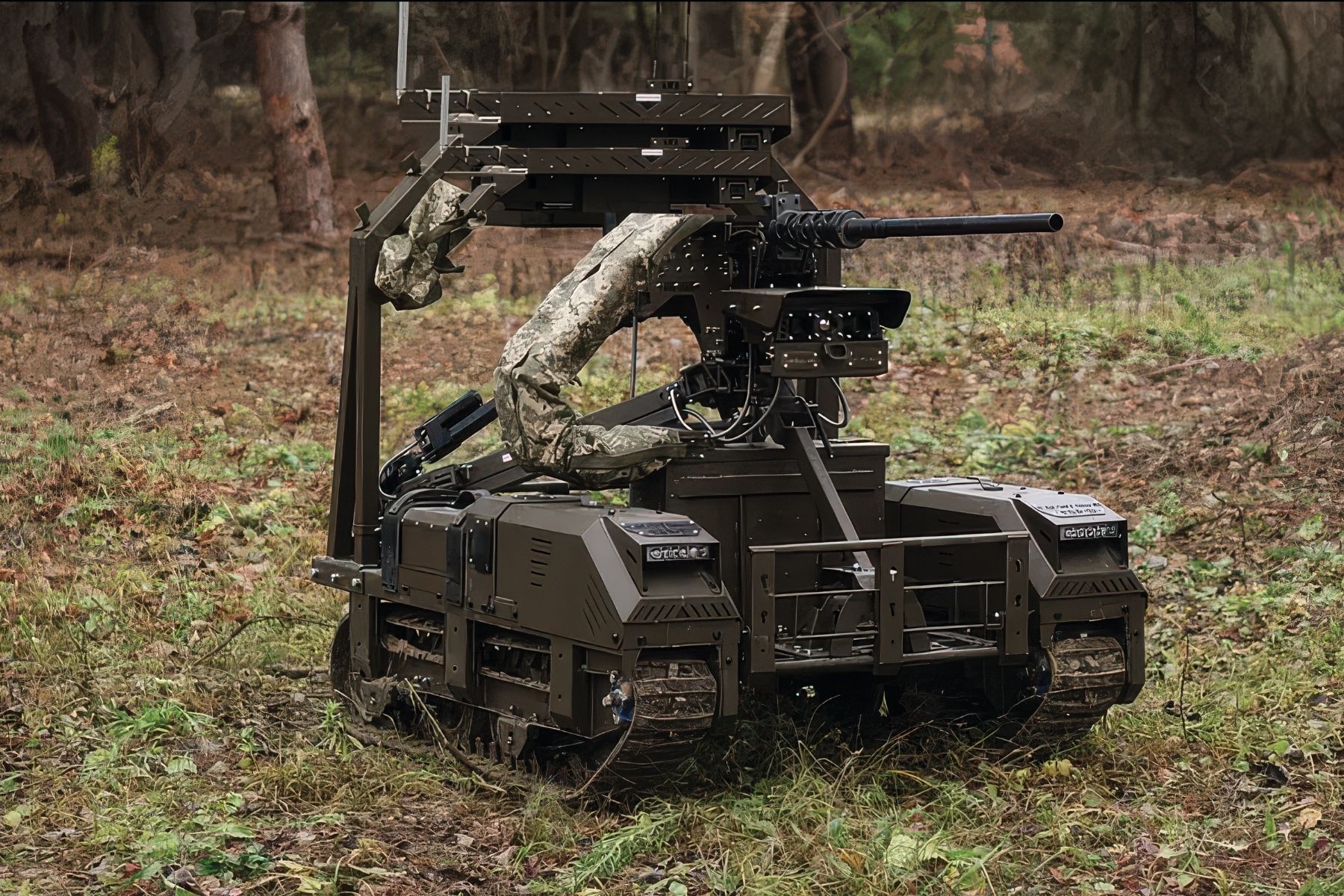
But no troops were needed to neutralise the threat they posed. Instead, the Russians died at the hands of drone operators controlling three unmanned aerial vehicles (UAVs) and two unmanned ground vehicles (UGVs), each armed with a large-calibre machine gun.
Satellite-enabled warfare
While aerial drone strikes have been commonplace since Russia invaded Ukraine in February 2022, the use of UGVs to hold and retake positions has accelerated in the past six months.
Such is the potential of UGVs in both defensive and offensive operations that the Ukrainian military recently launched a competition to source new designs.
According to the official press release announcing the competition (vividly illustrated with an AI-generated image of Terminator-esque robots firing at human-shaped targets), “The key objective of the initiative is to maximise the automation of the front lines and reduce risks to military personnel.”
That’s always been the goal of UGVs, explains Robert Tollast, a researcher in the Royal United Services Institute’s (RUSI) land warfare team.
Though history offers plenty of cases of armed remote-controlled ground vehicles – see, for example, the ‘Schneider Crocodile’ deployed by the French army during the First World War – in Ukraine, such robots rose to prominence as a means of resupplying isolated forward positions and evacuating the wounded.
Both Russia and Ukraine make regular use of these UGVs, most of which resemble flatbed trolleys with caterpillar tracks. But improved communications technology has allowed the devices to move from saving soldiers to fighting.
A growing supply of Starlink satellite internet terminals to the Ukrainian army has allowed human operators to maintain reliable links with UGVs for far longer than conventional radio-based connections, which can also be easily jammed.
Though the Starlink system is “not impervious” to these problems, says Tollast, its ability to rapidly switch between high-band frequencies has made operations like the one outside Dobropillya possible.
Ukraine has had the edge over Russia in this area since February 2026, when Starlink blocked the latter’s military use of its terminals, although that may not last forever, argues Tollast.
Russia is working with China to find ways of blocking the service without relying on the former’s expensive, truck-sized jamming systems, which Ukrainian UAV operators have repeatedly destroyed in recent months.
In the meantime, however, Ukraine has been exploring new ways to use its growing army of UGVs, which now number several thousand.
A four-legged threat
One obvious application lies in offensive operations. In July, the Ukrainian army landed an ARK-1 robot armed with a machine gun on the Kinburn Spit, a highly contested sliver of Russian-occupied territory south of Mykolaiv.
Though the outcome of that raid remains unclear, Tollast predicts more operations of this kind from the Ukrainians in the coming months.
Might humanoid robots soon be spotted on the front line? Tollast thinks not, and the Ukrainian army agrees, stating that such drones are heavy, expensive and often topple over.
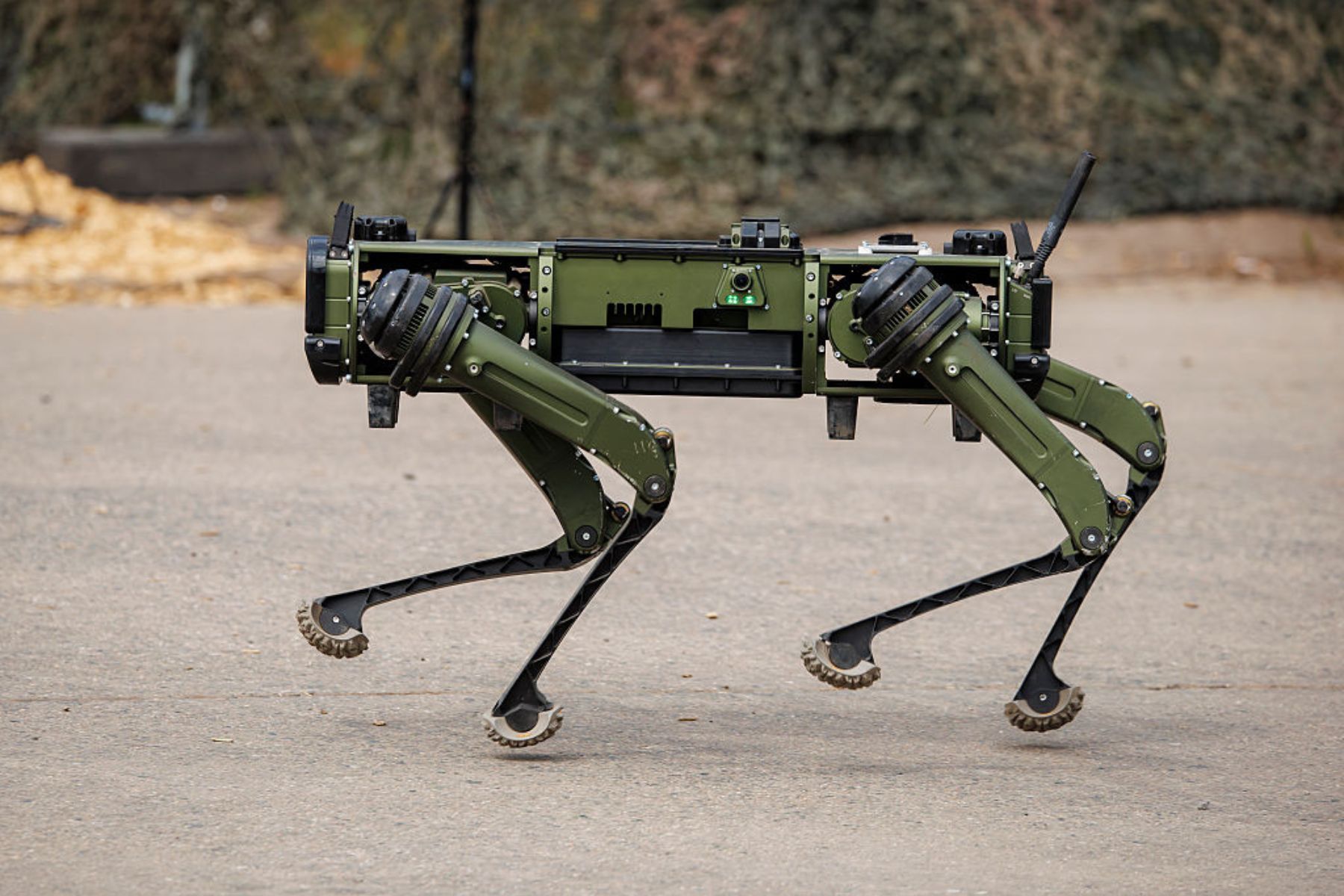
Quadruped robots are much more likely, argues Tollast. These would – in theory – be able to traverse the battlefield with relative ease (a prospect frighteningly visualised in the 2017 Black Mirror episode ‘Metalhead’).
Uncrewed tanks are another possibility, Tollast says. But the Ukrainian army’s progress in UGV development is only sustainable if a reliable connection is maintained between the human operators and the drones in the field. If China and Russia succeed in finding cheaper ways to block Starlink, all bets are off.
A solution to this problem might be to make the machines fully autonomous, as is increasingly the case among UAVs deployed by both sides in this conflict.
“I expect that the Ukrainians will be working hard on this,” says Tollast, “and they’ll probably crack the problem at scale.”
It may take some time. Though the cost of the sensors necessary for autonomous navigation is falling, even drones powered by the latest machine vision systems find it difficult to traverse the churned-up terrain of Ukrainian no man’s land.
As such, we’ll probably have to wait a while for robots to take over soldiering. Assuming that’s the only option besides an end to the fighting.
Read more: