Magazine
BBC Science Focus is the BBC’s science and technology monthly magazine. Jargon-free and accessible, you don’t need a PhD in particle physics to enjoy reading it. All you need is a quizzical mind that wants to understand the world around you, and gain a fact or two to keep up your sleeve in a pub quiz emergency.

Anti-ageing pills are real, and some of us are taking them without knowing it
Eternal youth is the stuff of religion and mythology, but what if we could just have a bit more of it? What if there was a pill that could slow down the ravages of time, so that you could feel younger for longer. It sounds like snake oil, but there’s a growing body of research that’s betting on making it a reality.

New issue: Brain-melting heat
As I write this, it’s stupid hot. I mean that literally: it’s so hot that it’s difficult to think. My thoughts feel as though they’ve been wrapped in cotton wool and then set on fire. As it turns out, though, the way I feel isn’t that far removed from what’s happening inside my brain. Nothing is actually burning between my ears, but heat can interfere with the millions of tiny electrochemical interactions that my – and your – neurons rely on to function. Brain cells have a temperature range in which they work at their best, but push the temperature too high and some of the molecular machinery involved in sending signals becomes less reliable. It’s a little like an orchestra losing its conductor: the instruments are still there, but the timing starts to fall apart. Taken to extremes, this is why heatstroke can cause confusion, dizziness and other changes in brain function. And the heat doesn’t only affect the brain directly. As my body heats up, my circulatory system sends more blood towards my skin to help me lose heat, making my heart work harder. Sweating also means losing water and salts, and as dehydration sets in, maintaining a normal blood supply becomes more difficult – adding another challenge for a brain that’s already under thermal stress. Sweat and aggravation are, of course, far from the worst consequences of extreme heat. But this year, the soaring temperatures have felt relentless. Wave after wave of heat has battered Europe and the US, with barely enough respite before the next one arrives. We’re going to have to adapt. We can change our buildings, routines and behaviour to make extreme heat easier to bear. But what happens to the organ that controls all those decisions when the temperature keeps rising? In this issue, we're exploring what heat does to the brain – from our ability to think clearly and make decisions, to our mood, sleep and mental wellbeing. And because knowing it’s too hot doesn’t make it any cooler, we've also found some scientifically proven advice on the fastest way to cool down.

BBC Science Focus Crossword solution #436
Here is the solution to the crossword from issue 436 of BBC Science Focus magazine
null
undefined

This article is scientifically proven to improve your willpower
Scientists are discovering there are some mind tricks that can take your powers of self-control to the next level…

New issue: Our Next Giant Leap
We’re going back to the Moon, and this time we’re staying. That was roughly the message from NASA when, in March, it shared its plans to build a Moon base via a series of events and documents intriguingly titled “Ignition”. Meanwhile, Lunar Gateway – the proposed permanent space station orbiting the Moon, intended to support future missions to the Moon, Mars and beyond – has been put on hold. NASA is focusing its attention on other things now, possibly due to the pressure coming from another nation: “We find ourselves with a real geopolitical rival, challenging American leadership in the high ground of space,” said NASA administrator Jared Isaacman earlier this year. If we put aside the worrying perception of space as the ultimate “high ground” for a moment, the message is clear. The US doesn’t want China running around on the Moon and having it all to itself. So, the race to put boots on the lunar surface – boots that might one day be dusted with regolith and stored by the airlock of a little lunar ranch in the shadow of a crater – is on. When will it all happen? Well, NASA is targeting a human landing in 2028, and a habitat – one that astronauts can spend the night in, if not stay permanently – could be ready by2032. China, on the other hand, is proposing to have its taikonauts arrive on the Moon in 2030 and has set 2035 as a deadline for some kind of semi-permanent structure there. So, in what feels like the blink of an eye, the idea of a Moon base has come to life. It’s gone from being a leap of imagination that lived exclusively on the pages of science-fiction novels to becoming the actual, next giant leap for humanity. Discover how these lunar outposts will take shape – and why China and the US are racing to establish them – in this issue.

BBC Science Focus Crossword solution #435
Here is the solution to the crossword from issue 435 of BBC Science Focus magazine

New issue: Preventing Dementia
A recent study estimated the risk of men and women developing dementia after the age of 55 at 42 per cent. So what’s driving this rather frightening number? Well, for one thing, we’re living longer, and it would seem our minds aren’t quite keeping up with our bodies. Why? Nobody is really sure. But there’s another way of looking at those figures. And that’s to remember that anything you can do now to keep those percentages down, is likely to pay off later on. Like so much in medicine, prevention – helping people stay well enough to avoid hospitalisation – really is the key. Mercifully, there are dozens of small changes you can make now that can reduce your risk of developing dementia in later life. We take a deep dive into what they are, and why they work, in this issue. Personally, I’m going to try to get better sleep. But one way or another – whether it’s cutting down on wine, getting more exercise or changing my diet (all helpful in their own right) – I’m going to commit to getting better rest. I’ve read it does wonders for the brain… time for a nap.

BBC Science Focus Crossword solution #434
Here is the solution to the crossword from issue 434 of BBC Science Focus magazine

New issue: Inside a Black Hole
At this point in time, black holes feel… inescapable. I’m not talking about their gravitational pull, but rather how every week seems to bring the publication of a new paper about these cosmic monsters. For such enigmatic objects, we hear an awful lot about them. This is mostly thanks to the discovery, made a little over 10 years ago, that we could detect and measure gravitational waves. When this happened, we found a new way to look at the Universe. Until then, we had relied on various types of sensors to collect light (X-rays, visible light, radio waves and so on) or particles, such as cosmic rays, to examine the Universe. All of which, famously, tell us almost nothing about black holes. But then, on 14 September 2015, we picked up the signal created by two black holes spiralling around each other and merging. The event didn’t create a flash or a bang; instead, it created a ripple in spacetime that surged towards us at the speed of light. Here on Earth, the Laser Interferometer Gravitational-wave Observatory (LIGO) picked up this vibration in the fabric of spacetime and, in doing so, gave us a new way to probe the Universe – and a means to investigate the behaviour of black holes. Fast forward to today, and LIGO and its new partners – the Virgo interferometer in Italy and the Kamioka Gravitational Wave Detector (KAGRA) in Japan – have become black hole hunters, tracking 300 mergers between them. The signals received and the measurements taken are slowly disrobing black holes of their secrecy. By analysing these signals, scientists can determine how a black hole formed, its mass and spin, its energy output and much more. We’ve discovered black holes are much bigger and much more common than we thought, and that there might be different generations spread throughout the Universe. And yet, we still haven’t been able to peer inside one. That final frontier still remains… or does it? Read this issue to find out.

BBC Science Focus Crossword solution #433
Here is the solution to the crossword from issue 433 of BBC Science Focus magazine

What your intrusive thoughts actually reveal about you
Occasionally, you’re minding your own business when a weird – and sometimes disturbing or upsetting – thought pops into your head. Why does your brain do this, and does it mean that you’re a bad person?

New issue: Mirrorlife
Mirror life could end all life on Earth. That sounds dramatic, but senior biologists have raised the alarm about experiments happening all around the world. It sounds like something in a Doctor Who plot, but no – mirror life is a real possibility. So why do scientists want to create something that’s potentially apocalyptic? Well, it could also have huge benefits. The first thing to say, however, is that mirror organisms are still a little way away yet – but only decades, not centuries. So far, scientists have only made mirror molecules, one of life’s building blocks. What for? Life works because its building blocks fit together. Imagine drilling a screw into a piece of wood. The screw cuts a hole with a thread that snugly matches its own. If, for some reason, the Doctor showed up and handed you a mirror version of the screw, its thread would be in reverse. It wouldn’t twist into the hole you’d just made as the threads wouldn’t match. That said, the mirror screw would still work; you’d just have to create a mirror hole for it. Mirror molecules, including DNA, work a bit like that. They follow the same principles as the biology around us, but they’re entirely incompatible with traditional biological functions. In medical terms, this means they’re effectively invisible to your body’s systems. Our biology doesn’t have the tools to recognise these molecules and break them apart. And if someone took these mirror molecules and put them together to make a cell and then an organism… you’d have mirror life. But we don't have any way of breaking it down. If it escaped the lab, we’d just have to hope it didn’t have an appetite.
BBC Science Focus Crossword solution #432

New issue: What really causes autism?
Our best research – studies that looked at the health records of millions of children – has, to date, found no causal link between taking acetaminophen (otherwise known as paracetamol and sold under the brand name Tylenol in the US) during pregnancy and the onset of autism. In fact, as rates of autism diagnoses have gone up, acetaminophen use during pregnancy has actually gone down. So why do some high-profile US politicians suggest otherwise? Well, there was a study, published a decade ago, that looked at data collected on almost 2,650 children, which did find an effect. But it’s possible that this research was actually observing the effect of whatever symptom the drug was meant to treat – not the drug itself. The backdrop to this row is the undeniable observation that autism diagnoses are on the rise. One in 59 children were thought to have the condition in the US in 2015; that figure is now one in 31, according to the Centers for Disease Control and Prevention (CDC). Most experts attribute this rise to improvements in identifying autism. Indeed, we’ve gotten better at understanding what autism looks like in all its forms. And therein lies some clarity. Just as we’re beginning to understand that there are different types of autism, there are likely to be several factors that can shift the dance between genetics and the environment as your brain develops during pregnancy. Timing is everything in the womb, which is why one scientist is growing tiny human brains (or at least parts of them) in a lab – to find out when and where the first signs of autism appear.
BBC Science Focus Crossword solution #431
Here is the solution to the crossword from issue 431 of BBC Science Focus magazine
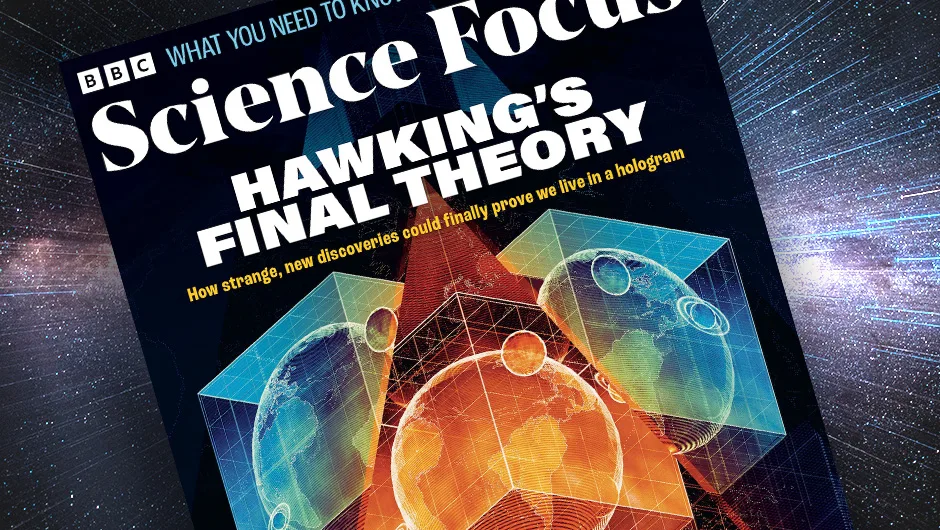
New issue: Hawking's Final Theory
Stephen Hawking spent much of his life pulling at a thread, one that had been swallowed by a black hole. He was interested in what happened to material once it passed a black hole’s event horizon – the point of no return, where gravity crushes anything that crosses it into an infinitesimally small point in space. Other theories hypothesise that if you fell in, your atoms would become part of this cosmic monster and reside there until the end of time. Hawking’s maths suggested something else, however. According to his calculations, black holes don’t last until the end of time. In fact, quantum mechanics suggests that a black hole would, over time, fizz away. Its particles would evaporate over aeons until a final, massive burst of energy. Why does this matter? Well, until this point, the prevailing idea in physics was that nothing is ever really destroyed. If we could somehow fish your atoms out of a black hole, and invent a machine that knew where to put them (like your pattern caught in a transporter buffer), we could, in theory, rebuild you. The death of a black hole, and the ultimate end of everything within it, seemed to violate this rule. Hawking had spotted a crack in our model of the Universe. The resolution to this problem that he settled on, after many intellectual battles with other theoretical physicists, was the ‘holographic principle’ (an idea first proposed by physicists Gerard ‘t Hooft and Leonard Susskind). It’s a headscratcher of an idea that suggests the Universe is actually a projection. In this issue, Thomas Hertog, one of Hawking’s closest science collaborators, takes a closer look at this idea. He thinks that we’re close to a discovery that will let us see Hawking’s maths play out in the real world. A discovery that could finally move us closer to a single, unified theory of everything.
BBC Science Focus Crossword solution #430
Here is the solution to the crossword from issue 430 of BBC Science Focus magazine

How to spot dementia early and reduce your risk by half
New science is uncovering how Alzheimer’s could be detected decades before symptoms strike

New issue: The Mystery of Free Will
There’s a growing school of thought in neuroscience that argues every action is predetermined, or at least highly probable. That my actions are just the sum of biological and environmental interactions outside of my control. Roughly speaking, the idea is that electricity pinballs between my ears, bouncing around the memories and concepts I hold there without my being conscious of it, before arriving at a series of outputs that prime my fingers to type this very sentence. And only then, do I become aware of ‘deciding’ what I want to write. Action precedes thought, in other words. This isn’t just a theory – there’s evidence to back it up. It seems that, in certain scenarios, neurons controlling your arms and fingers are ready to fire before those involved in conscious thought are fully active. I’m skipping over a mountain of philosophy and psychology, but you get the picture. If, like me, this idea leaves you feeling a little uneasy, maybe this will help. Neuroscience has gotten incredibly close to the minutiae of the brain in the last two decades, but it hasn’t yet wrestled with the big picture. The discipline can tie different actions to different parts of the brain, but it can’t explain why it feels good to spontaneously dip your hand in a cold, clear river, for example. My point is, neuroscience is uncovering all kinds of fascinating oddities about how the brain works, but we’re a long way away from a true understanding of how this adds up. Does free will actually exist?
BBC Science Focus Crossword solution #429
Here is the solution to the crossword from issue 429 of BBC Science Focus magazine

New issue: Don't count the calories
January’s long nights, howling winds and unending drizzle that constitute a British winter all seem to scream: stay indoors, get under a blanket and stay very still. But every year, I reach January and the same conclusion as millions of others: it’s time for change. Christmas is what does it. There’s only so much indulgence the body can take. It starts on the 24th when, if you’re lucky, work’s finished and the fridge is full. Over the next seven days, I’ll feast like a Tudor monarch, picking at carcasses, stabbing at cheese and washing it all down with a bit of port (well, someone’s got to finish it). But by New Year’s Day I’ve had enough. Meaningful, lasting change isn’t easy. The science says so. Sure, a fitness influencer will scream at you until they’re Christmas-ham-pink in the face that losing weight is JUST SIMPLE MATHS: burn more calories than you consume, and you’ll lose weight. But your genes, biology and chemistry don’t work like a calculator. There’s more to it. So we’re here to help you construct bite-sized changes that will add up to significant improvements in your health and wellbeing this year.
BBC Science Focus Crossword solution #428
Here is the solution to the crossword from issue 428 of BBC Science Focus magazine

Only a genius could solve these 7 Christmas puzzles in 10 minutes
Is your grey matter feeling a bit fried? Give it a workout with these tricky puzzles.

New issue: Lost in Space
Imagine having access to a time machine. You could experience historical events first-hand – and finally get to the bottom of all manner of mysteries. Although we can’t travel back in time physically, with a good telescope – like the James Webb Space Telescope – we can essentially see back in time. That’s almost as good, right? Take, for example, the very first stars, which formed around 100-200 million years after the Big Bang. Their sudden appearance set the stage for the Universe we see today, triggering a chain reaction that’s still occurring. And by uncovering the oldest objects in the cosmos and examining their unique makeup, we can retrace the chemistry and physics of creation. Those first stars should be easy to spot thanks to their special compositions, and stellar archaeologists (a cool job title, if I’ve ever heard one) have been seeking them for a long time. But as Dr Emma Chapman explains in this issue, the reason we haven’t found them yet could be because we've not been looking for the right things. What we have found, is that so-called 'ancient stars' aren’t behaving quite as we expected. So far, our search into the deep past has raised more questions than answers.
