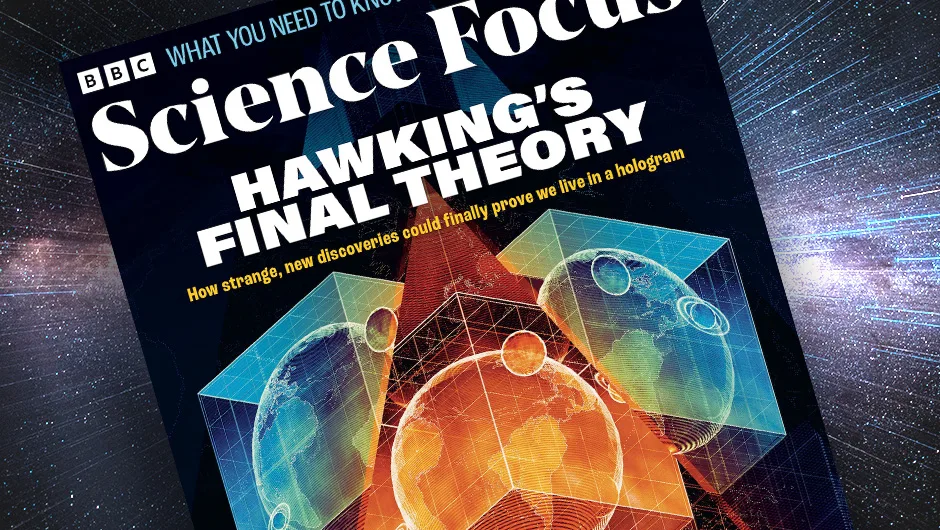
New issue: Hawking's Final Theory

Stephen Hawking spent much of his life pulling at a thread, one that had been swallowed by a black hole. He was interested in what happened to material once it passed a black hole’s event horizon – the point of no return, where gravity crushes anything that crosses it into an infinitesimally small point in space. Other theories hypothesise that if you fell in, your atoms would become part of this cosmic monster and reside there until the end of time. Hawking’s maths suggested something else, however. According to his calculations, black holes don’t last until the end of time. In fact, quantum mechanics suggests that a black hole would, over time, fizz away. Its particles would evaporate over aeons until a final, massive burst of energy. Why does this matter? Well, until this point, the prevailing idea in physics was that nothing is ever really destroyed. If we could somehow fish your atoms out of a black hole, and invent a machine that knew where to put them (like your pattern caught in a transporter buffer), we could, in theory, rebuild you. The death of a black hole, and the ultimate end of everything within it, seemed to violate this rule. Hawking had spotted a crack in our model of the Universe. The resolution to this problem that he settled on, after many intellectual battles with other theoretical physicists, was the ‘holographic principle’ (an idea first proposed by physicists Gerard ‘t Hooft and Leonard Susskind). It’s a headscratcher of an idea that suggests the Universe is actually a projection. In this issue, Thomas Hertog, one of Hawking’s closest science collaborators, takes a closer look at this idea. He thinks that we’re close to a discovery that will let us see Hawking’s maths play out in the real world. A discovery that could finally move us closer to a single, unified theory of everything.


The front cover of BBC Science Focus magazine

Microbiomes of the superagers

The secrets to a healthy and prolonged life may lie in the guts of centenarians, people who live beyond their 100th birthday.

Processed Food

We all know that ultra-processed foods are bad for us, but some ingredients are worse than others. We take a deep dive into the most harmful ingredients lurking in ultra-processed foods, what they're doing to our bodies and how to spot them.

Delete Your Memories

We might soon be able to delete our bad memories forever. But losing them could come at a cost.

Too good to be true?

Injectable drugs such as Ozempic, Wegovy and Mounjaro can all help you shed the pounds, in some cases up to 20 per cent of your body weight. But now, the next generation of weight-loss medication is here, and it comes in pill form... but is it too good to be true?

Plus

  • Get your New Year's resolutions back on track: Struggling to keep up with your New Year's Resolution? You're not alone – the downward pressure of real life can make the best of intentions seem unreachable. But there are things you can do to get yourself back on track.
  • No humans allowed: Did you know there's a social media platform just for AI agents? It's called Moltbook... and the conversations are getting strange.
  • Q&A: Your questions answered. This month, our experts discuss: Do any animals hoard treasure? Does exercise ‘use up’ your heartbeats? How many birds fly into buildings? Would an increase in rocket launches harm the ozone layer? Does my brain live a little in the past? Can you stop your sense of taste from dulling as you age? Does my dog have ADHD? Have I ever technically touched anything? How big were medieval war horses? How can I get over my ex? And more…

Issue 430 on sale Tuesday 24 February 2026

Subscribe to BBC Science Focus Magazine

Don’t forget that BBC Science Focus is also available on all major digital platforms. We have versions for AndroidKindle Fire and Kindle e-reader, as well as an iOS app for the iPad and iPhone.
Footer banner
This website is owned and published by Our Media Ltd. www.ourmedia.co.uk
© Our Media 2026