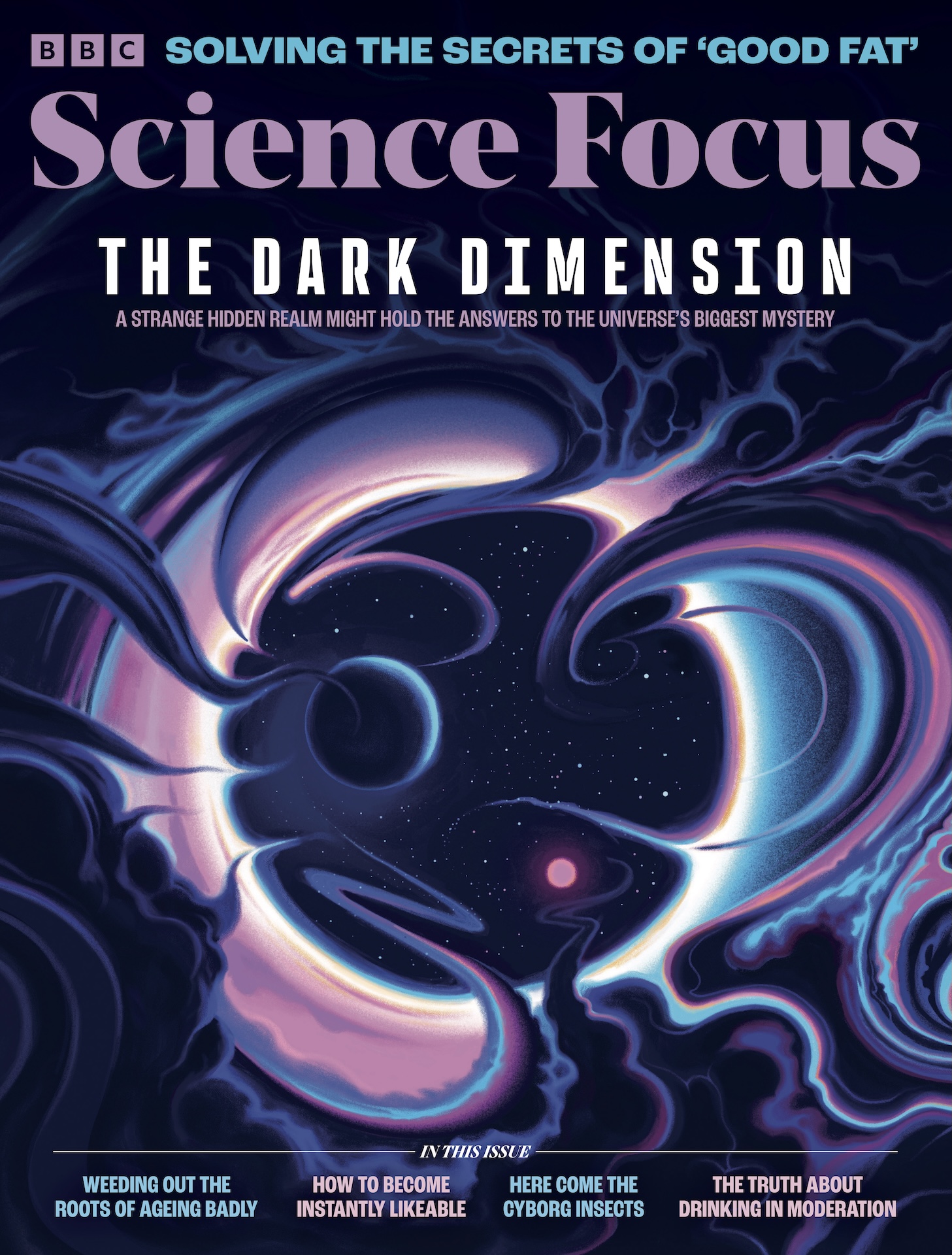
New issue: The dark dimension

Most of the Universe seems to be missing – or at least, we don’t know what 95 per cent of it is. And at this point, my biggest question is, does it matter? Most of the missing stuff (68 per cent) is something called 'dark energy'. It was 'discovered’ in 1998 when astronomers observed that distant supernovae (exploding stars) were dimmer than expected. We knew the Universe was expanding, and so the supernovae should become fainter over time, but we thought that expansion was slowing down. After all, the Universe is full of matter and that matter produces gravity, which should be pulling everything together. Instead, it seemed the expansion was accelerating. So, the physics world decided on a new kind of universal constant, dark energy. It’s a similar story for dark matter (the other 27 per cent). It was something used to fix the difference between what our model was predicting and what we were seeing in the Universe. The trouble is, we’re still nowhere near understanding exactly what either of them are. So, back to my question. Does it matter? Well, we also don’t really know what gravity is, fundamentally, but we know a lot about how it behaves. And that’s the important part – we can model what it does extremely well. This lets us probe planets, stars and phenomena light-years away from us and so it seems to matter less, even as the mystery boils on. But if you would really like to know what’s going on, one set of cosmologists has a wild new theory to help us understand what dark energy could be. Find out what that theory is, in this issue.


Issue 437 of BBC Science Focus is on sale from 22 September 2026

How to age well

What if the break down that causes ageing wasn’t going on in our cells and body parts, but in the complex communication systems running between them?

Be more likeable

The easiest ways to make a bigger, better impression at work and on the people around you, summed up in 7 habits.

Cyborg insects

Resistance is futile in the face of cyborg creepy crawlies. (Just don’t step on them!)

Good fat?

Not all fat is bad. In fact, experts are finding that there’s one type that serves unexpected and vital purposes.

Plus

  • Blue zones: Do Blue Zones, where people live significantly longer and healthier lives, hold the secret to healthy alcohol consumption?
  • Mixercise: A massive, 30-year study has revealed that variety is the spice of life when it comes to exercise. You need to mix things up to keep getting those gains.
  • Q&A: Your questions answered by our team of experts. This month: Can you beat a lie detector test? How do predators hunt in total darkness? Can you make light without electricity? Should I exercise today? Is there a natural way to stop mosquitoes from reproducing? Why don’t woodpeckers knock themselves out? Why is there a hexagon on Saturn? And more…

Issue 437 on sale Tuesday 22 September 2026

Subscribe to BBC Science Focus Magazine

Don’t forget that BBC Science Focus is also available on all major digital platforms, including Apple News. We also have versions for Android and an iOS app for the iPad and iPhone.

This website is owned and published by Our Media Ltd. www.ourmedia.co.uk
© Our Media 2026