
An innovative new study of people who have had near-death experiences has found a surprising link in what they saw.
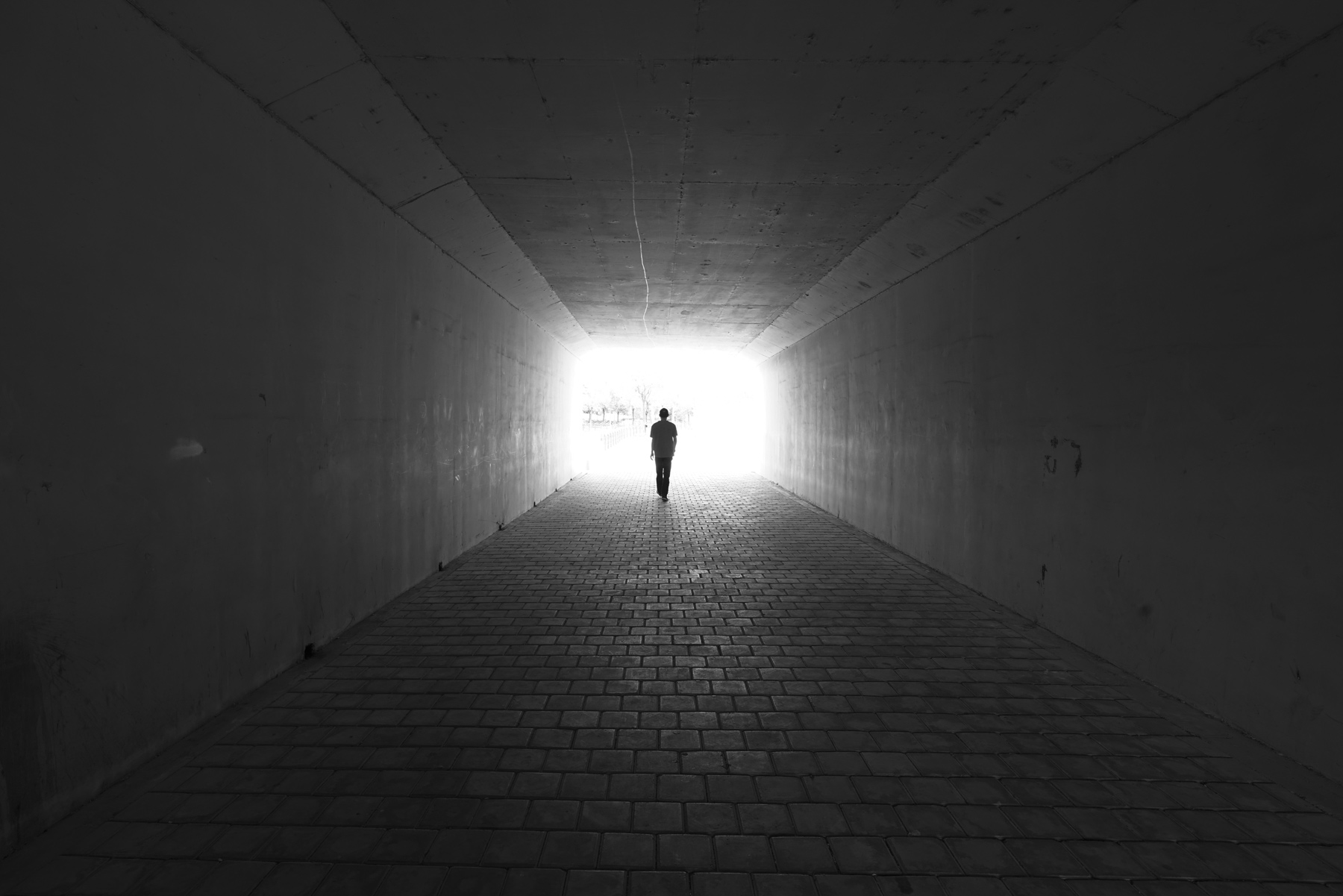
The research, published in Frontiers in Psychology, found that people who saw tunnels mostly remembered them in black, white or grey, while those who saw wide, arching spaces mostly recalled them in vivid colour.
The team asked 50 people who had reported a near-death experience, typically around 15 years earlier, to draw the spaces they remembered. Of the 28 tunnel-like spaces they described, 22 were colourless, while 27 of the 31 broad, curved spaces were in colour.
Led by neurophenomenology researcher Dr France Lerner of the University of Haifa in Israel, the researchers used guided online sessions in which participants mapped each stage of their experience with a set of geometric shapes, marking where they were, how they moved and what colours they saw.
Most of the scenes fell into four categories:
- Cone-shaped spaces, including tunnels
- Broad, curved spaces, like archways
- Flatter, more gently curving spaces
- Spheres or ovals that surrounded the observer completely
The study suggests that not everyone sees the classic tunnel and bright light. But what people do see tends to follow a pattern, and the shape of a space often predicts whether it’s seen in colour.
Many of those who described tunnel-like spaces said they felt they were moving very fast. One volunteer described starting in darkness before moving into a space with a being of “pure light” and a garden “with rolling hills, tall grass...children playing, animals roaming.”
Another described a spherical space: “I was in the centre of an immense bubble of light. It enveloped me completely. I can say that I was part of it. It was at the perfect temperature.”
Lerner and her colleagues note that some of these patterns resemble known quirks of vision. When the retina or brain is short of oxygen, the visual field can narrow into tunnel vision. In dim light, the eye’s low-light cells take over and colour fades.
The bubble-like spaces resemble what is known as the Ganzfeld effect. When people look at an even, featureless field of light that fills their whole view, with nothing to focus on, the brain starts filling in the gaps. People report feeling immersed in light and can even see things that aren’t there. A brain near death, receiving little normal input, might behave in a similar way.
Dutch cardiologist Dr Pim van Lommel, one of the world’s leading researchers into near-death experiences, who was not involved in the study, said he had not previously come across descriptions of structures like these.
Believing the brain alone can’t fully explain such experiences, he said: “There are now good reasons to assume that our consciousness does not always coincide with the functioning of our brain.”
Studies suggest up to 1 in 12 people have had a near-death experience – rising to almost 1 in 4 among cardiac arrest survivors.
Read more:
