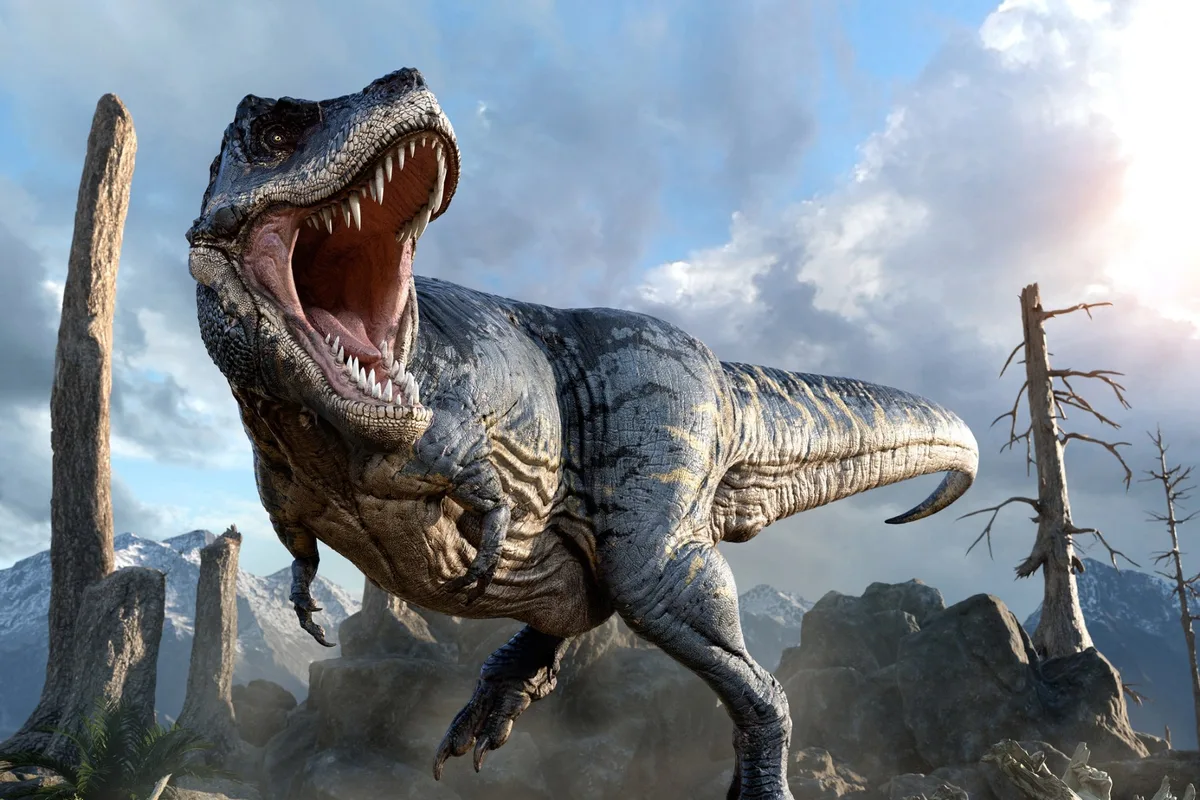
Find yourself in the face of the world’s most fearless dinosaur? Insult it where its insecurities lie – in its tiny, tiny arms.
While scientists have long agreed the miniature limbs of a Tyrannosaurus Rex were pretty useless, the actual evolutionary trigger behind their size remained up for debate. But now, thanks to new research, we might have the answer.
Researchers from University College London (UCL) and Cambridge University studied 82 species of theropods – the group of two-legged, primarily meat-eating dinosaurs that T. rex belong to – and found that their arms shrank as their heads and jaws grew larger.
This suggests that the Tyrannosaurus (and other predatory dinosaurs) evolved to use their head and jaws as their main weapon of attack, rather than their claws. As a result, their arms shrank over time with disuse, until eventually they were so outsized by the dinosaur’s enormous jaw and body they became the tiny arms we joke about.
Researchers have known for a long time that the Tyrannosaurus Rex’s arms were vestigial – meaning they lost most or all their original function through evolution – but the link between shrinking arms and swelling heads is a new proposition.
The study, published in the journal Proceedings of the Royal Society B, found that smaller arms were linked more closely with the development of large, powerful skulls and jaws – rather than the overall body size of the dinosaur. This shows that the small arms of a T. rex weren’t simply a result of their bodies getting bigger.
“The head took over from the arms as the method of attack,” explains lead author Charlie Roger Scherer, a PhD student at UCL Earth Sciences. “It’s a case of ‘use it or lose it’ – the arms are no longer useful and reduce in size over time.
“These adaptations often occurred in areas with gigantic prey. Trying to pull and grab at a 100ft-long sauropod with your claws is not ideal. Attacking and holding on with the jaws might have been more effective.”
Although we most often associate tiny arms with the T. rex, there were plenty of other theropods skipping arm day. Scherer cites the Carnotaurus as having even smaller arms than the T. rex.
One thing that doesn’t seem to matter is the dinosaur’s overall size. Several smaller theropods had similarly built strong heads and tiny arms, despite being a fraction of the size of a T.rex.
Read more:
