
Across the Atlantic, a volcano could be threatening to wreak devastation on the US. But the danger doesn’t lie with the volcanic gases, ash clouds or molten lava spewing out from a future eruption.
Instead, the volcano threatens to create a ‘megatsunami’ that will come barrelling towards the east coast. Inhabitants may have just hours to evacuate before a wall of water comes slamming into the coastline.
There’s no way to predict when it might happen. Death will come swiftly and unlooked for – a wall of water surging out of nowhere.
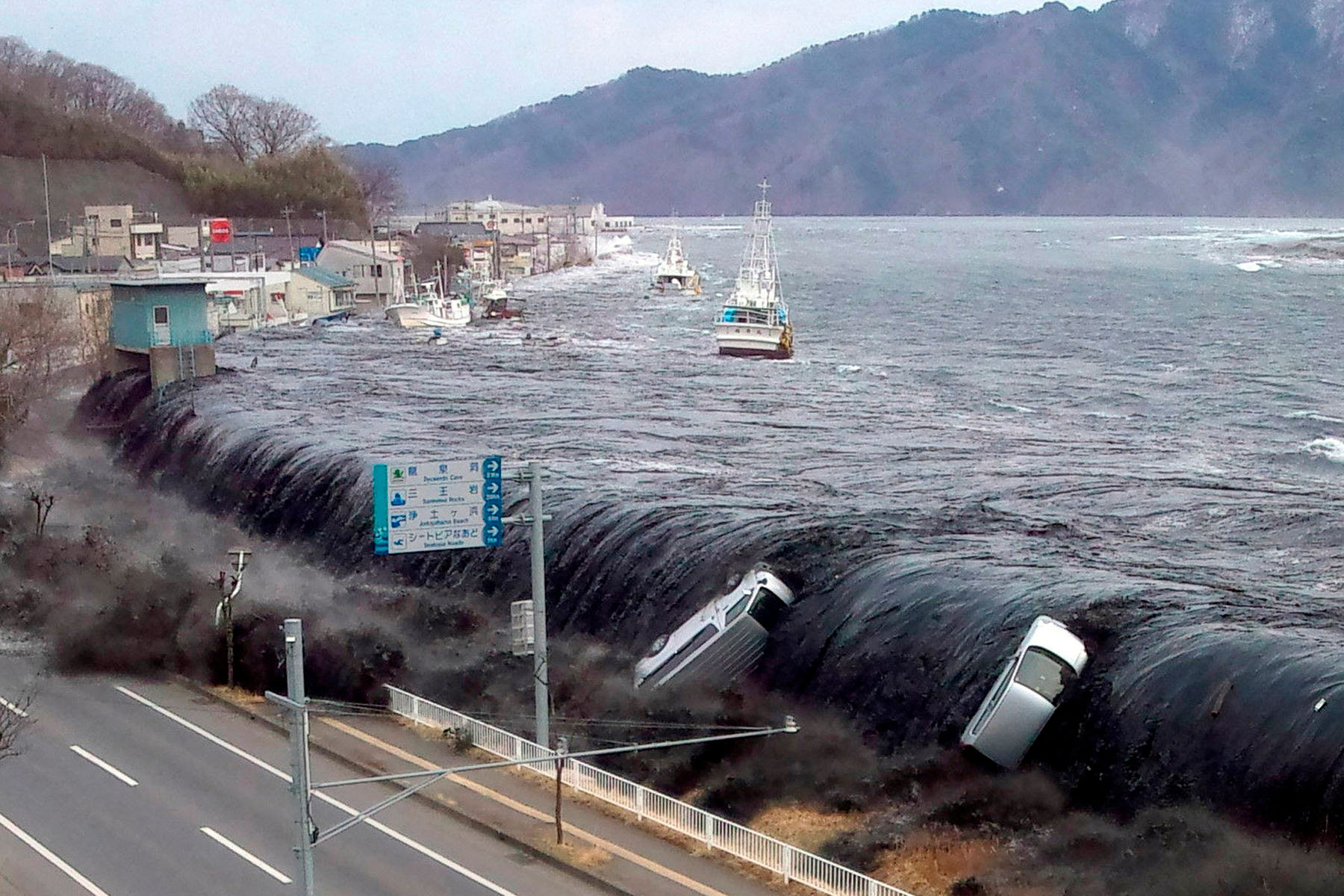
Worst of all, it’s not the only one. While most people are concerned with deadly tsunamis created by undersea earthquakes – such as the 2004 Indian Ocean tsunami which took 230,000 lives, or the Japan tsunami seven years later – volcanoes on land can spark waves that are just as, if not more, dangerous.
From volcano to tsunami
In just the last 300 years, coastal or island volcanoes have been responsible for at least nine lethal tsunamis that, together, have taken 55,000 or more lives.
Most of these came from the tsunamis raised by the eruption of Krakatau, commonly known by its anglicised name of Krakatoa, in the Sunda Strait between the Indonesian islands of Java and Sumatra. The eruption in 1883 tore the volcano apart, creating waves reaching heights in excess of 45m (150ft) and scoured nearby coastlines of every trace of habitation, consigning at least 30,000 people to oblivion.
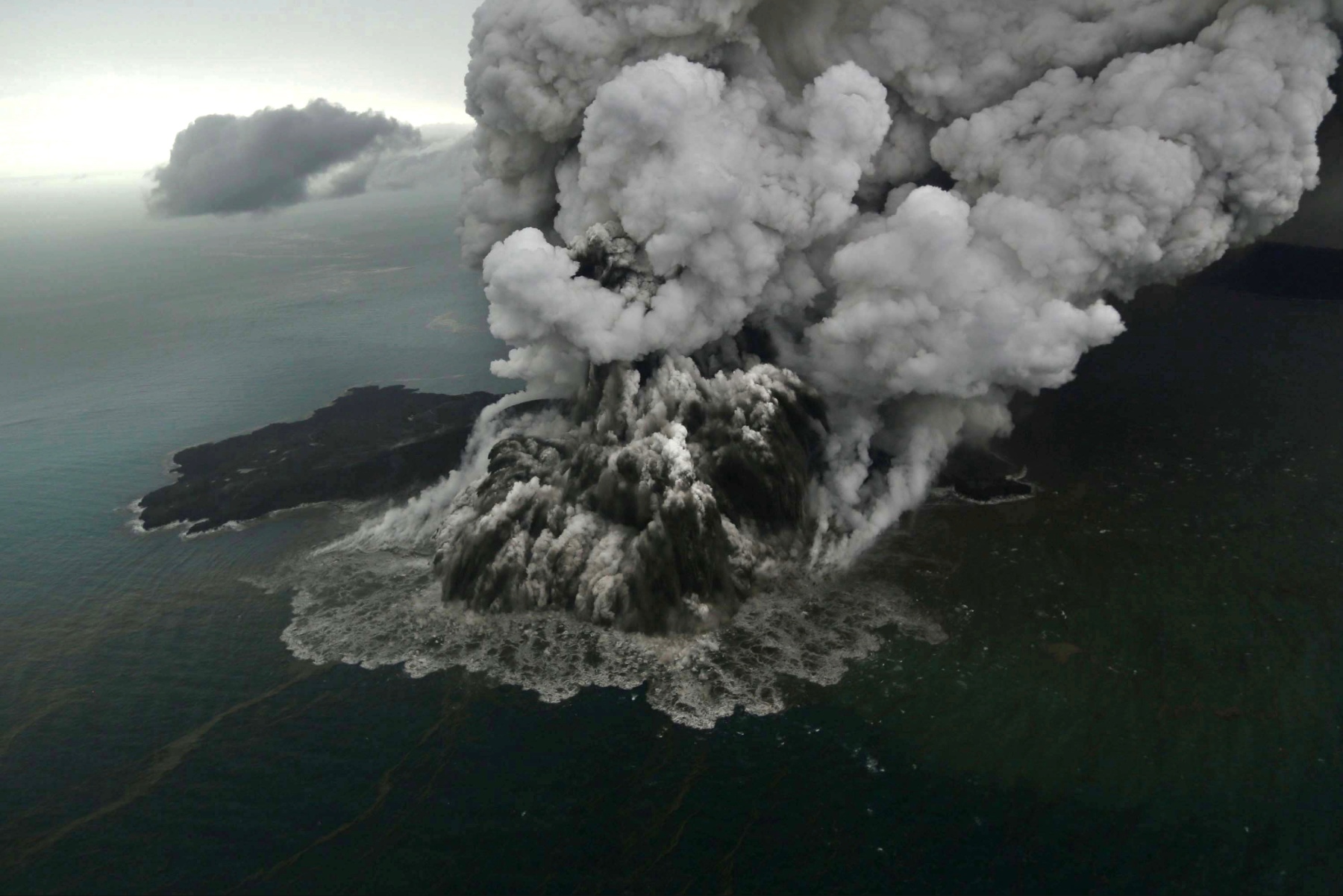
More recently, three days before Christmas 2018, the Anak Krakatau volcano – which grew on the remains of the original Krakatoa – erupted, sending huge waves rolling outwards from the volcano at more than 100km/hr (60mph). Less than 30 minutes later the surging tsunami crashed into unprepared coastal communities, destroying thousands of homes, taking more than 400 lives, and leaving almost 15,000 injured.
There are a number of ways in which what we volcanologists call ‘volcanogenic’ tsunamis can be generated. The central idea is that some volcanic process suddenly displaces a huge amount of seawater, raising a tsunami in the resulting turmoil.
The 2018 Anak Krakatau waves, for example, were caused by half of the 300m (1,000ft) high volcano falling into the sea.
How the 1883 Krakatoa tsunami formed, on the other hand, is less clear.
One possibility is the collapse of the volcano into a giant submarine crater, or caldera, formed once the magma had been evacuated. Alternatively, it could be from immense pyroclastic flows – rapidly moving mixtures of hot ash, pumice, gas and debris – slamming into the sea. It could even be from prodigious explosions caused by the mixing of magma and seawater, or of different types of magma. Perhaps it was some combination of all of these.
Like earthquake tsunamis, those sourced by volcanoes consist of a ‘train’ of successive waves. What makes volcanic tsunamis so dangerous is that they have a shorter time between successive waves than those from undersea quakes, meaning there is little respite as death and destruction are visited upon affected coastlines again and again.
They also travel more rapidly, reducing the time available for those in peril to escape inland, meaning volcanic tsunamis are all the more devastating when they strike.
Collapsing volcanoes
I have spent much of my academic career studying and monitoring the stability of active volcanoes and their worrying tendency to collapse at a moment’s notice. Just because a volcano isn’t erupting doesn’t mean a guarantee of safety. Large rock masses can fall into the sea from coastal or island volcanoes at any time, driving devastating waves onto nearby coastlines and sometimes to great distances.
Volcanoes might seem like bastions of stability, but many are just tottering piles of rubble, rotted internally by seeping volcanic gases and looking for any excuse to collapse. This typically involves a section of the flank failing and transforming into a rapidly-moving landslide – a mechanism known as lateral, or flank, collapse.
A volcano that has attracted huge interest – and concern – in recent decades is the Cumbre Vieja on the Canary Island of La Palma.
Attention has focused on the steep western flank of the volcano, which became partly detached during an eruption in 1949.
During the 1990s, my research team confirmed that this huge mass of rock – adding up to hundreds of cubic kilometres in volume – was creeping slowly seawards, at perhaps a centimetre or two a year.
Based on extensive studies, I expect this part of the flank will eventually crash into the North Atlantic, launching a megatsunami in the process.
There has been huge debate and discussion, sometimes quite heated, about the level of expected destruction, and – in particular – whether devastating waves will reach the coast of North America.
Huge boulders dumped on shore in the Bahamas are believed to have been carried there by ancient tsunamis sourced in the Canary Islands, suggesting that a Cumbre Vieja tsunami would have the potential to be hugely destructive even after crossing the Atlantic, but this is disputed by some. However, when it comes to disaster management, betting on the smallest outcome is rarely a good idea.
One model predicts, for a worst-case scenario, that collapse will generate an initial dome of water almost a kilometre high, which will subside to create waves hundreds of metres in height that overwhelm the coastlines of La Palma and neighbouring islands. Waves of around 20m would crash into Florida just nine hours later, leaving little time for a mass evacuation.
Other estimates are for waves to be half this height when they arrive at the US east coast – still big enough to cause severe levels of destruction and – without evacuation – massive loss of life. I have no doubt this will be a cataclysmic event, but have no idea when it will happen – it could easily be centuries or even millennia down the line.
The west coast of the United States is not immune to future megatsunamis either, and further major collapses of the Hawaiian volcanoes are a certainty. Based on the Nu’uanu slide, we have some idea of the impact such an event could have.
Simulations found the tsunami created by the slide pounded California with 60–70m (200–230ft) high waves and took just five hours to reach the mainland. Another Hawaiian collapse could devastate the US once again.
A tale of two tsunamis
Should such a wave strike the US, we only need to look back in time to see how devastating volcanic tsunamis can be.
Unzen is an active volcano on the Japanese island of Kyushu that still rumbles today and which took 43 lives in 1991, mainly journalists and volcanologists – including colleagues of mine – there to observe pyroclastic flows.
Back in 1792, a couple of earthquakes around Unzen shook off a huge chunk of an old dome of solidified lava, triggering a giant landslide through the town of Shimabara and into Ariake Bay.
The initial wave created as the debris crashed into the sea was 30m (100ft) high, and more a localised ‘splash wave’ than a tsunami. This and the violent passage of the landslide through the town took around 10,000 lives, but that wasn’t the end.
The initial wave collapsed into a true, ocean-shifting tsunami, which slammed into the far side of the bay and then bounced back towards Shimabara, battering it once again with huge waves, bringing more destruction and causing another 5,000 or so deaths. More than 230 years later, this remains Japan’s biggest volcanic disaster.
Read more:
- A 100 ft 'mega tsunami' could hit the US at any moment. And that’s only the beginning
- A biblical megaflood could hit the US at any moment. And that’s only the beginning
- Yellowstone eruption: This is how a supervolcano explosion will unfold
In 1888, almost a century on and more than 4,000km (2,500 miles) to the south, it was the turn of the Ritter Island volcano – part of the Bismarck Archipelago off the north coast of Papua New Guinea – to launch a tsunami into the Pacific Ocean. The volcano had displayed no reliable signs of activity for almost a hundred years, when more than half the steep-sided cone crashed into the sea early in the morning of 13 March.
Recent studies suggest that the volcano had been slowly sliding sideways for some time on a layer of weak seabed sediment before it gave way altogether, possibly triggered by an explosion caused by seawater and magma coming into contact beneath the surface.
The resulting tsunami spread rapidly, striking other islands in the archipelago, bludgeoning coastlines with waves as much as 20m (65ft) high, wiping out villages, and taking at least 1,500 lives. The tsunami also travelled far and wide, with reports of 8m (25ft) high waves clattering into the coastline of New Guinea several hundred kilometres away, with additional detections in Chile and Australia.
Megatsunami
The Unzen and Ritter Island tsunamis would have been terrifying enough, but they were tiny ripples in comparison to the monstrous waves caused by the greatest volcanic island collapses in prehistoric times.
From places as far apart as Hawaii in the Pacific to the Canary Islands and Cape Verde in the North Atlantic, ancient deposits left by tsunamis testify to truly prodigious waves that are almost beyond belief.
On the sea floor around Hawaii are the remains of giant, tsunami-raising landslides. One, the Nu’uanu slide, off the north coast of the island of O’ahu, is 230km (140 miles) wide and made up of blocks – a single one of which is 30km (19 miles) long and 2km (1.2 miles) high.
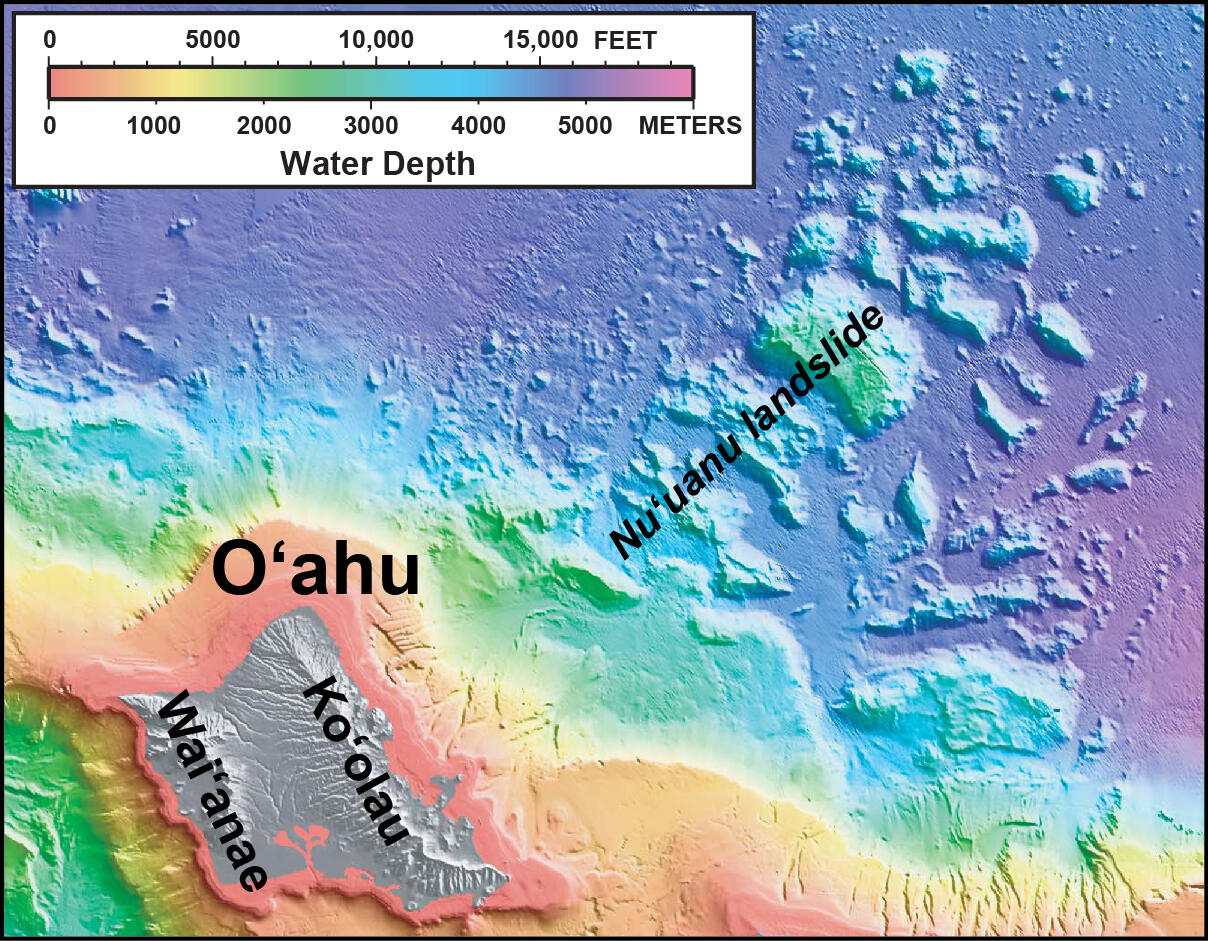
The volume of the slide, which formed sometime between 1 and 1.5 million years ago, is around 3,000 cubic kilometres (720 cubic miles) and has been linked to tsunami deposits almost 400m (1,300ft) above sea level.
Similarly, in the Canary Islands, debris emplaced by ancient volcanic tsunamis is found up to almost 300m (980ft) above sea level. These point to the formation of at least five megatsunamis in the last million years, most likely triggered by monumental flank collapses.
In the Cape Verde islands, tsunami deposits found 275m (900ft) above sea level have been linked to a prehistoric collapse of Fogo volcano.
Major flank collapse is a normal part of the lifecycles of large island volcanoes, and is certainly not going to stop happening just because we are around. The average return period for giant collapses capable of generating devastating megatsunamis – with waves 100m (330ft) or more high – is around 10,000 years, possibly less.
The last of these happened on the Indian Ocean volcanic island of Réunion, about 5,000 years ago, but we will certainly see the like again. The question is where – and when.
What can we do?
Fortunately, with today’s technology, we no longer have to simply sit around and wait for disaster to strike. We have the know-how to monitor volcanoes – either by satellite or on the ground. This can tell us not only when a volcano is becoming restless prior to an eruption that might trigger a tsunami, but also if part of a volcano is becoming critically unstable and might collapse.
In most cases, this would provide an advance warning of at least a few weeks before eruption or collapse. We can also build inundation maps to show which parts of threatened coastlines are in most danger. Together, this can provide the time to allow orderly evacuations to be carried out.
The problem is, however, that most of the hundreds of active island and coastal volcanoes are located in majority world countries and not monitored at all. The stupendous 2022 explosion of Hunga Tonga in the South Pacific took us completely by surprise, and generated a tsunami that took four lives. This could easily happen again, and result in a far greater death toll.
The bottom line is that we just can’t say where the next volcanic tsunami will happen, nor how big it will be, but happen it will.
Read more:
