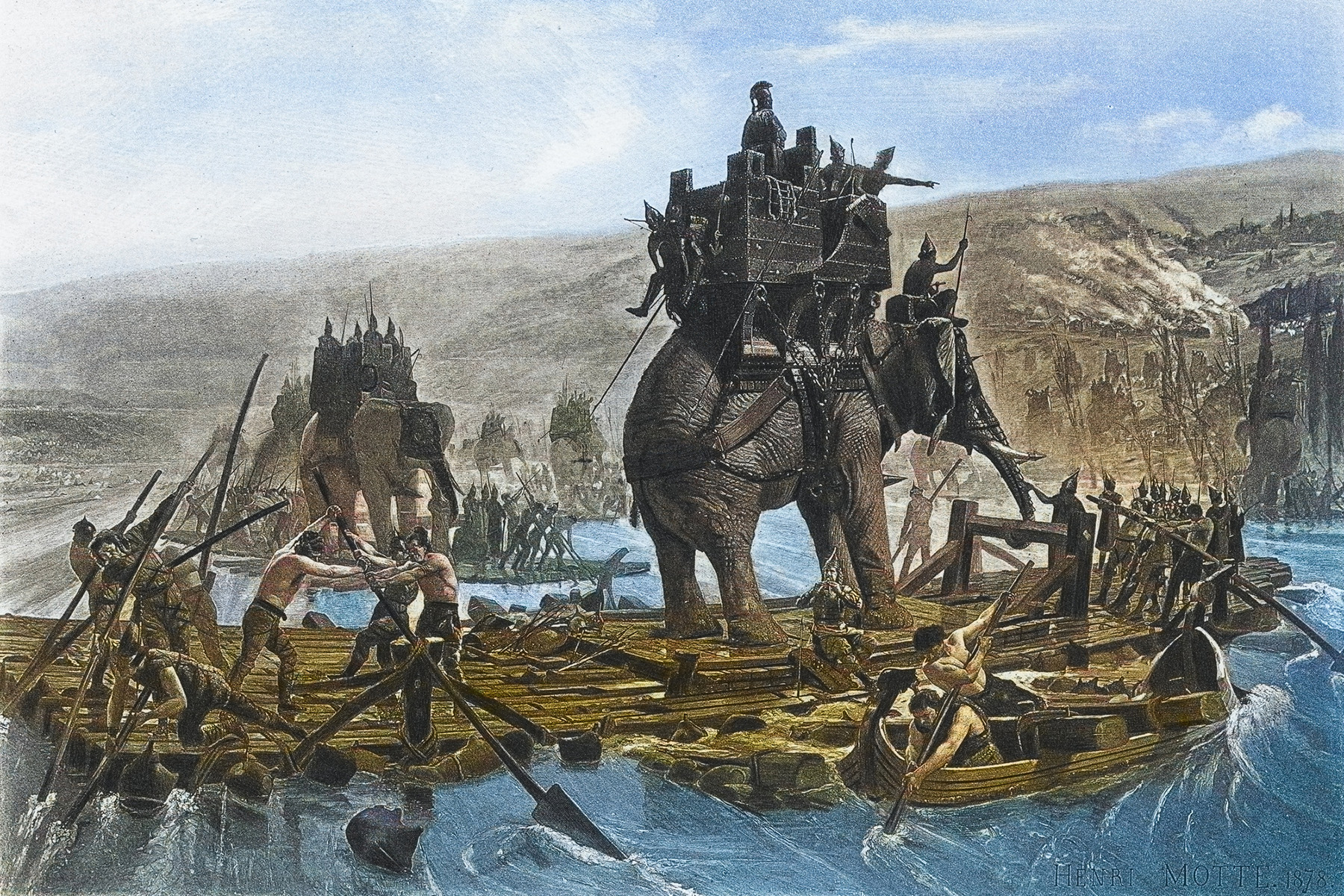
Scientists claim to have found the most likely route for Hannibal’s crossing of the Alps – with his elephants – according to a new study.
The paper by Dr Emilio Berti of Friedrich Schiller University Jena, Germany, and Prof Fritz Vollrath of the University of Oxford makes the case that the Carthaginian warlord used the Col de la Traversette pass to enter Italy with his army.
This valley, which snakes through modern-day France and Italy, would have been the shortest available to the army – and therefore the one most likely to preserve Hannibal’s contingent of 37 African war elephants.
“The question of Hannibal’s exact route has been debated for generations,” said Berti.
“The new analysis does not eliminate all ambiguity, but it does strengthen the case for the Traversette route by demonstrating that it would better accommodate the demands of moving a large army that included elephants through extremely difficult alpine terrain.”
Formerly the governor of the Carthaginian Empire’s territories in the Iberian Peninsula, Hannibal invaded Roman territory in Italy via the Alps in 218 BC during the Second Punic War.
Often praised by ancient and modern historians as an example of military daring – even though half his army died during his crossing of the mountain range – the general’s precise route has been lost to history. Many have believed it was the Col du Clapier crossing but Vollrath and Berti think otherwise.
In their paper, Vollrath and Berti say the length of Col de la Traversette makes it the most likely option for Hannibal to take, as it would have preserved more of the energy of his men and elephants.
To investigate their hypothesis, Vollrath and Berti modelled the energy expenditure of Hannibal’s army across different routes.
They found that the total energy cost for the assembly would have been 5.42 terajoules for the Traversette, clearly superior to other passes like the Col de Montgenèvre, which the army could have crossed for 6.02 terajoules, and the Col du Mont Cenis, at 6.45 terajoules.
In the event, most of Hannibal’s elephants survived the crossing – more evidence, perhaps, supporting Vollrath and Berti’s argument. However, historian Richard Miles remains unconvinced that geographic distance was the only determinant behind Hannibal’s choice of alpine pass.
Deputy Vice-Chancellor at Queen’s University Belfast and author of the book Carthage Must Be Destroyed, Miles says that while “it is logical that [Hannibal] would try and take the easiest path he could”, the definition of ‘easy’ was also influenced by the advice of local guides.
These guides could not or would not have necessarily given him accurate information on what lay ahead, or how many hostile Celtic tribes he might have to fight before he reached Italy.
For Miles, the contention that the most logical path for Hannibal’s army was the shortest is "predicated on this idea that he’s got some sort of modern-like knowledge. That seems a bit anachronistic to me."
With little archaeological evidence, all we do know is that Hannibal did eventually make his way to Italy. His elephants spent many weeks resting after the 15-day journey across the Alps before succumbing to the Battle of Trebia and the harsh winter that struck the Po Valley in northern Italy later that year.
The research was published in the Proceedings of the National Academy of Sciences (PNAS).
Read more: