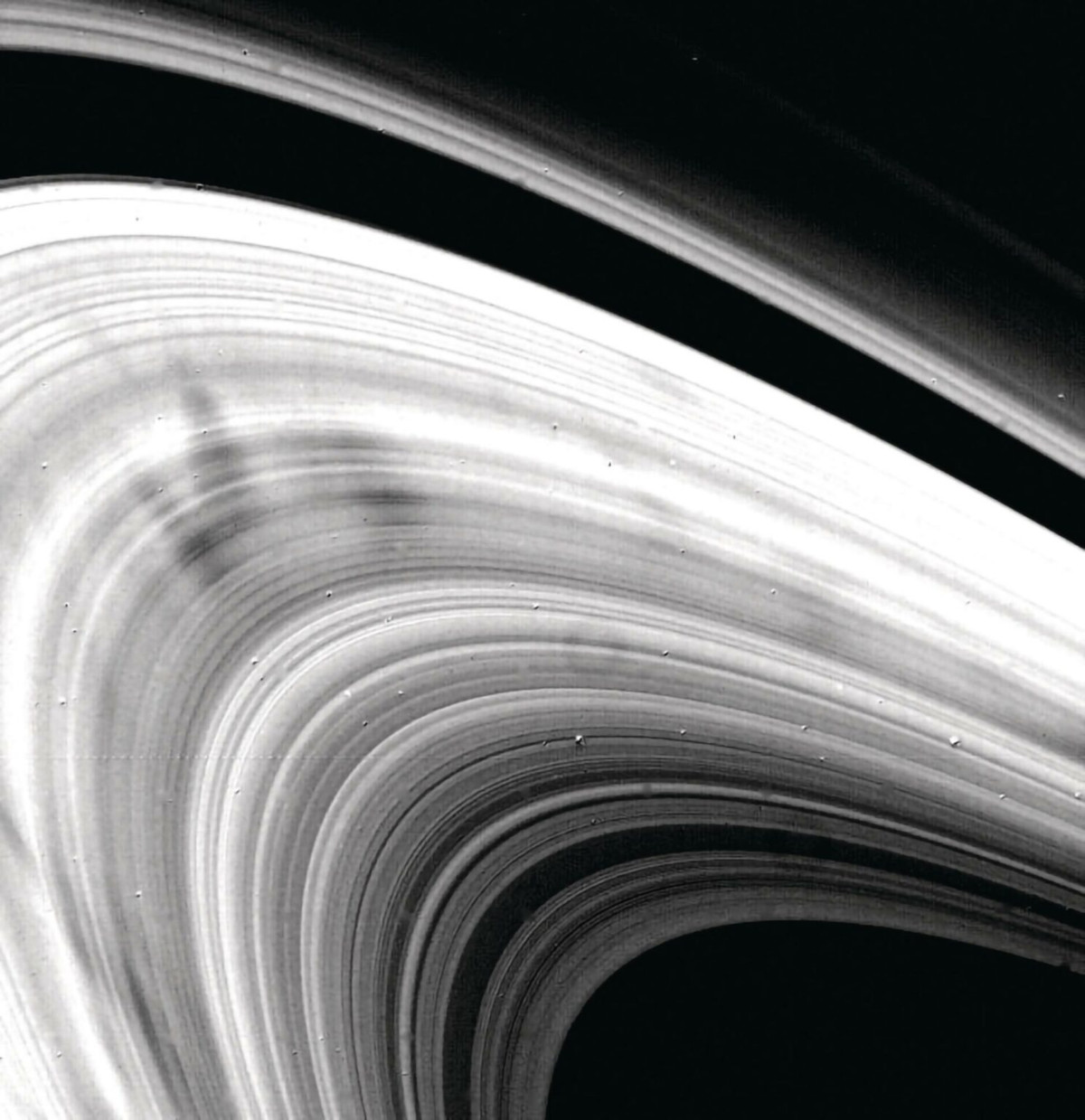
There are many mysteries about the planet Saturn and its entourage of moons. One, of course, is how its spectacular ring system was formed.
Recently, scientists showed that the answer to that mystery may be tied up in another.
A decade ago, measurements of the mass distribution of Saturn by the Cassini probe suggested that its mass is slightly more concentrated towards its centre than expected.
This could be explained if Saturn once had an extra moon, which astronomers called Chrysalis.
Astronomers thought that this missing moon could have broken up to form the rings after an encounter with Titan, Saturn’s largest moon (and the second-largest moon in the Solar System, after Jupiter’s Ganymede).
However, recent simulations of this process showed that Hyperion, the smallest of Saturn’s major moons, would almost certainly not survive an encounter between Chrysalis and Titan.
Hyperion and Titan are in an orbital ‘lock’, which appears to be relatively young, suspiciously dating to the same period as the disappearance of the extra moon and the formation of the rings.
So, the latest idea is that Hyperion didn’t miraculously survive the encounter but actually resulted from it. In this scenario, it was a moon about four times as big as Chrysalis, dubbed ‘proto-Hyperion’, that collided with Titan.
This meeting of moons explains many things: why Titan has such a shortage of impact craters, why its orbit is quite eccentric, why it is ‘locked’ with Hyperion’s orbit, the irregular shape and low density of Hyperion itself and the long-standing mystery of the orbital tilt of Saturn’s distant moon Iapetus.
But crucially, this event can also explain the origin of Saturn’s rings. The widening of Titan’s orbit catastrophically destabilised Saturn’s inner moons and sent them colliding into each other.
While the timing of this second cataclysm is unclear, it must have occurred after Titan’s merger with proto-Hyperion, consistent with the rings’ estimated age of about 100 million years.
This article is an answer to the question (asked by Pauline Dutton, via email) 'What really made Saturn's rings?'
To submit your questions, email us at questions@sciencefocus.com, or message our Facebook, X, or Instagram pages (don't forget to include your name and location).
Check out our ultimate fun facts page for more mind-blowing science
Read more: