
For more than 50 years, particle physicists have explained our Universe through one framework – the Standard Model, a theory that describes all the elementary particles of the physical world and how they interact through three fundamental forces.
What makes the model so useful is that it creates specific, testable predictions, such as ‘missing’ particles, which have proven to be incredibly accurate. One notable example is the Higgs boson, which was discovered in 2012 using data taken by the Large Hadron Collider (LHC) almost half a century after it was first predicted to exist.
Increasingly, however, particle physics is finding that its most essential tool doesn’t seem to quite match up with the world around it. The most notable problem is that it cannot explain gravity. Nor does it suggest any particle that could explain the phenomenon of dark matter that appears to be holding the Universe together.
Other experiments are showing cracks in the theory as well. Particle physicists are on the edge of a precipice. Could it be time to throw out the Standard Model they have come to rely on and create an entirely new theory?
The problem with penguins
An experiment at the LHC looking at the decay of a particular particle called a B meson could be the latest nail in the Standard Model’s coffin.
Normally, particle physicists conduct their investigations by using accelerators, such as the LHC, to smash together smaller particles at almost the speed of light to create heavier ones. However, some researchers are instead trying to infer the existence of these more massive particles indirectly.
One such experiment studies how particles called B mesons decay. On very rare occasions – around 1 in 1 million observations – the process can be affected by larger ‘unseen’ particles, in something called penguin decay.
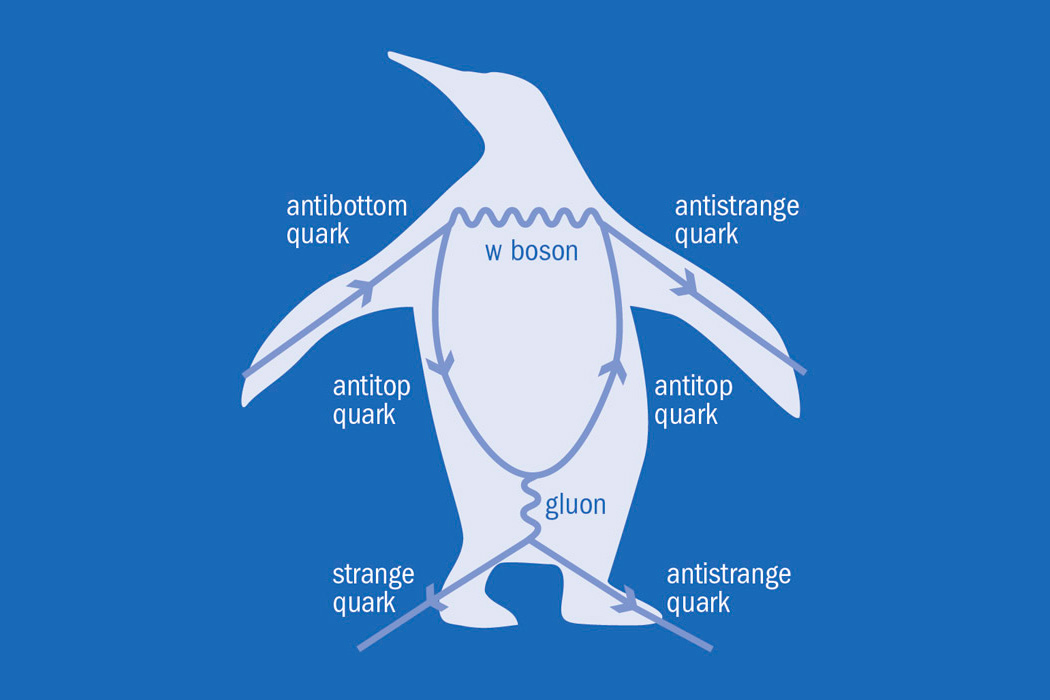
This penguin decay is predicted by the Standard Model, but the rates predicted don’t match the frequency the LHC has observed during experiments.
That might not sound like a big deal – maybe the experiment just chanced to see penguin decays less often – but it becomes more striking when you consider the sheer number of observations involved. The LHC researchers analysed 650 billion B meson decays and found not only fewer penguin decays than they should have, but also an anomaly in the observations of the directions the particles point in.
This finding isn’t iron-clad, and it isn’t a clear smoking gun against the Standard Model. It’s an intriguing indication, though.
At the moment, the results don’t meet what’s known as the five-sigma threshold (the point at which there is a one in 1.7 million probability of the observations being down to random chance, considered the gold standard for a scientific discovery). Achieving that threshold will require even more observations.
It is also possible that the findings could be caused – at least in part – by an extremely difficult-to-measure phenomenon called, enchantingly enough, ‘charming penguins’. These are interactions involving a ‘charmed’ quark but their results are difficult to predict.
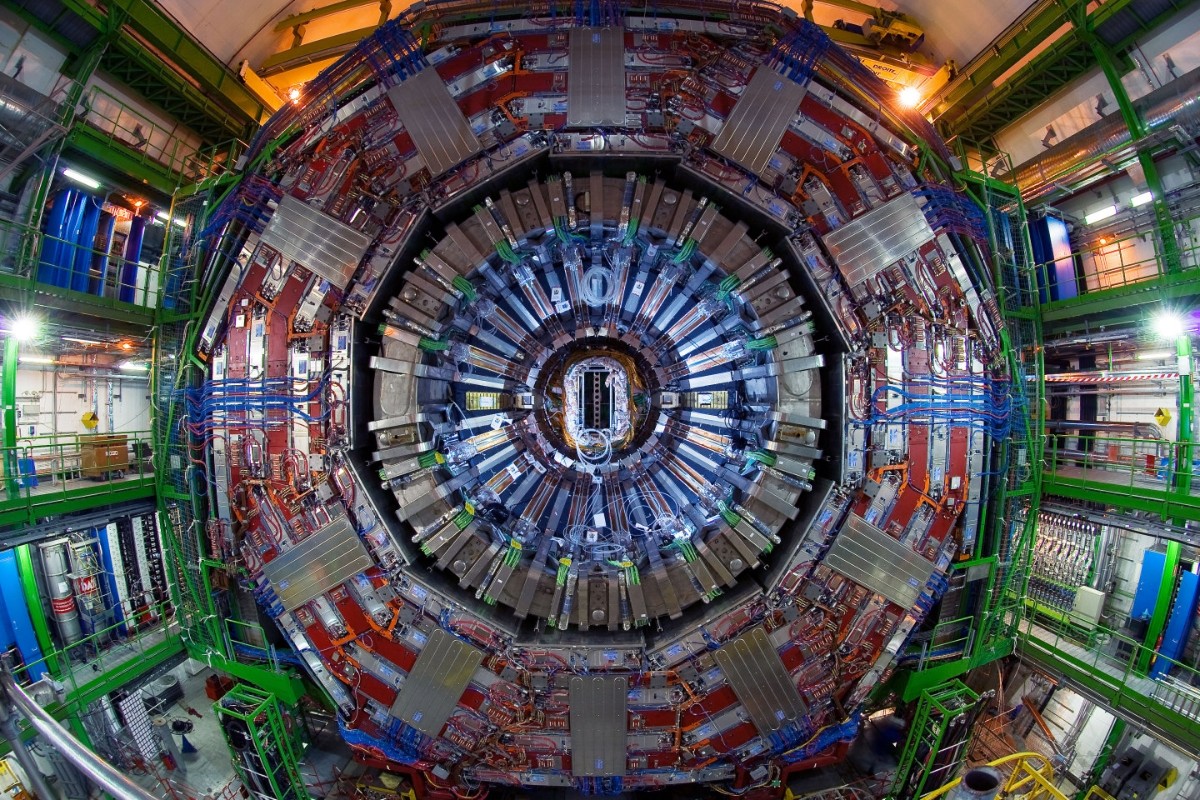
However, the hint of non-Standard Model physics is supported by work with one of the LHC’s detectors, the Compact Muon Solenoid or CMS. This work also looked at penguin decay, but used different hardware, a different methodology, and was performed by different researchers, making it valuable as a source of independent verification.
The cracks grow
All of this is growing evidence that we’re finding more instances where the Standard Model doesn’t work. “We’re starting to see cracks from these kinds of measurements,” says Dr Mark Smith from Imperial College London, one of the researchers investigating the topic.
That’s not forgetting the long-standing problems of gravity and dark matter, which aren’t explained by the Standard Model either.
“We’ve always known there should be new physics beyond the Standard Model,” says Smith. “The problem is we just don’t know what.”
This is not the first time the Standard Model has required modifications. In the 1990s, for example, the model was tweaked to allow for the neutrino – a particle previously thought to be massless – to have mass. Indeed, a theoretical model can normally be tweaked in almost infinite ways, but particle physics requires a more constrained approach.
Read more:
- 'If I'm wrong, I can retire': Why some physicists are now betting big that dark energy doesn't exist
- 'The world isn't what it seems': 7 ways your brain is being fooled by the universe
- New theory could finally make ‘quantum gravity’ a reality – and prove Einstein wrong
“One of the exciting things about particle physics is that nothing exists in isolation,” Smith says. One measurement, or the existence of one particular particle, affects other parts of the model too.
If you were to drop in a new particle to explain dark matter, for example, then its existence would have to be incorporated into the whole framework. “So, you don’t just get one new particle to try and explain the measurements you get, you inevitably get a whole new range of particles.”
The growing clues proving non-Standard Model physics – from penguin decay to dark matter to gravity – are not likely to be things that can be easily folded into the Standard Model as it currently exists.
They are likely to involve a shift to entirely new physics concepts, and whatever that shift involves, it may well be able to explain the growing number of non-Standard Model observations, from why the penguin decay rate is what it is, to what forms dark matter, to how gravity operates.
“It would be very natural if the explanation for this [penguin decay] also gives you an explanation for dark matter, or at least candidates for dark matter,” according to Smith.
To have an idea of what this new physics might involve, we’re going to need more data. And the good news on that front is that there has already been a wealth of data collected at the LHC, which is in the process of being analysed and presented.
The researchers now have five times more data available than they had for the most recent paper, which they hope will provide the five-sigma threshold to meet the gold standard of particle physics evidence, and there is more upcoming data from CMS as well. Smith estimates that the question of penguin decay will be settled within 5 to 10 years.
And there is a ton of further potential data coming from experiments around the world, from other particle physics groups working on topics like dark matter and neutrinos – which could also point our way towards new physics.
The challenge – and the excitement – is that we don’t have a roadmap for what we’re looking for in terms of a new model.
“We’re in the region where, for the first time, we don’t know what’s next,” Smith says. Previous breakthroughs in particle physics, such as finding the Higgs boson, were momentous achievements but they were expected and predicted by the Standard Model. Now, we have no idea what the next particle to be identified should be or where we should look for it. “If we see something new, it will be entirely unexpected. And I think that’s very, very exciting.”
Read more:
