We open on a dimly lit room, with a woman standing before a shiny black table. “My name is Maria and I was asked to be your home decor consultant today,” she says in soft, sing-song voice. Dropping to a whisper, she adds: “I’m going to show you different techniques and different ways to fold towels.”
Over the next 18 minutes, she slowly and carefully fulfils that promise, explaining several towel-folding techniques. But nobody is watching this particular YouTube video to learn how to fold towels. They’re watching it to experience a sensation known as ASMR.
“ASMR stands for Autonomous Sensory Meridian Response,” explains Dr Giulia Poerio, a psychologist at the University of Sheffield. “It’s a term used to describe a sensation that some people experience in response to set triggers.” The sensation originates in the scalp as a tingling feeling, and spreads down the rest of the body through the spine and the limbs. “It’s often associated with feeling very relaxed and calm,” says Poerio.
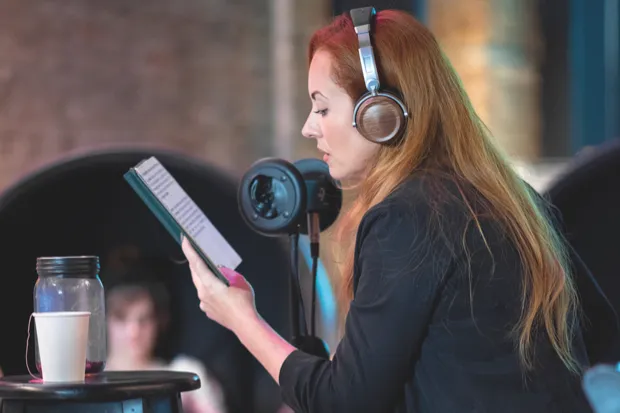
The things that cause ASMR are different for different people, but commonly reported triggers include whispering, soft speaking, close personal attention, delicate hand movements and gentle tapping. “People typically remember it from experiences in their childhood,” says Poerio. “Like getting shoes fitted for school, or lice checks. You can find lice check ASMR videos on YouTube.”
Indeed, YouTube is full of videos of people who refer to themselves as ‘ASMRtists’ simulating situations that they hope will trigger ASMR in others, and many of these videos have millions of views. In one of Poerio’s research papers, she describes how eclectic these videos get, “from simulations of haircuts, massages and medical examinations, to careful dissections of fruit and vegetables, the squishing of packets of Haribo sweets, and the fondling of bubble wrap”.
It’s possible that humans have been experiencing ASMR since long before we became human. “If we think more globally about what [triggers ASMR], it’s grooming actions,” says Dr Nick Davis, a senior lecturer at Manchester Metropolitan University. “You can imagine a gorilla is experiencing something similar to that when a lower status gorilla is grooming them. I wonder if it’s related to something much more basic in our make-up.”
Indeed, descriptions of experiences that sound very like ASMR can be found in literature. A passage from Virginia Woolf’s novel Mrs Dalloway describes a nursemaid speaking “deeply, softly, like a mellow organ, but with a roughness in her voice like a grasshopper’s, which rasped his spine deliciously and sent running up into his brain waves of sound”.
Head orgasm
The modern phenomenon of ASMR as a leisure activity can be traced back to approximately 2007, when the first descriptions of ASMR appeared on forums like SteadyHealth.com and IsItNormal.com. ‘Weird sensation feels good’, was the subject line of one early posting, where a user named okaywhatever51838 described experiencing a sensation “in my head and all over my body” when watching a puppet show, or when a friend drew on their hand with marker pens. “I’m not complaining, ’cause I love it,” they wrote. “But I’m just wondering what it might be... help.”
People who identified with those posts gathered into a Yahoo! Group called the Society of Sensationalists in 2008, and by this point, people were already uploading ASMR-style videos to YouTube, usually with titles that referred to ‘whispering’. Various names were proposed in the discussion groups, including AIHO (attention-induced head orgasm) or AIOE (attention-induced observant euphoria), but it was a woman named Jenn Allen who coined the term ASMR in 2010, founding a site named asmr-research.org.

Since the term ‘ASMR’ became accepted, the community has grown exponentially and caught the eye of researchers like Poerio and Davis. “In 2013, I was at a conference, and there was a really boring speaker, but she had an amazingly relaxing voice,” says Poerio. “I spoke to my colleague afterwards, and was like, ‘oh, her voice is just so relaxing, it made me feel all tingly.’ And she replied, ‘That sounds like this weird thing that I heard on the radio about people getting really relaxed by watching towel-folding videos.’ So I went and Googled it, and spent the whole evening watching ASMR videos.”
The next day, in the office, she hunted for any academic literature on the subject, but found nothing. “I started speaking to different people about it, and I started thinking: ‘what would it take to get people to really take this seriously?’”
One of the first scientific papers to be published on the subject was by Davis and his colleague Dr Emma Barrett in 2015. “We published the first peer-reviewed study into ASMR, which described the phenomenon, and how people used it for relaxation and to alleviate low mood,” says Barrett. “Those who were depressed reported a stronger boost from ASMR than those who were not. That sparked our curiosity about the possibility of ASMR use in a therapeutic setting.”
Emma WhispersRed speaks to BBC Science Focus commissioning editor Jason Goodyer in the Science Focus Podcast:
At the same time, Poerio was conducting studies of her own. “We showed people a range of videos,” she says. “We showed them spoken ASMR videos where somebody’s whispering or speaking, and sound-only videos which don’t contain any speech, and we asked them about their emotional responses,” says Poerio. The results confirmed that ASMR was a real phenomenon.
“We found that people who experience ASMR find these videos more consistently relaxing and calming than people who don’t experience ASMR.” She also found that the spoken videos induce more ASMR than the non-spoken ones.
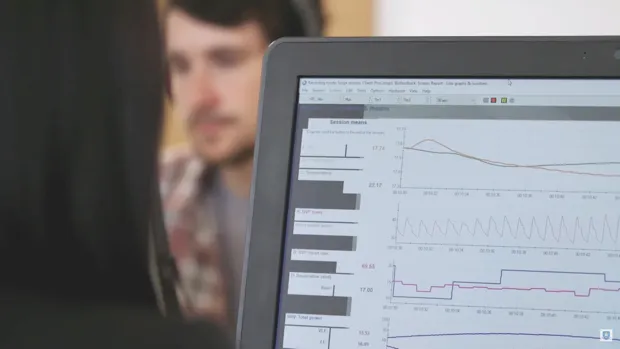
In a second study, she brought people into the lab to see what was happening physiologically. “It’s one thing for people to tell us that they’re feeling more relaxed, but we wanted to know if their physiology was telling us the same thing as well,” she says.
They found that people who said they experienced ASMR showed significant reductions in their heart rate while watching ASMR videos, compared to watching control videos. Unexpectedly, however, they also showed significant increases in skin conductance – a measure of emotional arousal. “We think this might reflect the emotional complexity of ASMR,” says Poerio. “A blending of seemingly opposing emotional and physiological states.”
Studies since have looked at the effects of different triggers, trying to be more precise about what causes the ASMR state. “We’re interested in things like whether particular settings might be helpful, or particular object interactions,” explains Davis.
“[The results] were actually a bit of a mix. But the one thing that was really clear and surprising is that people didn’t like background music. That to me is really odd, because we use music all of the time to enhance a mood that you’re trying to experience. That doesn’t seem to work for ASMR. It seems to distract from the sound of an object being interacted with.”
ASMR: relaxing, not raunchy
It’s worth noting that there’s often a perception of a sexual aspect to ASMR, most likely due to the intimacy of some of the videos. This interpretation is strongly refuted by both the community and the scientists.
“In our research study we specifically asked people about their levels of sexual arousal,” says Davis. “We didn’t find any evidence that ASMR is something that’s sexually arousing. Some of the videos you might think have a bit more of a sexual element than others, but in all, I don’t think the response that it’s eliciting in people who experience ASMR is a sexual one. I think the community is quite clear that it’s not really about that. It’s about relaxation. It’s about this tingling sensation.”
To date, the response from the ASMR community to the scientific work has been positive. “I get quite a lot of people from the public, contacting me and saying, ‘thank you for doing this research, it’s validated an experience I’ve had my whole life’,” says Poerio. The response from the academic community, however, has been more muted. “I think it’s really sparked the public interest more so than academics,” she adds.
Meanwhile, plenty of questions still surround the phenomenon. The proportion of people who experience it is unknown, and whether there’s a binary that you either experience it or you don’t, or whether there’s a spectrum of intensity. We know that speech enhances the experience, but we don’t know whether it’s necessary to understand the language of the person speaking. We also don’t know whether it has a deep physiological basis, referring back to apes grooming each other, or whether it’s something else.
The answers to these, and other questions, could help further validate ASMR as a genuine phenomenon, and even begin to unpick whether it could be useful in a medical context. “It’s something that people are already using, and saying that it’s giving them a lot of personal benefit,” says Poerio. “I think it’s really important to mirror that with science, so to try to test these ideas, and see whether they’re potentially clinically important.”
Davis agrees that the phenomenon has positive potential. “There don’t seem to be side effects, as far as I can see,” he says. “It doesn’t give you headaches, or give you heart palpitations, and it doesn’t seem to be addictive. It makes people happy with no drawback. People are using ASMR to help them cope with things like depression or chronic pain, and we wouldn’t want to go so far as to say that ASMR is a treatment for those conditions. But if it can be used to help people who are receiving treatment in another way, then that would be beneficial.”
This is an extract from issue 330 of BBC Focus magazine.
Subscribe and get the full article delivered to your door, or download the BBC Focus app to read it on your smartphone or tablet. Find out more
What it’s like to experience an ASMR response
Jennifer has been experiencing ASMR since she was a youngster
Can you describe the sensation of ASMR?
It travels up into my head and it feels like it’s glowing. Then it kind of trickles down the spine and goes up and down. I imagine it as lights going on and off up and down the spine like a ripple. It’s so good.
Do you remember the first time you felt it?
Definitely – I was 12 or 13, and it was the first time I listened to music using headphones.
I was lying on my front in bed, and it was dark because the lights were out. I was listening to Christina Aguilera’s The Voice Within. There’s this incredible bit towards the end, it’s so passionate and heartfelt and her voice is amazing.
What kinds of experiences trigger the sensation in you?
Really mundane and simple things, to be honest. Someone cooking something really competently, where everything they need is easily reached and you watch it all come together. It’s like watching a masterpiece being created. Pouring drinks is another one, watching people work at a bar. But sometimes it’s just someone walking through a room well, which is hard to explain.
I’ve even had it from food. At a restaurant in Paris, I was eating an octopus and hummus dish. The texture of it was amazing and made my ears feel all tingly, and then the taste was so unexpected and a combination I hadn’t experienced before.
Do you seek out ASMR as an experience, or just enjoy it when it happens?
I usually just enjoy it when it happens. Sometimes I’ll listen to the same song again when I know I’ve had the feeling, but it won’t always work and I don’t mind. It sometimes happens with a really well-told story too. When the ending just works. So yeah, I think there’s definitely a satisfaction element to it.
Did you think that everyone experienced the sensations?
I thought it was a thing everyone experienced. I think it’s more present when I’m in a good place. When I’m happy I’m very open, and it’s all about being open. When I’m low I feel closed, like I don’t want to feel things.
Follow Science Focus onTwitter,Facebook, Instagramand Flipboard