As Apple turned 50 in April 2026 (happy birthday Apple!), we decided it was best to take a look at some of the company's most iconic products, the flops that helped shape it, and what could be coming next.
The hits
#1 Apple II
Launched in 1977, the Apple II was the machine that turned Apple from a scrappy startup into a serious juggernaut.

Unlike the hobbyist computer kits of the era, it arrived fully assembled and ready to use, with colour graphics and the ability to plug into your home’s television set.
Apple II’s software was the real key to its runaway success, though. VisiCalc – the first mainstream spreadsheet application – launched exclusively on the machine, making it a hit with small businesses.
The revenue it created funded Apple’s 1980 stock market flotation, securing the company’s financial future and bankrolling much of what would come next.
#2 Macintosh 128K
The Apple II may have delivered the company’s first commercial success, but the Macintosh 128K was the product that shaped Apple into the company we see today.
Released in 1984, it revolutionised how regular people used computers, replacing a chain of text commands with a user-friendly interface controlled by a mouse.

While sales were modest, partly due to its higher price than competing IBM machines, it helped spark the desktop publishing boom and cemented Apple’s identity as a company that championed design and user experience.
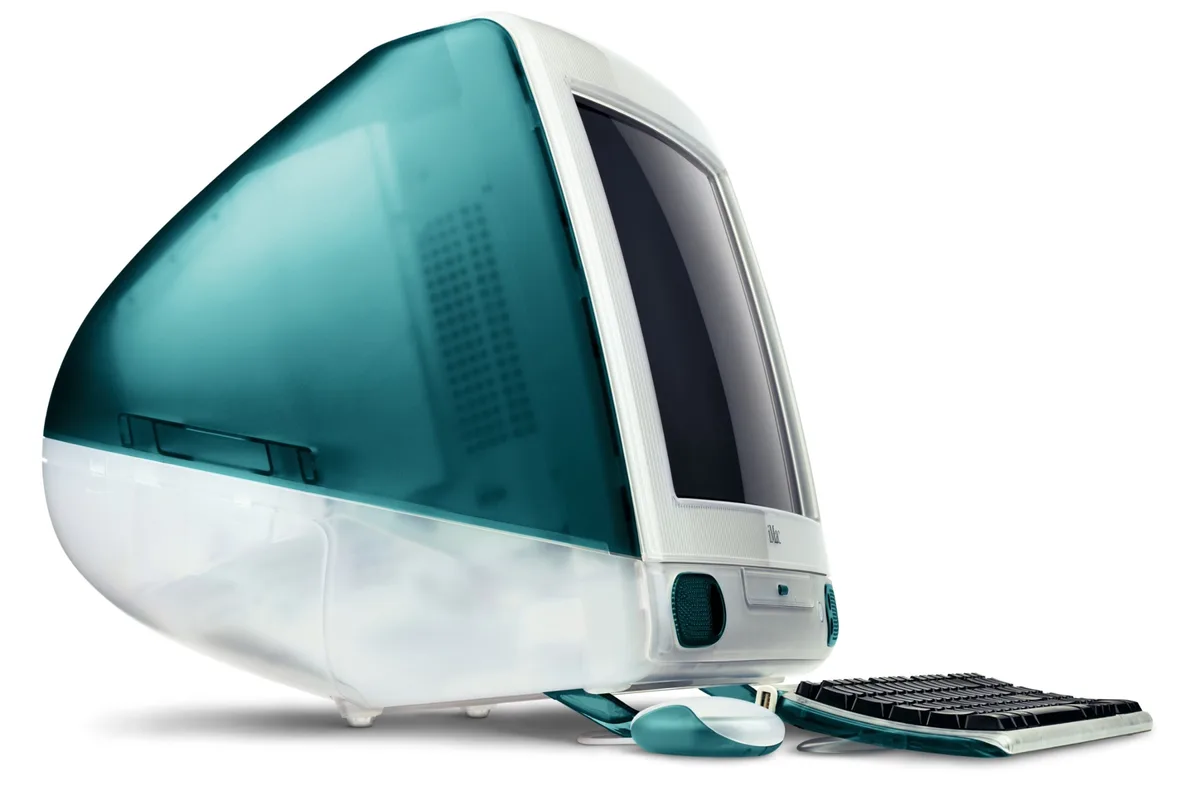
#3 iMac G3

By the time the iMac G3 launched in 1998, Apple was in serious trouble. Steve Jobs hadn’t long returned to the company, having been forced out by the board more than a decade previously.
Now, with Apple on the verge of bankruptcy, it desperately needed a hit. The colourful, translucent iMac G3 was the answer: an all-in-one computer designed by Jony Ive, the man now synonymous with Apple’s signature sleek style.
It was forward-thinking as well as eye-catching, ditching floppy disks to embrace USB.
Its ‘hockey puck’ mouse divided opinion, but it still became one of Apple’s fastest-selling computers, pulling the company back from the brink and resetting its identity under Jobs.
#4 iPod (1st Gen)
In 2001, Apple was still a fairly small player in a market dominated by PCs. The launch of the iPod changed that, catapulting Apple into cultural relevance.

With its simple scroll wheel and a seamless link to iTunes, the iPod made previously-released rival MP3 players look clunky and complicated – a trick Apple would make a habit of.
Beyond sales, the iPod (and by extension, the iTunes Store, which came two years later) reshaped how people bought and listened to music, and laid the groundwork for mobile devices that followed.
#5 iPhone 3G
While the first iPhone set the scene for Apple’s smartphone intentions, the iPhone 3G was where those ideas really took shape.
Alongside much-needed support for faster 3G internet, the key to its success was the App Store, which launched on the device. Suddenly, the iPhone wasn’t just a phone, it was a multimedia gadget that could do it all.

Within months, developers had created thousands of apps and games, allowing owners to hyper-personalise their devices.
Sales surged, competitors scrambled to play catch-up, and the modern smartphone era was born, launching Apple into the tech stratosphere.
The misses
Apple III
In an attempt to piggyback on the Apple II’s success, the Apple III was rushed to market without proper testing in a bid to challenge IBM in the professional market. Its fan-less design was ambitious, but suffered from overheating and instability.
The machine flopped and damaged Apple’s early credibility – a costly misstep that taught it the risks of scaling too quickly.
Apple Pippin
The Pippin was Apple’s attempt at bringing the Mac experience to the living room, fusing it with third-party gaming in the form of a console.
While technically capable, it arrived at the height of the PlayStation’s success and with its high price, lack of games and confusing positioning, it couldn’t compete. Apple hoped to sell 500,000 – it sold 42,000.
Apple Vision Pro

With its advanced optics and software, Apple’s first mixed-reality headset impressed critics, and remains arguably the best example of the tech in its category.
But its incredibly high price, bulky design and limited everyday use cases for regular users have affected sales, reportedly leaving its future in the balance.
The future...
So, what’s next for Apple? Among rumours of AI powered smart glasses, a smart home display and even its own brand of security cameras, the loudest whispers (and numerous leaks) suggest a foldable iPhone could finally be on its way this year.

Currently dubbed the iPhone Fold, it’s expected to be a “book-style” foldable that opens up from a 5.3in (13cm) screen to an iPad mini-sized display.
That’s nothing new, of course – Google, Samsung and numerous Chinese brands have released similar phones over the past few years.
But as history has shown us, even if the competition gets there first, that doesn’t necessarily mean Apple is behind.
Reports suggest it’s been taking its time to finally get rid of the annoying ‘crease’ that has plagued flexible displays so far. But it won’t be cheap – the iPhone Fold is rumoured to cost as much as $2,500 (almost £1,900).
Read more:
