Climate change is worsening the diets of Antarctic Adélie penguins, according to a new study published in Current Biology.
US researchers used three decades of data from satellite imagery to study the changing colour of the penguins’ faeces.
They found a direct correlation between the poop – signalling the amount of fish in the penguins’ diets – and the volume of sea ice present near their colonies.
The general decline in sea ice in the Southern Ocean during the study period was linked to more krill in the penguins’ diets. This, in turn, was linked to decreased survival prospects for individual chicks and declining colony sizes.
“Satellites enabled us to do something that would otherwise be impossible,” said Dr Casey Youngflesh, an assistant professor at Clemson University, South Carolina, in the US, and the study’s lead author.
“The innovation wasn’t the satellite technology itself, but the ability to leverage these decades of satellite imagery with modern geochemical, statistical and computational tools.
“No one intended for these satellites to be used to monitor penguins, but now we’re able to use them in these novel ways.”
Youngflesh and other researchers from the University of California, Santa Cruz (UC Santa Cruz), NASA and Stony Brook University, New York State, analysed changes in Antarctic Adélie penguin guano from 1984 to 2013.
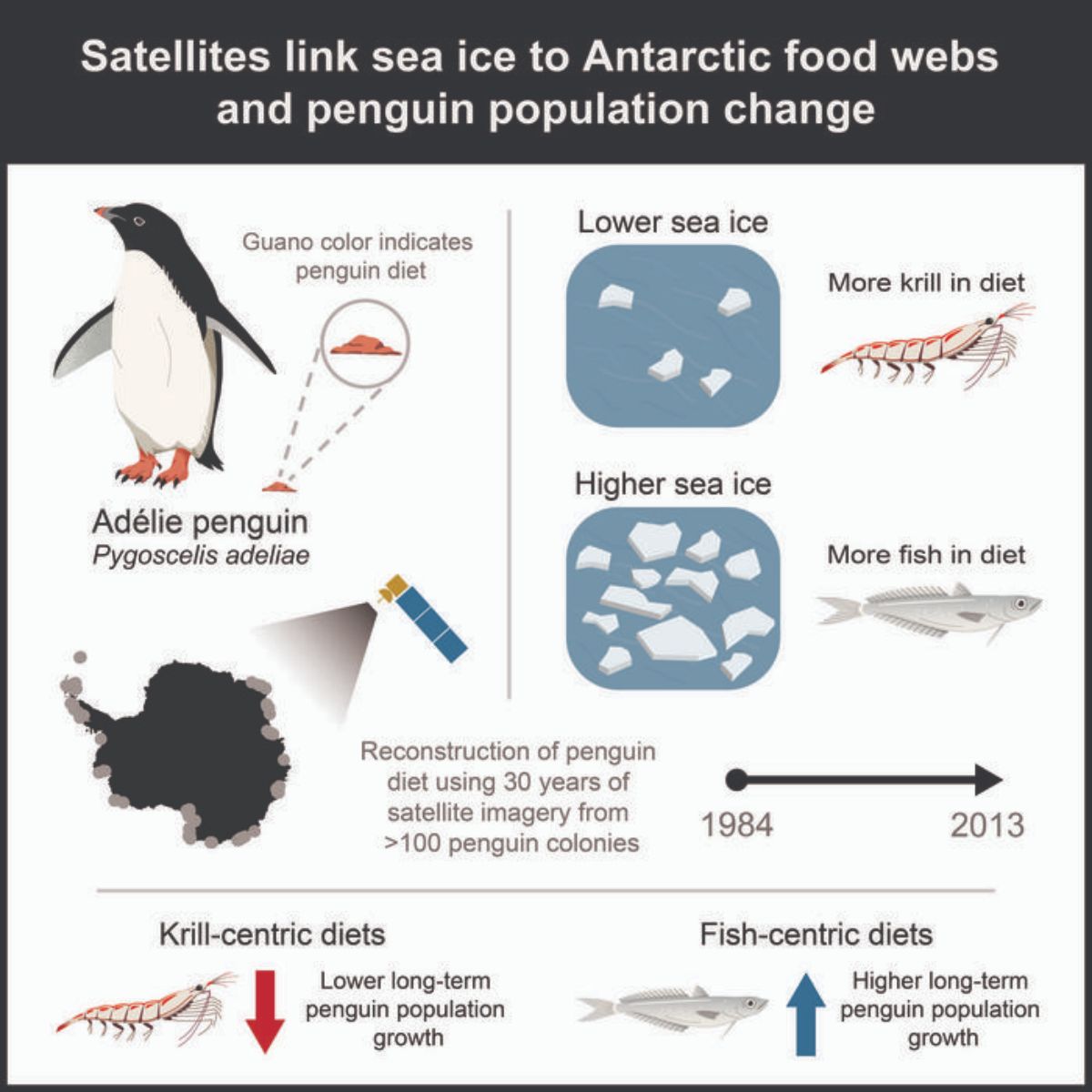
They were able to detect the spectral signature of the poop – meaning, the pattern of electromagnetic radiation that identifies a chemical or compound – to work out what they had been eating and how their diets had changed over time.
To work out which shade of faeces corresponded with which food source, Youngflesh collected penguin poop samples in Antarctica himself, before analysing them in the lab.
But, in simple terms, penguins that predominantly eat krill tend to have pinker poo, while those that eat fish produce whiter guano.
By comparing those findings against spectral analysis of three decades’ worth of satellite photos, the team could draw conclusions about the evolution of the penguins’ diet without having to repeatedly visit each site on the frozen continent over multiple years.
Though krill is a suitable food source for Adélie penguins, the crustaceans make for a less calorific dinner than their preferred quarry of silverfish.
Previous studies have shown that chicks fed with silverfish tend to be more robust, and therefore have a greater chance of survival through Antarctica’s harsh winter than their krill-eating brethren.
Decreasing sea ice means there are more krill in the penguins’ diet because there are fewer silverfish for them to eat.
That’s because silverfish use sea ice to deposit eggs, so having less of it hampers their breeding. Warmer waters also impact the health and populations of silverfish.
Concentrating on the changing diet of Adélie penguins also has wider benefits for our understanding of the health of other Antarctic ecosystems, said study co-author Dr Michael Polito, an associate professor of ocean sciences at UC Santa Cruz.
The birds “are an iconic species breeding all around the continent of Antarctica,” he explained. “They act as a ‘canary in the coal mine’, and our study illustrates how recent warming has disrupted the Antarctic marine food web they rely on to the detriment of many of their populations.”
Unfortunately, the future does not bode well for Adélie penguins, based on the study’s link between sea ice and the birds’ krill consumption.
Since the final year of the study period in 2013, sea ice has either been lower or disappeared entirely from their ranges.
Consequently, it seems that krill will be on the menu for your average Adélie penguin for some time to come – for which they will also be competing against many other species like whales, seals and humans.
Read more: