
Researchers have created what they say is the world’s first synthetic cell capable of growing, dividing and repeating the cycle – a breakthrough some experts say marks a major milestone in biology.
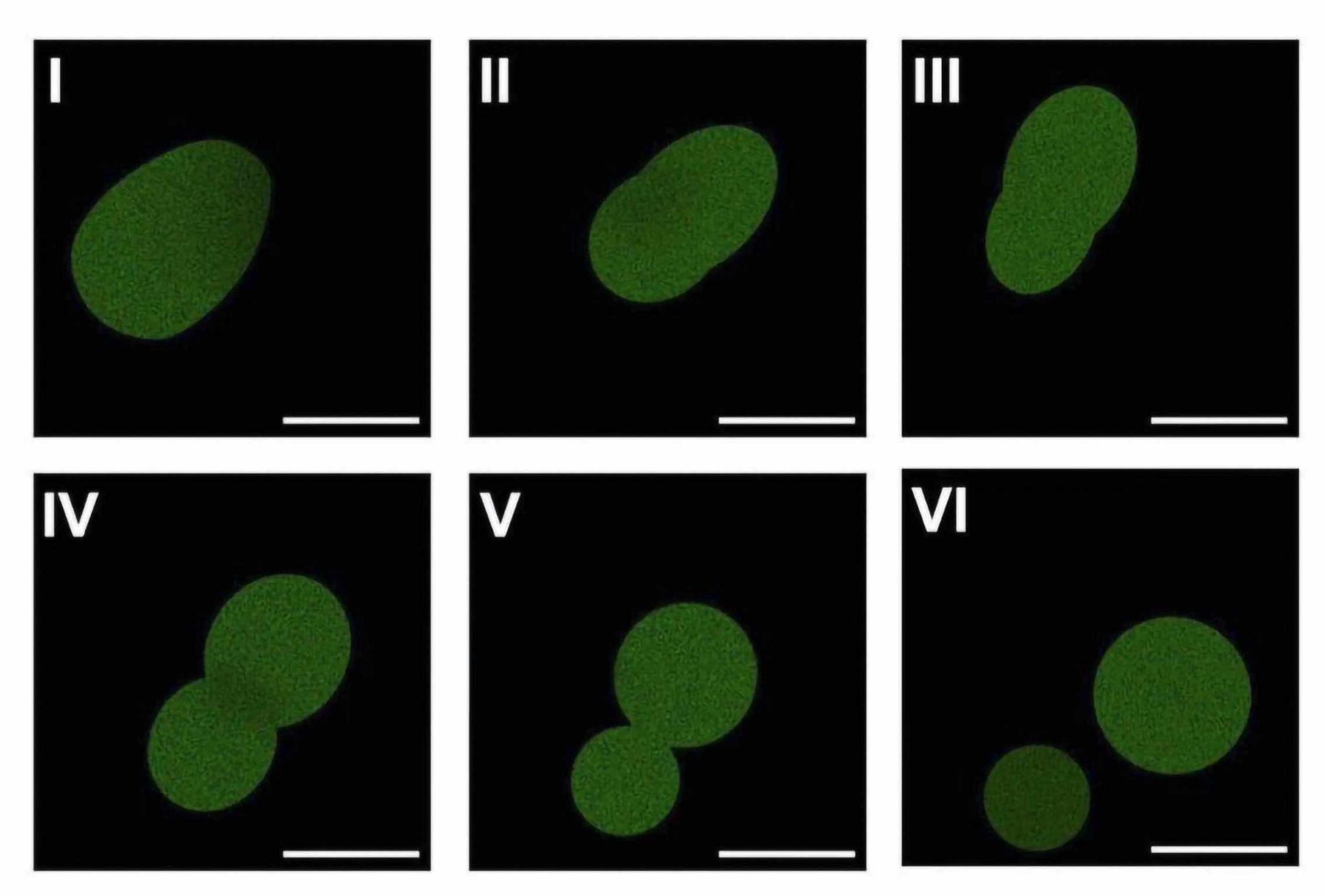
The artificial cell, nicknamed SpudCell, is smaller than the tip of a needle and is visible only under a fluorescence microscope.
Rather than being made from living material, it was assembled from non-living chemicals by Drs Kate Adamala and Aaron Engelhart and their teams at the University of Minnesota, in the US. Once put together, these chemicals were able to work like the components of a living cell.
Unlike previous synthetic cells, which could carry out only individual tasks, SpudCell combines several of the key processes needed for life into a single system. It can grow, replicate its genome, divide into daughter cells and even show competition between variants. Together, these processes make up a complete cell cycle.
“We’ve replicated in chemistry what only used to be possible in biology: the complete set of behaviours of a cell,” Adamala said.
“It proves that the most fundamental functions of life, like growth and replication, do not need a mysterious magical spark.”
Researchers say the breakthrough could fundamentally change how synthetic cells are designed.
“It makes a genuine engineering approach to bioengineering possible in ways not previously doable,” said Prof John Glass, leader of the synthetic biology group at the J Craig Venter Institute in California, who wasn’t involved in the research.
How it was built
SpudCell was made using a bottom-up approach – the reverse of how synthetic cells have traditionally been made.
“Instead of starting with an existing living cell and removing parts until only the essentials remain, the scientists are trying to build cell-like behaviour from defined non-living components,” said Dr Tara Deans from the Wallace H Coulter Department of Biomedical Engineering at Georgia Tech and Emory University, who was not involved in the SpudCell project.
Rather than modifying a living cell, the researchers assembled SpudCell from scratch. They combined 36 lab-made proteins, which carry out the cell’s chemical processes, with a synthetic genome containing around 90,000 DNA letters.
The whole system was then enclosed inside a fatty outer membrane similar to those found in living cells.
Its potato-like appearance inspired the ‘Spud’ part of its name, while the researchers say the full name also echoes Sputnik, another landmark scientific achievement.
Scientists say there are two main reasons for trying to build synthetic cells. The first is their potential practical applications.
“In the long term, cell-like systems could become safer, more controllable biological systems for medicine, manufacturing, environmental sensing and biosecurity,” said Deans.
“For example, one can imagine cell-like systems that deliver a therapeutic molecule, detect a toxin or pathogen, or manufacture a useful compound without relying on a fully living organism.” The second motivation is more fundamental, Deans said.
“We want to understand how life works.”
Living cells are incredibly complex, containing thousands of different molecules that interact in countless ways. That makes it difficult to work out which parts are truly essential for life and which are simply helpful extras.
By building a much simpler, cell-like system from scratch, researchers can test those questions one by one. “What does a membrane do? What genetic information is required? How is energy used? How does growth and division become coordinated?” said Deans.
SpudCell may also help answer one of science’s biggest questions – how life began in the first place.
“As far as we know, life emerged only once in 4.5 billion years of Earth’s history,” said Dr Yuval Elani, associate professor in biochemical technologies at Imperial College London, who was not involved in creating SpudCell.
“The possibility that science might one day engineer a second instance of that transition, not by waiting for nature, but by building it deliberately, is one of the most profound prospects in all of modern science.
“We’re not there yet. But work like this is a meaningful step in that direction.”
Read more:
- 'Stunning' new treatment may reverse frailty after just one dose
- What really causes autism? We're about to find out
- This new drug may have cracked the 'cheat code' for reversing ageing
Is it alive?
Despite the excitement, experts stress that SpudCell is still a long way from becoming a true living organism, or being used outside the laboratory.
Currently, the artificial cell can’t survive on its own. According to Deans, one reason for this is that SpudCell can’t yet make its own ribosomes – the tiny molecular machines that build proteins inside cells.
Instead, it has to borrow them from specially designed support structures. Even with that support, the system breaks down after roughly five rounds of division – meaning SpudCell can only reproduce a handful of times before it stops working.
The next major step is to make the system more self-sufficient, so that it can grow, divide and regenerate its most important building blocks over many generations without repeated intervention.
“Achieving that would bring us much closer to being able to say that we have made something plausibly ‘alive’,” Elani said.
Because of its limited capabilities, experts consider SpudCell low-risk for now. “It’s more like a carefully designed soup of chemicals that does interesting things under controlled laboratory conditions,” Elani said.
In the long term, however, the ability to build autonomous cell-like systems would require serious consideration of the implications with regard to containment, environmental release, misuse and governance.
“The field is well aware [of all these factors], and discussions around biosafety and governance are well underway,” said Elani.
The next hurdle
Not everyone has welcomed how the findings were shared. Adamala has faced criticism for publishing the research before it had been checked by independent experts through the peer review process.
However, Deans claimed that Adamala’s approach didn’t necessarily undermine the findings.
“Preprints are now a normal part of scientific communication, and they can be valuable because they let the community see and discuss new results quickly,” Deans said.
“But for a claim this significant, careful peer review matters. It’ll help clarify exactly how strong the evidence is and how the advance should be understood in the broader field.”
If the findings hold up under peer review, researchers say it could mark an important step towards a new generation of synthetic biology.
“We’re at the dawn of an era of new biology,” said Glass. “I can’t wait to see what it brings.”
Read more:
