In many parts of the world, taking an IQ test has become a rite of passage. Yet most of us probably know someone with a high IQ who is pretty useless at everyday life. So, how much do these tests really tell us?
IQ or ‘intelligence quotient’ is measured through a series of puzzles and questions that test logic, memory and reasoning.
IQ test scores are standardised so that the average IQ is 100, with around two-thirds of people scoring between 85 and 115.
People often put a lot of emphasis on IQ, but at best, it’s an incomplete measure of intelligence. At its worst, it’s something far more sinister.
Defining intelligence
Part of the problem is that IQ scores simplify an incredibly complex characteristic. Unlike height or weight, which are simple to measure and can be described with a single number, intelligence is a multi-faceted trait.
Scientists haven’t even been able to agree on a definition.
“Intelligence is a very complex thing. It’s difficult to define and difficult to measure,” says Dr Rebecca Sear, a psychology professor and anthropologist at Brunel University of London.
Fundamentally, intelligence describes how well we can adapt and thrive in our environment. That’s something that is influenced by lots of different cognitive skills, many of which aren’t captured by IQ.
For example, interpersonal skills, creativity, empathy and common sense all play a role in how well we adapt to the world around us.

“These adaptive skills are very important, but they’re not what’s measured by an IQ test,” says Prof Robert Sternberg, a psychologist at Cornell University in the US.
And while IQ tests do a good job of measuring conscious problem-solving skills, they can’t assess whether we choose to apply those skills at the right moment, rather than falling back on our instincts.
That’s why even people with very high IQs can make poor decisions in the real world.
Given all these flaws, it’s hardly surprising that IQ scores are only loosely correlated with academic achievement. In fact, research shows that IQ explains about 30 per cent of the variability in school grades.
What we don’t know is how much IQ tests themselves may influence educational success.
IQ scores risk becoming a self-fulfilling prophecy – a poor score early in life might influence how a child is taught, what opportunities they are given and even how they view themselves.
Read more:
Culture matters
Another problem: IQ tests aren’t universal across cultures.
People in different parts of the world live in different environments and face different daily challenges, so the characteristics that help them adapt are also different.
“The attributes [of intelligence] are universal. You need practical intelligence everywhere. You need creativity everywhere. But what is practical differs from one place to another,” explains Sternberg.

Standard IQ tests also rely heavily on skills that are developed through formal education, so in countries that don’t have formal education, IQ test scores tend to be lower, but that doesn’t mean the people there are less intelligent.
“If a child or an adult has never had any kind of formal education, they’re really going to struggle with an IQ test, however intelligent they are, because they may simply never have seen paper and pencil,” says Sear.
Because of these issues, a universal measure of intelligence across cultures doesn’t exist, and may never be possible.
Something more sinister
At an individual level, IQ suffers from some major flaws. Zoom out to the global scale, and you’ll find a much more disquieting side to IQ scores.
Some researchers have attempted to compare nations’ average IQ scores, often with racist motivations. The most prominent example is the national IQ database, compiled in 2002 by British psychologist and self-described “scientific racist” Richard Lynn.
Since its publication, Lynn’s database has been used by ‘race science’ activists to justify discrimination and stoke fears over immigration. But the data is deeply flawed – scientists have been sounding the alarm over its methodological problems for more than two decades.
Firstly, Lynn estimated each nation’s IQ using limited and unrepresentative data. His calculation of the average IQ for Somalia, for example, was based on a single study of children in a refugee camp.
“If you want to estimate a national IQ, you need data that is representative of that country’s population,” Sear explains. But this data isn’t available for many countries worldwide.
Psychologists and anthropologists haven’t invested the vast amounts of time and energy needed to collect nationally representative data on IQ because “this data just isn’t useful,” Sear says.
Genetics plays a part in determining a person’s intelligence, but there is no evidence that intelligence differs systematically between races, ethnic groups or nationalities.
Average scores on IQ tests tend to reflect economic development and the quality of the educational system, rather than the average intelligence of the population.
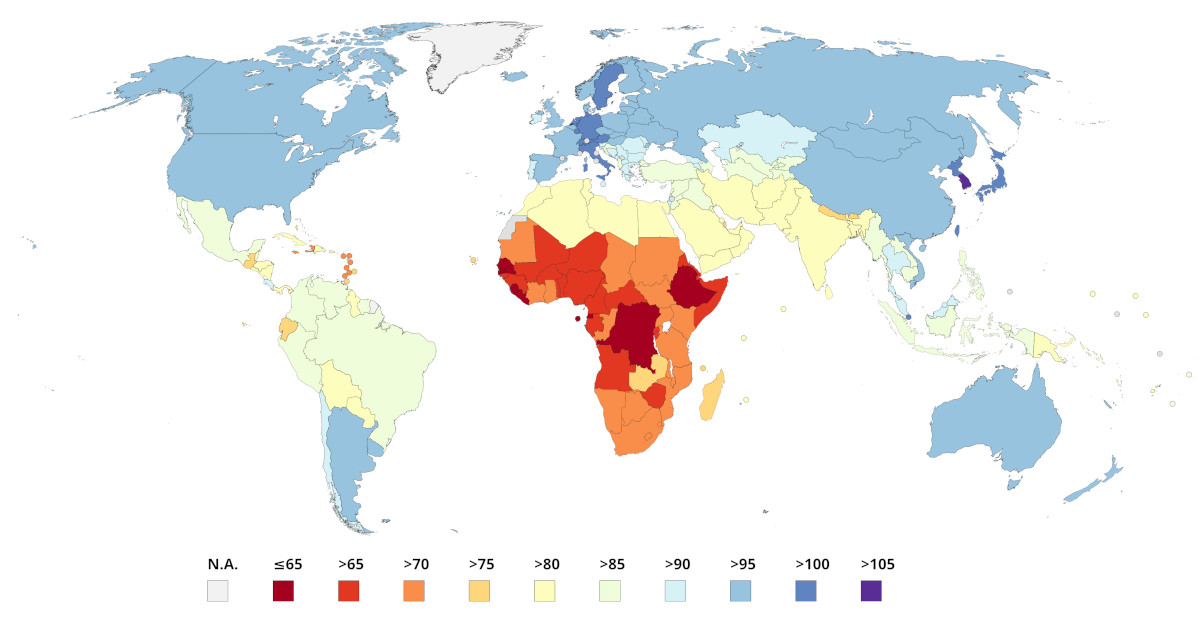
Other proposed measures of national intelligence – such as school achievement scores, number of Nobel prizes or academic research output – all fall foul of the same problem.
Even if nationally representative data were available, comparisons of national average IQs can’t overcome the cultural differences that make a universal IQ test impossible.
“Cross-national comparisons are really flawed because of the cultural specificity of the test. It’s sort of rigged,” says Sternberg.
There’s also evidence that when assembling his database, Lynn excluded studies that didn’t fit with his hypothesis that people of colour are less intelligent.
An independent study in 2010 concluded that for African countries, Lynn selectively included studies which reported low IQs and discarded those that reported higher IQs.
Despite these issues, new papers using Lynn’s database continue to be published today. This has prompted Sear to launch a campaign for scientific publishers to retract or reject research papers that use its flawed data.
The end of the line for IQ
Perhaps the main reason IQ has held such a prominent position for so long is simply that it is easy to test. “People are suckers for things that are easy to measure,” says Sternberg. But “do we want to measure the wrong thing just because it’s easy to measure?”
Intelligence is an incredibly complex trait, and how it manifests depends on the environment. So, it’s unlikely that any test can ever fully capture the complexity of intelligence across the full spectrum of cultural diversity.
Since IQ scores tell us so little and can be used to do so much harm, maybe it’s time we abandon them for good.
Read more: