
Some astronomers believe something is rotten in the heart of cosmology. So much so that our cherished ideas about the evolution and fundamental properties of the Universe may be wrong.
Rest assured, the general idea of the Big Bang as the explosive catalyst of the cosmos still stands solid. But recent results from a huge multi-year survey of millions of galaxies suggest that the Universe behaves differently from what current theories predict.
If this conclusion is borne out, the consequences would be huge. Scientists might be forced to introduce new particles beyond our well-established Standard Model of particle physics.
What’s more, while conventional wisdom suggests the Universe will expand forever, some new data hint at the remote possibility of a catastrophic ‘Big Crunch,’ in which expansion eventually reverses and the cosmos collapses.
“I’m very convinced about the result [that the Universe may be expanding differently than expected],” says astrophysicist Prof Catherine Heymans of the University of Edinburgh, who is the Astronomer Royal for Scotland.
“It was achieved by a mature, experienced, fantastic team with the best technology and telescope that you could use to do this measurement.”
But not everyone’s convinced – cosmologist Prof George Efstathiou of the University of Cambridge being one of them. “The team claims that there’s only a 1 in 50,000 chance of this result being a fluke,” he says. “I’m more confident than that that their interpretation is wrong.”
So what’s going on?
The dark mysteries of the Universe
It all has to do with the way the Universe is growing. Ever since the 1920s, astronomers have thought that empty space is expanding, pushing galaxies away from each other, as a direct result of the Big Bang.
Intuitively, you’d expect the expansion to slow down over time, thanks to the mutual gravity of cosmic matter. But in 1998, two independent teams of astronomers found quite the opposite. Instead of slowing down, the expansion of the Universe turns out to be accelerating.
The breakthrough discovery earned the team leaders the 2011 Nobel Prize in Physics.
Partly based on ideas first set forth by Albert Einstein, theorists suggested that the accelerated expansion is due to a mysterious property of empty space, called dark energy.
Represented by the Greek capital letter lambda (Λ), dark energy is now considered the major constituent of the Universe, although its true nature remains obscure.
Ever since the 1970s, astronomers have also known of another mysterious cosmic component: cold dark matter, or CDM (a type of dark matter where ‘cold’ actually refers to its relatively slow movement). Again, no one knows what it is, but its gravitational effect is observed all over the Universe.
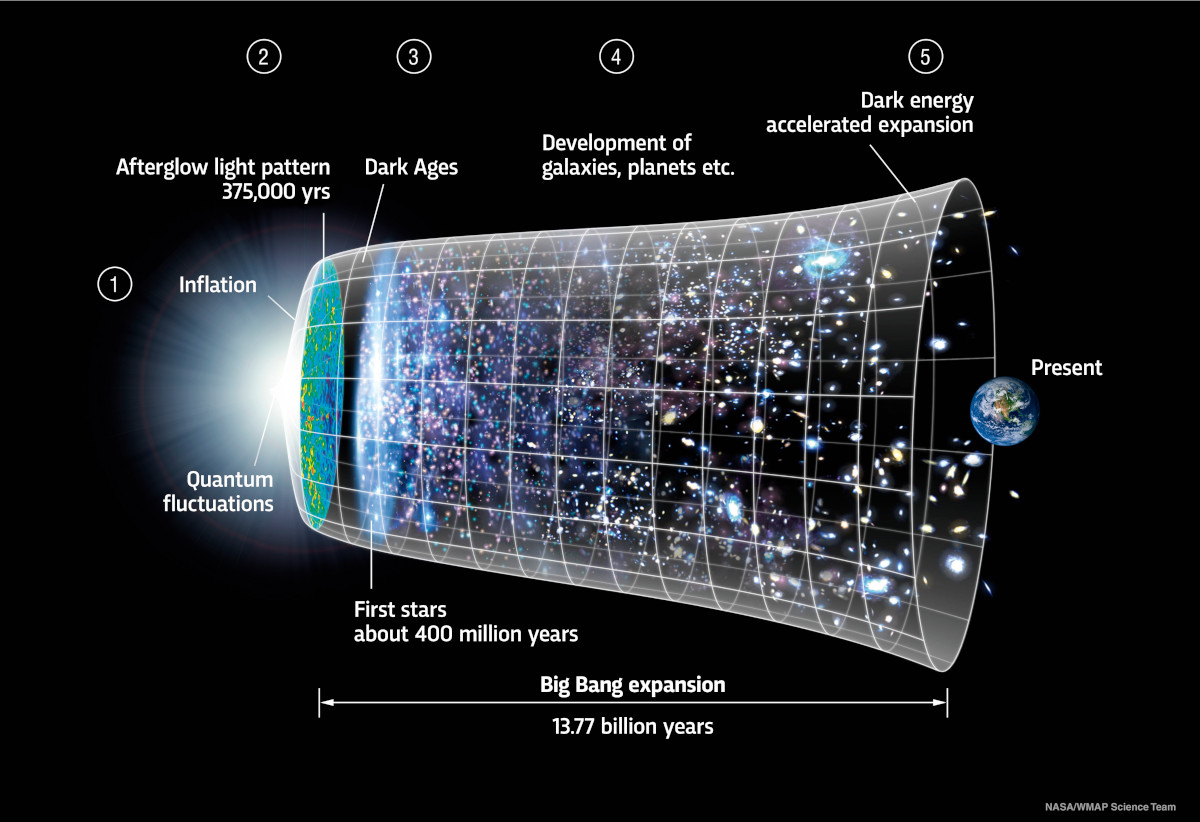
Thus emerged the Standard Model of cosmology, or ΛCDM, in which the familiar galaxies, stars, planets (and people!) constitute a mere 4.9 per cent of the total matter and energy content of the Universe.
The remaining 95.1 per cent is composed of dark energy (68.3 per cent) and dark matter (26.8 per cent).
Although dark matter and dark energy remain puzzling entities, high-precision observations by the European Space Agency’s Gaia space telescope are in perfect agreement with what you’d expect from the ΛCDM model, leading cosmologists like Efstathiou to state that they are “confident it doesn’t need to change.”
Releasing the pedal
Enter DESI, the Dark Energy Spectroscopic Instrument, run by a consortium of almost 1,000 researchers from dozens of institutions all over the world.
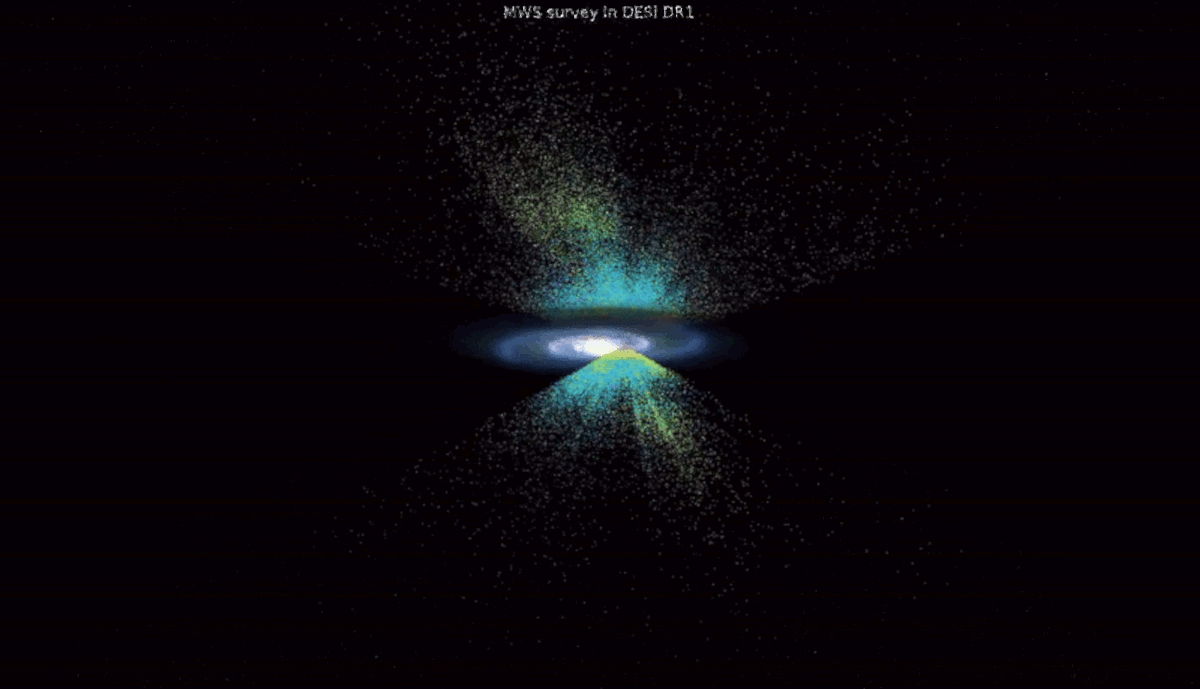
DESI is in the process of creating the largest three-dimensional map of the Universe, charting the positions and distances of almost 50 million galaxies.
And its preliminary results are shaking the foundations of cosmology.
An analysis of the first three years of DESI data, presented in March 2025, suggests that yes, the expansion of the Universe is accelerating, but the rate of acceleration is slowly dwindling over time – contradicting current cosmological wisdom.
To understand what this means, picture racing driver Lewis Hamilton during a Grand Prix. When he fully hits the gas, his Formula One car is accelerating steadily – that’s ΛCDM. But if he then slowly releases the pedal, the acceleration is decreasing.
His speed still continues to rise, but not as fast as before.
The DESI results seem to imply that the Universe is releasing its gas pedal. In other words: dark energy is not a constant repulsive force, but is weakening over time.
Who knows, in the distant future cosmic expansion may cease to accelerate at all, at which point gravity might take over.
This would lead to a potentially fatal phase of universal contraction – the expansion would reverse and collapse in a massive and catastrophic implosion.

If you’re a fan of the cosmological Standard Model, like Efstathiou, this is of course bad news. But Heymans is enthusiastic about the new results.
ΛCDM is “an unsatisfactory model”, she says, as it provides no good explanation for why dark energy exists in the first place.
“Actually,” says Heymans, “I would be excited if we could really rule out ΛCDM. In science, you can never prove a theory to be correct; you can only ever disprove a theory.
"To be able to disprove something is wonderful in cosmology, because we haven’t had much progress since the 1998 discovery of dark energy. Having something new is exciting.”
Unpicking patterns woven into galaxies
With so much at stake, we need to understand how strong the DESI claim really is. For one, how does a 3D map of the Universe reveal the behaviour of dark energy?
Well, the DESI map not only tells you the distribution of galaxies in space, but also in time. The light from extremely remote galaxies takes billions of years to reach our telescopes.
So looking far into space corresponds to looking far back in time. Put simply, the DESI observations tell us how the spatial distribution of galaxies has evolved over time.
Galaxies are not distributed randomly. Instead, they are gathered in small groups, larger clusters, and giant superclusters, separated by near-empty voids.
But there are also much more subtle patterns, which can only be identified statistically by charting the 3D positions of huge numbers of galaxies. Known as baryon acoustic oscillations or BAOs, these patterns date from the baby days of our Universe.
Shortly after the Big Bang, all of space was filled with a sloshing broth of normal particles (protons, neutrons and electrons), dark matter, and photons (particles of light).
The interaction between concentrations of matter and radiation created pressure waves in the primordial soup, resulting in a subtle pattern of over-dense regions of matter.
These pressure waves had a characteristic size of 450,000 light-years. But, after 13.8 billion years of cosmic expansion, these BAOs have grown by a factor of almost 1,100 to a typical size of 490 million light-years.
By mapping the distribution of millions of galaxies over some 11 billion years of cosmic history, scientists can trace the growth of the BAOs over time. That, in turn, yields information on the expansion history of the Universe.
“It’s the cleanest probe we have of the evolution of large-scale structures in our Universe,” says Heymans.
Read more:
- This bold theory could reshape how our Universe began
- The James Webb Space Telescope has captured images of ancient galaxies that shouldn't exist. A cosmologist explains what could be going on
- How do we calculate distances to other galaxies?
Measuring 5,000 galaxies
Telescopic photographs of the heavens tell you where galaxies are located in the night sky. But to create a 3D map showing the evolution of large-scale structure, you also need to know the light travel time for each and every galaxy, which is much harder to come by.
The trick is to measure a galaxy’s redshift by studying its spectrum. This is, essentially, a miniature rainbow.
During its long journey towards Earth, the galaxy’s light waves are stretched to slightly longer (redder) wavelengths by the expansion of space. A higher redshift means a longer light travel time. In other words, you’re looking further back in time.
In the past, astronomers could only measure one galaxy spectrum at a time, feeding the light into a spectroscope that disperses the radiation into its constituent wavelengths, or colours.
But over the decades, they have developed and perfected multi-object spectroscopy, using optical fibres.
As a result, DESI can measure a whopping 5,000 galaxy spectra simultaneously.
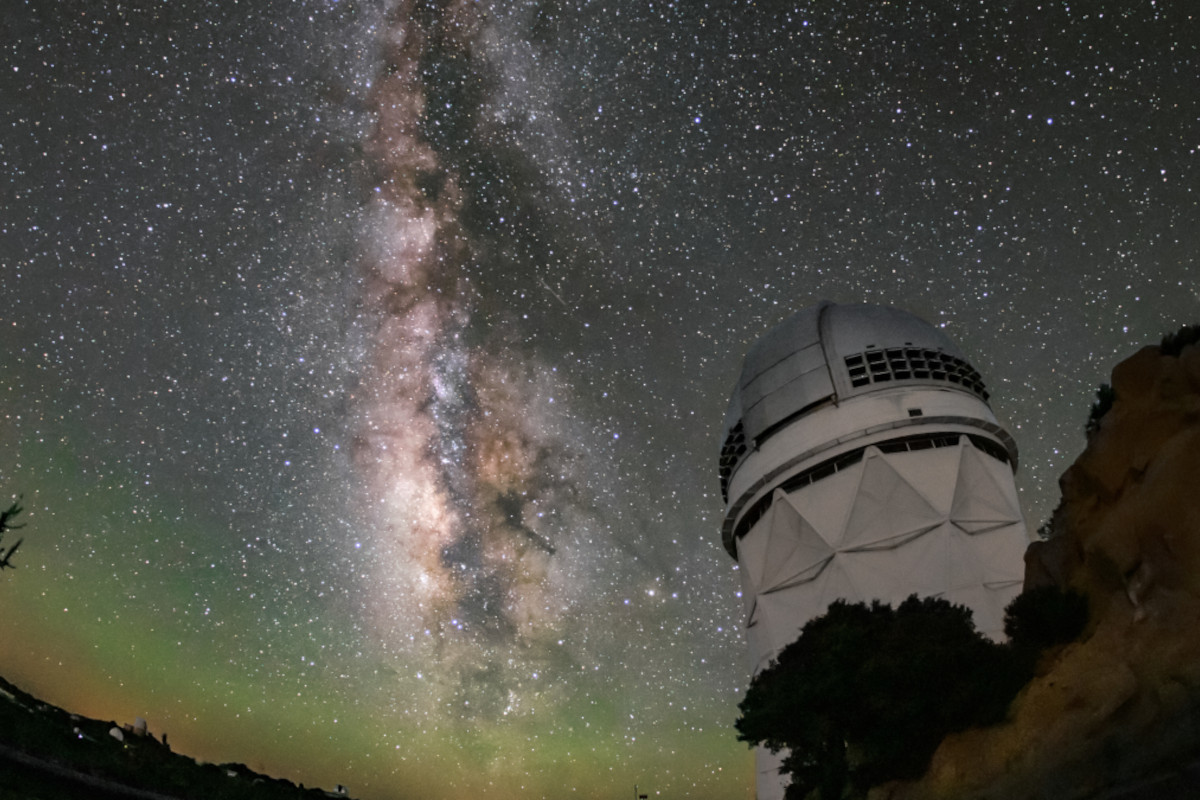
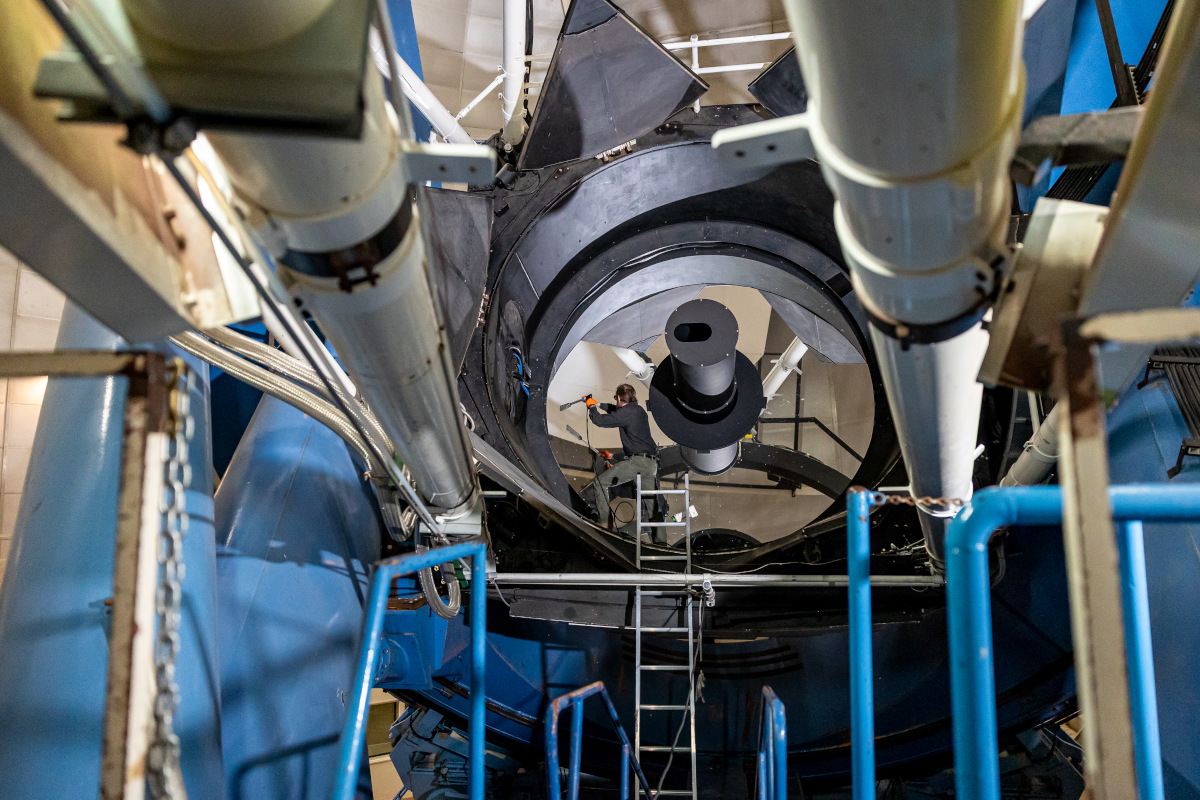
The heart of the instrument is mounted in the focal plane of the 4m (13ft) Nicholas U. Mayall Telescope at Kitt Peak National Observatory in Arizona, in the US.
For each new 16-minute exposure, DESI’s optical fibres are repositioned robotically to receive the light of 5,000 galaxies in the new field of view.
Through the fibres, the light is brought to ten huge spectrographs located next to the telescope, each of which is able to record 500 individual spectra at a time.
DESI’s 5-year survey started in May 2021 and was completed in 2026.
In 2024, an analysis of data from the first year of the survey already hinted at a weakening dark energy (in other words, a decrease of the acceleration rate of cosmic expansion) of some 10 per cent over the past couple billion years.
The results presented in March 2025 are based on the survey’s first three years of data, and seem to confirm the earlier results.
Observing supernova explosions
Here’s the thing: the DESI survey isn’t the only data set hinting at weakening dark energy. In their latest analysis, presented at the American Physical Society’s Global Physics Summit, the DESI collaboration also included observations of distant supernova explosions.
And in June 2025, members of the Supernova Cosmology Project published new results that seem to bolster the DESI findings.
So how can supernovae – exploding stars in remote galaxies – yield information about the expansion history of the Universe? Well, they also can also act as probes of cosmic evolution.
For a particular (and recognisable) type of supernovae, known as Type Ia, astronomers know that they always explode with the same true luminosity.
So when a Type Ia supernova shows up in a distant galaxy, it’s straightforward to calculate its distance: you just have to compare its observed brightness with this true luminosity.
Next, taking the spectrum of the supernova reveals its redshift and corresponding look-back time. Obviously, in a Universe with a constant expansion rate, you’d expect a one-to-one relationship between distance and look-back time.
Any deviation from such a linear relationship is evidence of a changing expansion rate. In fact, this is how dark energy was discovered back in 1998 in the first place.
Over the past quarter-century, many more Type Ia supernovae have been observed.
The Supernova Cosmology Project, led by Prof Saul Perlmutter of the University of California at Berkeley, has now analysed more than 2,000 of these so-called ‘standard candles’, and the data appear to be compatible with a weakening dark energy, in line with the DESI results.
Is dark energy weakening?
Two different research groups, two completely independent methods, one similar conclusion. Isn’t that proof enough that the cherished ΛCDM model is ready to be thrown out? Are we really forced to abandon the most successful theory in the history of cosmology?
Certainly not, as far as Efstathiou is concerned. “The supernova data are unreliable,” he says, “as the analysis is very complicated.”
Indeed, distance estimates of supernovae are based on a series of other measurements, including studies of variable stars in our own galaxy.
Moreover, Type Ias are not real standard candles: their luminosities partly depend on properties like age and composition, and astronomers need to apply hard-to-calibrate corrections to compensate for these effects.
In fact, Perlmutter agrees that the jury is still out.
In a UC Berkeley press statement, he said: “I don’t think anyone is jumping up and down getting overly excited yet, but that’s because we scientists are suppressing any premature elation since we know that this could go away once we get even better data.”
Heymans, too, admits there’s a potential problem here.
“The combination with supernovae is something I start to get a little more anxious about,” she says, “because it’s really hard. So to be convinced that we definitely have weakening dark energy, I’d love to see that convincing result from just the DESI data alone.”
And there’s the big problem, according to Efstathiou. Looking at just the DESI data, without including supernovae, the three-year result has no higher statistical significance than the one-year result published in 2024.
If dark energy is really weakening, he says, you would expect the results of the analysis to get more convincing when more data become available, and they are not. “Statistically speaking, DESI’s three-year data set is still consistent with ΛCDM.”
Will the Universe die in a ‘Freeze’ or ‘Crunch’?
OK, so the message is clear: don’t throw away the cosmological Standard Model just yet. But what if it really needs replacement? What would the consequences be if dark energy is really growing weaker and weaker over time?
First of all, it would mean that the lambda in ΛCDM is not the constant quantity that Einstein envisioned a century ago. If dark energy really is evolving, physicists would probably need new fields, forces and particles to describe its behaviour.
Since the DESI announcement, many papers have come out on a wide variety of possible solutions, including modifications to our understanding of how gravity works. “There’s a zoo of different models out there,” says Heymans.
What’s more: the fate of the cosmos becomes quite unpredictable. The ΛCDM model, with a constant dark energy, predicts a bleak future, with galaxies racing away from each other ever faster.
Eventually, this would lead to a huge, empty, utterly cold, pitch-black Universe – a scenario known as the Big Freeze.
However, if dark energy is evolving, everything is possible – depending on your specific model. What this means is that the expansion of the Universe could one day come to a complete stop and revert into an all-encompassing cosmic contraction.
That would lead to the mirror image of the Big Bang – a fiery death of the Universe nicknamed the Big Crunch or the Gnab Gib (hint: read it backwards).
Room for new ideas
Cosmologists are eagerly awaiting the final data release of the five-year DESI survey, containing information on some 15 million galaxies.
Meanwhile, other telescopes have joined the cosmological treasure hunt, like the European Space Agency’s Euclid space telescope, launched in 2023, and the Vera C. Rubin Observatory in northern Chile, which started operations in early 2025.
According to Prof Koen Kuijken of Leiden Observatory in the Netherlands, who is part of the Euclid science team, “one of Euclid’s goals is indeed to measure the properties and behaviour of dark energy, but I’m afraid we will only be able to do that precisely enough towards the end of the six-year mission.”
According to Kuijken, who is still on the fence with respect to the implications of the DESI results, “both Euclid and Rubin will use the growth of large-scale structure in the Universe as a probe of cosmic evolution, while DESI mainly relies on studying the expansion history. This complementarity is very interesting in itself.”
If the two approaches yield different results, he explains, that could possibly point at flaws in our understanding of gravity.
Efstathiou is confident we don’t need to go down that road, but others are not so sure.
DESI collaborator Prof Ofer Lahav of University College London told a reporter of The Guardian: “It’s fair to say we have no idea what dark matter or dark energy is. The [ΛCDM model] is already sufficiently challenging. I feel like: ‘As if things were not complicated enough’.”
Heymans looks at it more positively. The results “give the theorists room to think up new ideas about what could be happening on the dark side of the Universe,” she says. “That’s the fun.”
Read more:
