
Dark matter is one of the most mysterious things in existence. We can't see it or feel it, and yet it is threaded through the structure of the Universe, making up around 85 per cent of its mass.
It’s the sheer quantity of dark matter woven through the cosmos that allows astronomers to detect the presence of this otherwise invisible substance.
While it doesn’t interact with light, the gravitational pull of all that dark matter affects the matter we can see, like stars and gas. In fact, its gravity is one of the most important ingredients in making galaxies and prevents them from spinning themselves apart.
It’s such an important ingredient that it could be possible for a galaxy to be made entirely of dark matter. It sounds like a bonkers theory, but astronomers think these ‘dark galaxies’ exist. What’s more, they could be the key to unlocking just what this mysterious matter is.
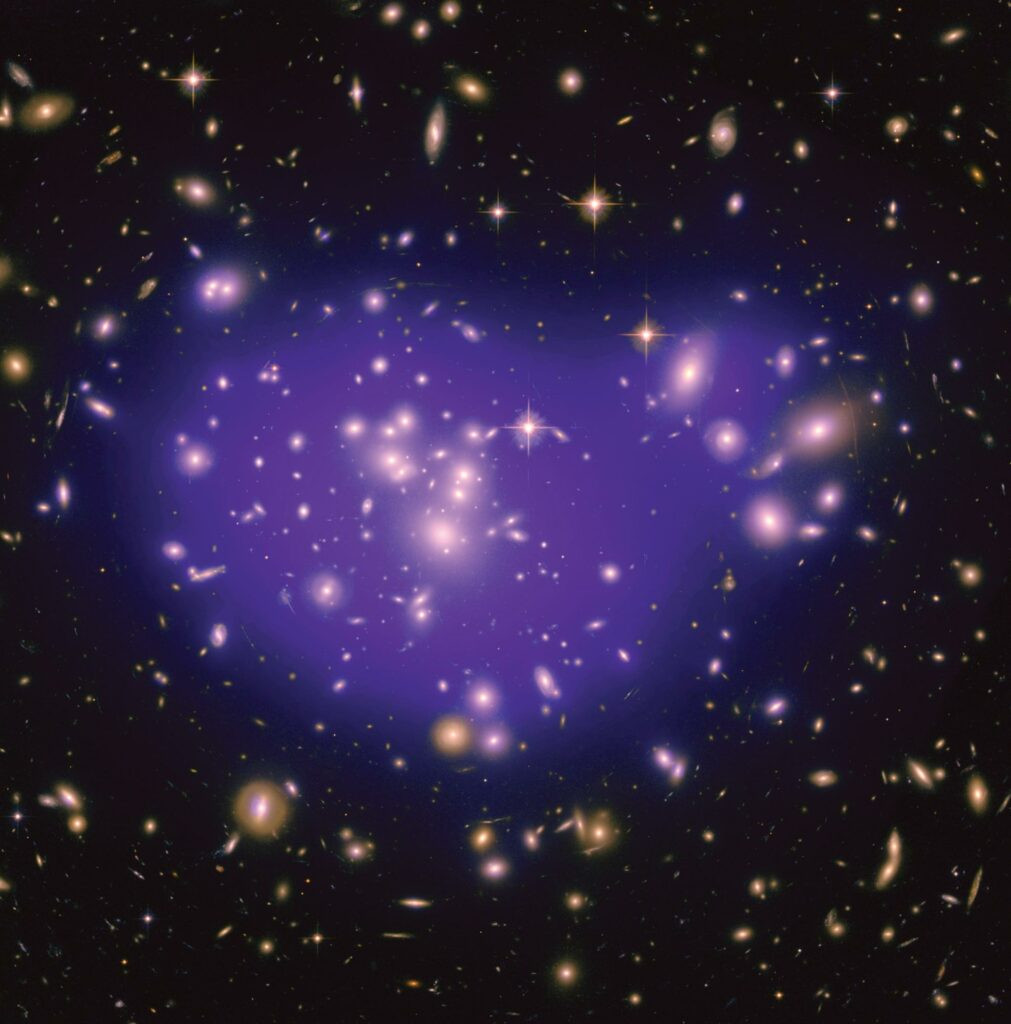
The trouble is, being ‘dark’ galaxies, they are all but impossible to find. And yet, last year, a group of researchers claimed to have done just that. They have found a galaxy that is 99.9 per cent dark matter, the darkest ever discovered.
Seeing the invisible
By definition, dark galaxies are dark. So how could you possibly find them? This was the question a team of astronomers wrestled with when they set out to find a dark galaxy.
The key, they realised, was not looking for the galaxy directly, but to hunt for signs of its gravity affecting the stars and gas around it.
“Usually, to measure the amount of dark matter in a galaxy, you take measurements about how things move,” says Prof Francine Marleau of the University of Innsbruck, in Austria, who took part in the study.
By looking at these motions, astronomers can work out how much invisible mass there must be to keep things orbiting in that way.
Dark galaxies make that difficult, though, because there’s so little ordinary matter present that it’s extremely hard to see how things are moving.
“The only trace you have to measure the amount of mass hidden there would be to use the globular clusters,” says Marleau.
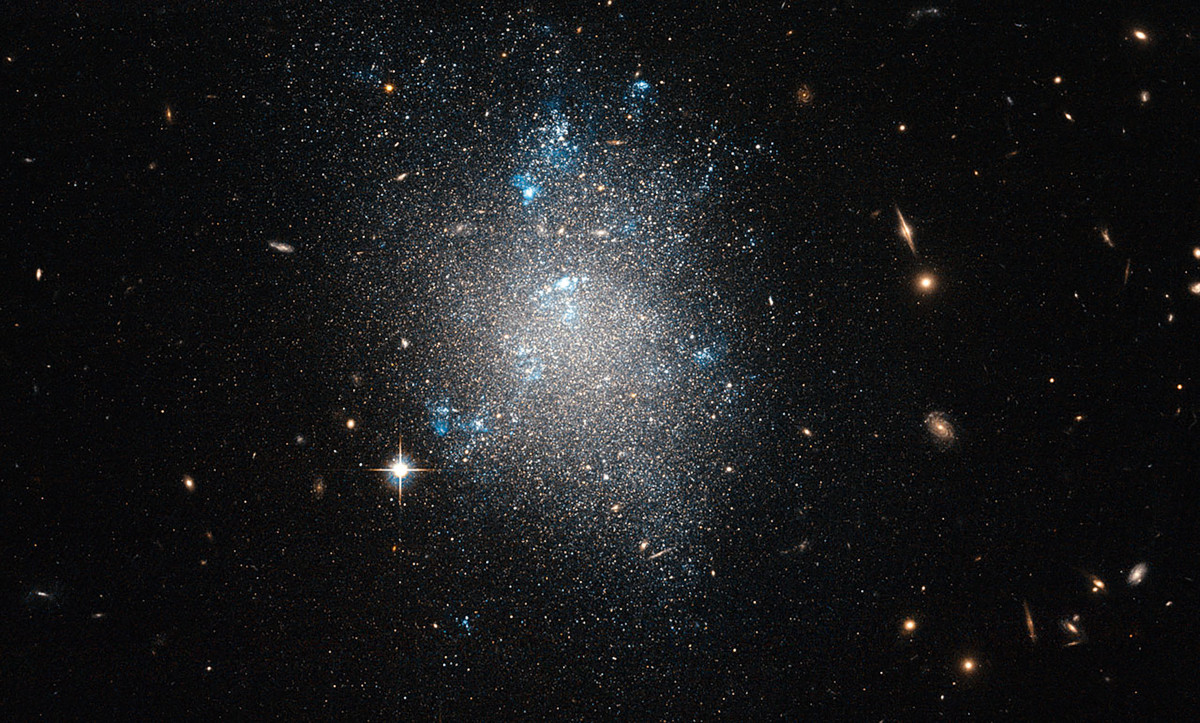
Globular clusters are tight collections of stars normally found in orbit around galaxies. They contain tens of thousands to millions of stars, meaning they’re much easier to see over the millions of light-years between galaxies.
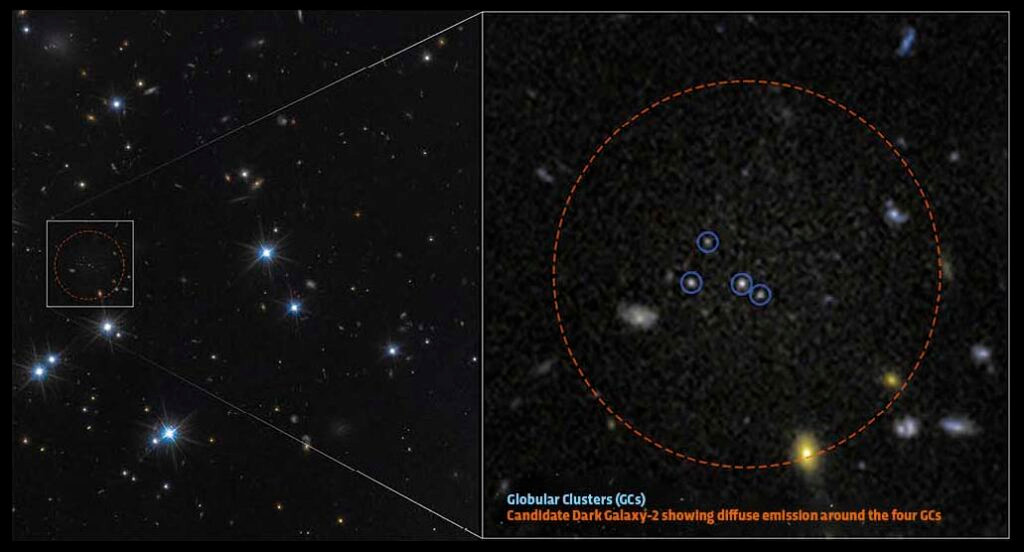
The astronomers were able to identify a group of four globular clusters around 250 million light-years away. They appeared to be huddled around nothing, but some gravitational force must be holding them all together.
Thinking this might be the dark galaxy they’d been searching for, they named it Dark Galaxy Candidate-2, or CDG-2.
When the team took a closer look at the clusters, they saw a faint blur hovering between them. This is the dim light of the 0.1 per cent of CDG-2 that is made up of visible matter, apparently confirming this really was a dark galaxy.
Creating a galaxy
Dark galaxies are fascinating to astronomers as by picking apart how they form, they also gain clues as to how star-filled galaxies are born.
That’s because astronomers know that dark matter plays an essential role in the birth of galaxies – it forms the basic structure around which ordinary matter clumps.
The dark matter arrives first, then ordinary matter follows to create the galaxies we see all around us. Some of the best clues to how galaxies form come from the least bright sources, called low surface brightness features, such as dwarf galaxies.
“These features, if we can observe them, help us rebuild the history of how the galaxy assembled,” explains Marleau.
That might leave you wondering what happens if ordinary matter doesn’t arrive. Or if stars stopped forming early, before the galaxy has had a chance to fully develop. In that case, you’d end up with a galaxy that was mostly dark matter. This is a dark galaxy.
These objects should be abundant in the Universe, according to simulation models. Yet, the difficulties in detecting them mean they’ve remained elusive, until now.
Read more:
- Dark matter: Is it time we gave up looking for it?
- Astronomers create the largest-ever map of our Universe's dark matter
- Supermassive black holes may be formed by collapsing dark matter halos
A galactic testbed
The main potential of dark galaxies like CDG-2 is that they can be used as testbeds to investigate different theories of dark matter.
“The problem with studying dark matter in typical normal galaxies, such as the Milky Way or Andromeda, is that these galaxies are too bright,” says Dr David Li, from the University of Toronto, who led the study. All that light obscures any signatures that might point to dark matter.
“It’s very hard to separate the effects from these two types of matter,” explains Li. “But for dark galaxies, like for a 99.99 per cent dark matter-dominated galaxy, you have much less visible matter, so the dark matter signature is much more apparent.”
The term ‘dark matter’ refers to a known phenomenon, describing gravitational effects that are seen across the Universe, but the actual nature of dark matter itself is the subject of debate and speculation.
The current prevailing theory, called cold dark matter, is that it’s some kind of heavy particle which doesn’t interact with electromagnetic radiation. However, there are other theories too: the warm dark matter model suggests a lighter particle.
There was, at one time, even a theory of hot dark matter, a particle with extremely little mass. Although this has now fallen out of favour, as when it’s modelled in simulations, it prevents large-scale structures like galaxies from forming anywhere in the Universe.
These kinds of simulations are how astronomers and physicists attempt to decipher what dark matter might be. They can’t measure it directly, so they must make assumptions about what it could be based on theory, then create simulations from those assumptions.
How well the simulation matches up with reality reveals whether the theory is right, or if it’s back to the drawing board.
In the case of hot dark matter, it was relatively easy to see that the theory wouldn’t work. When the simulations were created, the hot dark matter moved so fast that no galaxies could form.
When we look around at the real Universe, it very obviously does have galaxies in it – like the one we live in – so that theory couldn’t be correct.
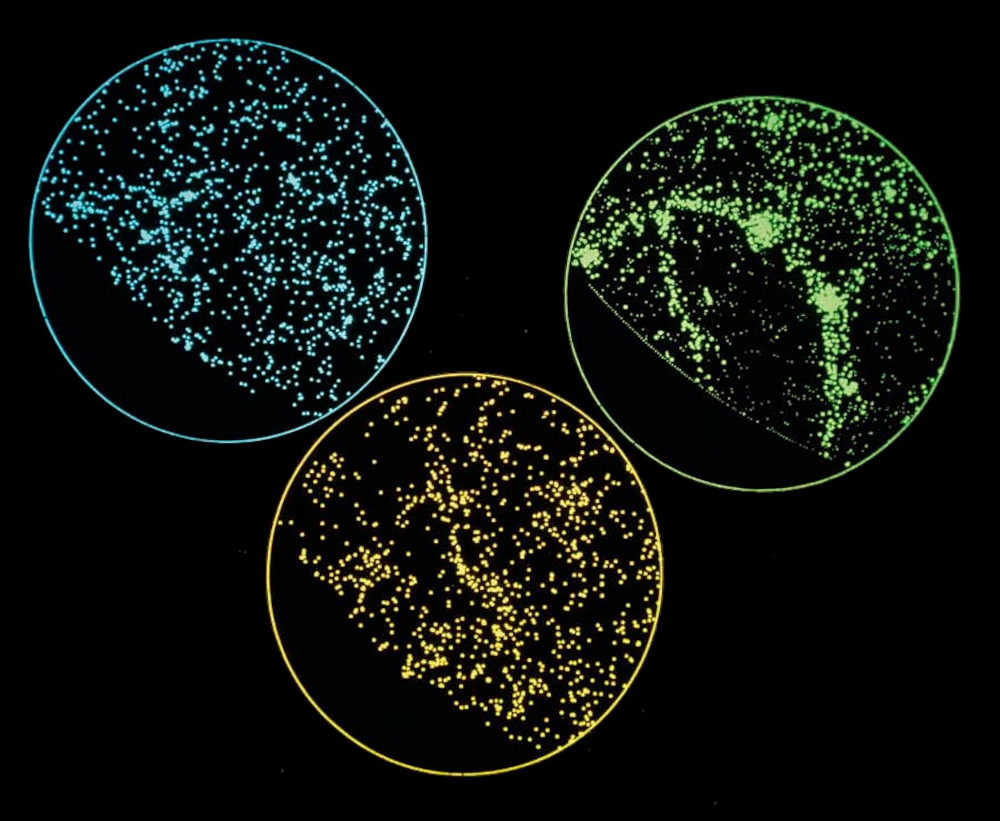
Similarly, researchers like Dr Sylvia Plöckinger from the University of Vienna, are creating computer-based simulations using different ideas of dark matter to see the gravitational effects of each model.
From there, they're trying to find which model best fits the known observations of the actual Universe.
“Cold dark matter is very heavy. If we talk about that in simplistic ways, that also means it’s very slow in the beginning,” Plöckinger explains. “Warm dark matter means the particle is lighter.” That, in turn, makes it very fast.
“It cannot be so easily gravitationally bound, because it’s moving so fast,” says Plöckinger.
These are the kinds of differences that could be tested out using dark galaxies like CDG-2. There are refinements of the models, too, such as the concept of fuzzy dark matter.
That puts forward the idea of an extremely light particle that behaves more like a wave, creating quantum effects that can be seen at large scales. There are also theories about self-interacting dark matter.
“Maybe dark matter isn’t just a particle by itself, but there is a full dark sector,” Plöckinger explains. This ‘sector’ could be an entire branch of particle physics we currently don’t know about.
In the world of ordinary matter, there are a variety of elementary particles called fermions (such as electrons) and bosons (such as photons). Perhaps there could be an equivalent variety of particles making up dark matter:
“Maybe there’s also a dark photon or a dark fermion, and they interact with each other similar to what we have in the standard model of physics.”
When it comes to trying to test out theories of dark matter in the real world, though, simulators have to work with the computing power and resources that are available to them.
That means they have to be pragmatic, and work with things that are a good enough fit rather than always chasing the finest details.
“One of the big successes of the cold dark matter concept is that it’s so simple to model. You just have your dark matter and it doesn’t do anything else, other than acting gravitationally. So it’s the simplest to model,” Plöckinger says.
“Something like fuzzy dark matter, with its quantum effects, is much harder to model and more computationally expensive.
“Sometimes it’s not necessarily a matter of which model is most promising, but also which one we can actually implement – for which model the effects can be converted into code and put into our simulations.”
Unanswered questions
So far, the cold dark matter model has a good match for most observations, but there are outstanding questions and places where the fit isn’t quite right.
For instance, different models of dark matter produce different distributions of dark matter throughout a galaxy.
Cold dark matter predicts a ‘cuspy’, or steeply rising, distribution in galaxies, where there is a large density of dark matter in the centre of a galaxy. Other models predict a more even spread of dark matter through the galaxy, which is (rather confusingly) called a ‘cored’ distribution.
When astronomers look at dwarf galaxies in particular, though, the way they rotate suggests that they have a cored distribution. So is the cold dark matter model wrong, or is there something about dwarf galaxies that we haven’t understood, or modelled correctly yet?
“In the case of this new dark galaxy, it would be very interesting to determine if it has a cusp or a core, because that constrains our understanding of dark matter and our cosmological model,” says Marleau.
Another issue that dark matter experts are vigorously debating is the rotation of dwarf galaxies.
For the small satellite galaxies which we observe around the Milky Way and our neighbouring galaxy, Andromeda, we see these moving in a coherent plane.
“The cold dark matter doesn’t predict that – it predicts that they should move randomly,” Marleau says.
So it could be just a matter of chance that our Galaxy and its neighbour happen to show this effect, or it could be a feature of satellite galaxies which doesn’t match with our current model of dark matter.
There have been plenty of issues with the cold dark matter model, which have been solved over time, however.
These include discrepancies in the number of dwarf galaxies observed in the Universe, and a mismatch between their density and their movements.

Often, what was assumed to be a problem with the dark matter model turned out to be a problem with our assumptions.
“It’s easy to blame the cosmology!” says Plöckinger.
Sometimes the reasons that simulations don’t match with observations aren’t because of fundamental errors in the theories, but rather because smaller details (such as the role that supernovae play in galaxy formation) were misunderstood.
A textbook dark galaxy
With one candidate dark galaxy identified, the next obvious step is to confirm it and then look for more. That might not take too long, as the study uncovered another potential candidate, CDG-1.
This galaxy could be even darker, perhaps made entirely out of dark matter. Confirming this, though, would require some serious telescope power.
“Even with the James Webb Space Telescope, you would need the highest precision configuration with very long exposure,” explains Li, which makes it hard to get time on the telescope.
If it were granted, though, and the galaxy confirmed, “It would literally be the textbook definition of a dark galaxy.”
For now, the existence of CDG-2 alone is enough to potentially drive a whole new area of dark matter research.
“The existence of this thing makes us certain that the existence of really dark or purely dark galaxies isn’t a fantasy,” Li says. “This kind of thing could exist.”
Read more:
