In the time it takes you to read this article, somewhere in the Universe, two black holes will have crashed together. In fact, such collisions are predicted to occur about once every ten minutes, each one releasing an astonishing amount of energy.
In just a matter of seconds, these crashes release more energy than the Sun will unleash in its entire lifetime several times over. The black holes themselves – many already over 30 times the mass of our Sun in size – will get even bigger, merging into one giant object.
These cataclysmic events are so intense that they can shake the very fabric of space-time, creating ripples known as gravitational waves.
Despite their extreme origins, the waves themselves are incredibly subtle. They can pass through an entire planet and make it shiver by less than the width of an atom.
For the last decade, astronomers have been able to listen out for these minute vibrations using detectors such as the twin Laser Interferometer Gravitational-Wave Observatories (LIGO), located in the US.
As gravitational waves pass by, they cause spacetime to ‘stretch and shrink’. When a wave passes through the 4km-long (2.5 miles) arms of the LIGO detector, it changes their length by a fraction of the width of a proton – but the observatories can even measure this minuscule amount.
In the last decade, LIGO and other facilities like it have found around 300 black hole mergers.
A wave detected on 23 November 2023, though, was different. When astronomers began to examine its signal, they soon realised it was the biggest merger of black holes the detector had ever picked up.
While most events end up with a black hole around 60 times the mass of our Sun, this one was somewhere closer to 200 – about 400 billion billion billion kilograms.
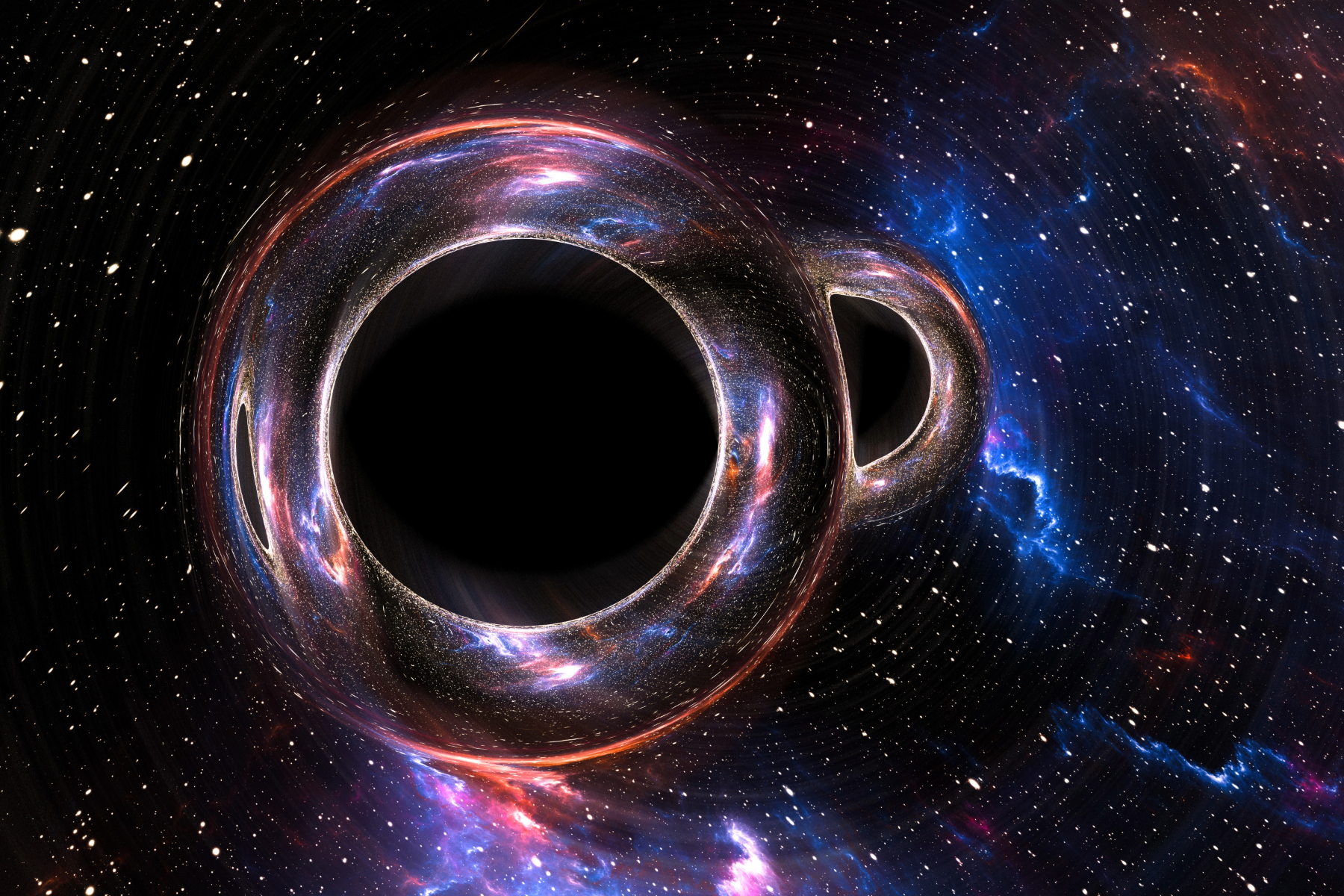
The closer they looked, the stranger things became. Prior to merging, the black holes were spinning at nearly the speed of light. Plus, they both appeared to be around 100 solar masses in size.
Only, black holes that size shouldn’t be able to form. The discovery has left astronomers arguing over exactly how these ‘forbidden’ black holes came to be.
The forbidden gap
Stellar mass black holes, meaning those up to a few hundred times the mass of our Sun, are born from the death throes of giant stars.
For most of their lives, stars maintain a delicate balance. Gravity pulls all of its mass inwards, trying to crush it down. Meanwhile, radiation pressure – the outward push from all the light the star is producing – tries to blow them apart.
As the star begins to run out of fuel, this balance becomes increasingly upset. In larger stars, the radiation pressure drops, until it loses its duel with gravity. The core collapses down in a matter of seconds, forming a black hole. The outer layers, meanwhile, bounce off the inner ones, creating a huge explosion known as a supernova.
For stars between about 130 and 250 solar masses, among the largest in the Universe, something slightly different happens.
“In the heaviest and hottest stars, light – which is made up of particles called photons – starts to spontaneously decay into pairs of electrons and anti-electrons,” says Prof Maya Fishbach, assistant professor at the Canadian Institute for Theoretical Astrophysics (CITA), University of Toronto.
Unlike photons, these particle pairs don’t help hold the star up against gravity. Quite the opposite: they cause the radiation pressure to drop, making the star unstable. A complex chain of events then follows, causing the star’s core to violently ignite, completely blowing the star apart and leaving nothing behind.
“The stars that would have otherwise made black holes between around 45 and 130 solar masses destroy themselves instead,” says Fishbach.
This leaves a so-called ‘forbidden gap’ – a range of masses where black holes shouldn’t be able to exist.
Yet, if you’ve been paying attention, you’ll notice that a black hole has been spotted in this gap. Two in fact: the pair seen on 23 November 2023. The current best estimate puts them at somewhere around 137 and 101 times the mass of the Sun, respectively – right in the middle of the forbidden range.
Finding the forbidden
The discovery set astronomers scrambling to explain how the forbidden black holes might have come to be. Had they misunderstood the physics? Or was the gap not quite as forbidden as they thought?
The first question in that endeavour is whether the forbidden range even exists. In a study published earlier this year, Fishbach and her colleagues aimed to find the answer by analysing the masses of the black holes involved in every merger detected so far.
At first, it looked like there were indeed some black holes that crept into the lower end of the forbidden gap. Yet, it was only ever the larger of the merging pair that was over the limit.
One explanation for how these seemingly forbidden black holes could come to be was hiding in plain sight – they themselves were second-generation black holes.
“We think that the black holes in the gap are not made from stars but rather made from previous mergers of smaller black holes,” says Fishbach. “For example, a 30 solar mass black hole merging with another 30 solar mass black hole can make a (roughly) 60 solar mass black hole, which is in the mass gap.”
These second mergers are quite rare, however. Most mergers happen in dense star clusters, where there are lots of large stars creating black holes that can then find each other and collide.
A side effect of the merging process, though, is that the resulting second-generation black hole ends up being shot away from the place it formed. This ejects it from the star cluster, and away from any other black holes it might have gone on to merge with again.
Read more:
- Here's what's (probably) on the other side of a black hole
- Our Solar System has a wall. And NASA is about to reveal its true shape
- 6 mind-blowing space missions now set to launch after Artemis II
“It’s very rare that a 60 solar mass black hole can go on to merge again, let alone find another 60 solar mass black hole to merge with,” says Fishbach.
The handful of second-generation mergers that have been observed most likely occurred in regions dense with stars, like the centre of a galaxy. Even if they were kicked out of where they were born, they’d still end up in another area rich with black holes.
If the initial black holes seen in GW231123 grew this way, they would both need to be second – if not third or fourth – generation black holes. Not only would they have needed to grow to such a size, they would then need to find each other to merge again.
Astronomers in a spin
The size of these black holes isn’t the only thing that’s unusual. Almost all black holes are rotating, but these two were spinning incredibly quickly – at almost the speed of light.
According to Prof Mark Hannam from Cardiff University, that suggests they did, indeed, grow from a merger.
“If you start with two black holes that are spinning, then when they merge the object that forms from that will also be spinning,” he says. “The fact that the black holes from this event look like they were spinning [very quickly] suggests that it is consistent with them coming from a previous merger.”
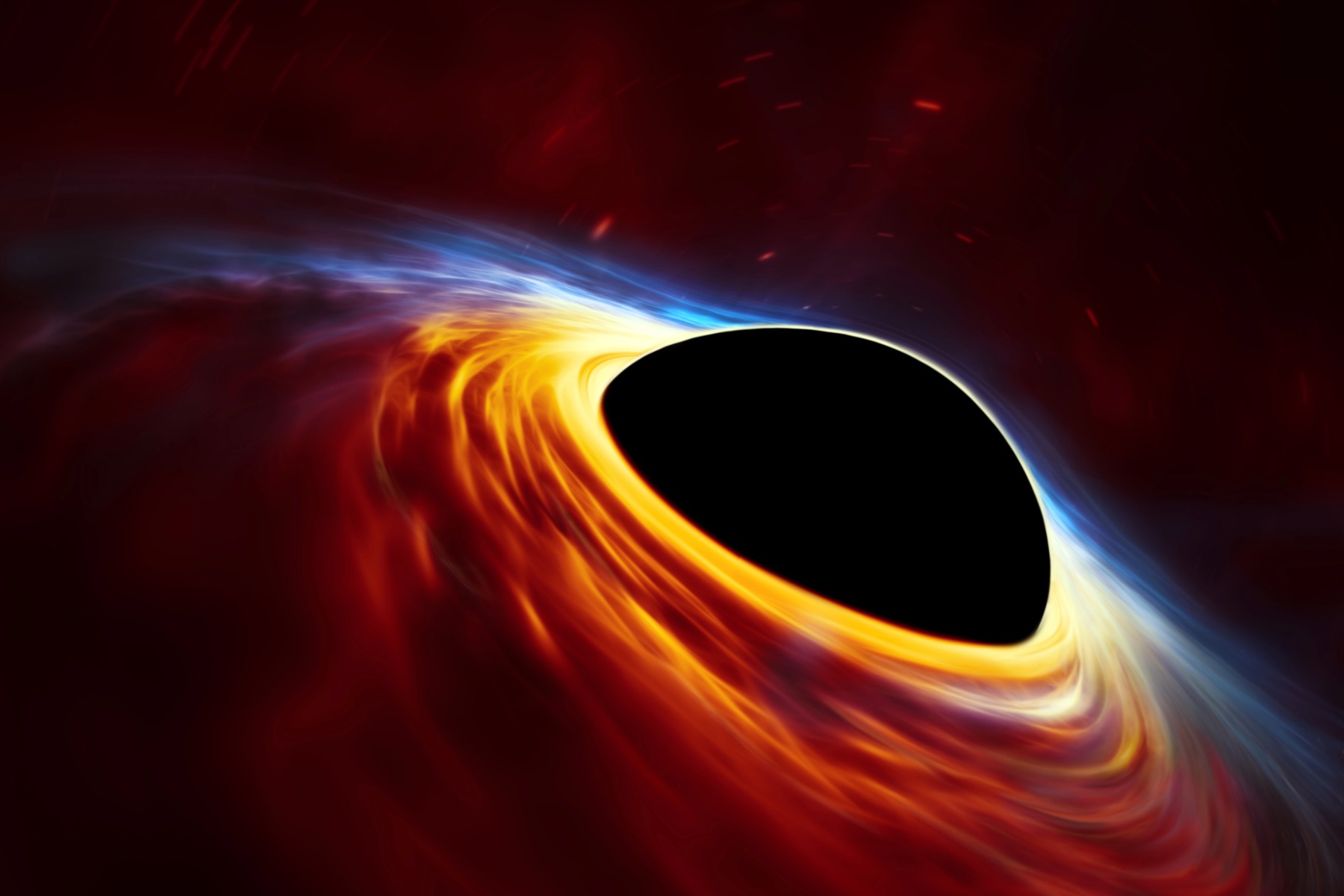
Not everyone is so convinced. Prof Ore Gottlieb from MIT suggests that their rapid spin could actually be evidence against them having grown to this size through merging.
The issue is that when black holes merge, it’s not just the speed they are spinning that matters, but the direction.
“Statistically speaking, there is no reason to think that the spins of two black holes that are merging should be aligned,” Gottlieb says. “They could be in different directions.”
If the two black holes were perfectly aligned, then their two spins would add together and get faster. However, if the two were exactly opposite, then they’d cancel each other out and the final black hole might not spin at all.
In reality, the black holes will be somewhere between the two extremes, and over multiple mergers these mismatches would cause the resulting black holes to slow down.
“It’s likely that when we have second-generation black holes – and even more for third or fourth – the spin will go down as it’s merging more and more.”
Instead, he proposes that this spin could be the key to understanding these impossible giants. Rather than smaller black holes growing into larger ones, he suggests this pair were actually at the other end of the scale – large black holes that were prevented from growing even larger.
Gottlieb’s explanation points to the very beginning of the black hole’s life, after it is created in a supernova. After these colossal explosions occur, not all of the gas from the star immediately makes its way into the black hole.
“If we start with a star of 150 solar masses, then it will initially form a black hole of 30–40 solar masses,” says Gottlieb. The remaining 100 solar masses of gas will then form a disc around the black hole, falling onto it over time.
“Previously, models have assumed that everything is just going to be falling onto the black hole, so they grow from 50 to 150 solar masses,” says Gottlieb. “However, there are multiple mechanisms through which we know that discs can eject mass.”
One of these is through jets. If black holes are spinning fast enough, they can twist up their magnetic fields. These can syphon up the gas, firing it off into space and stripping the disc.
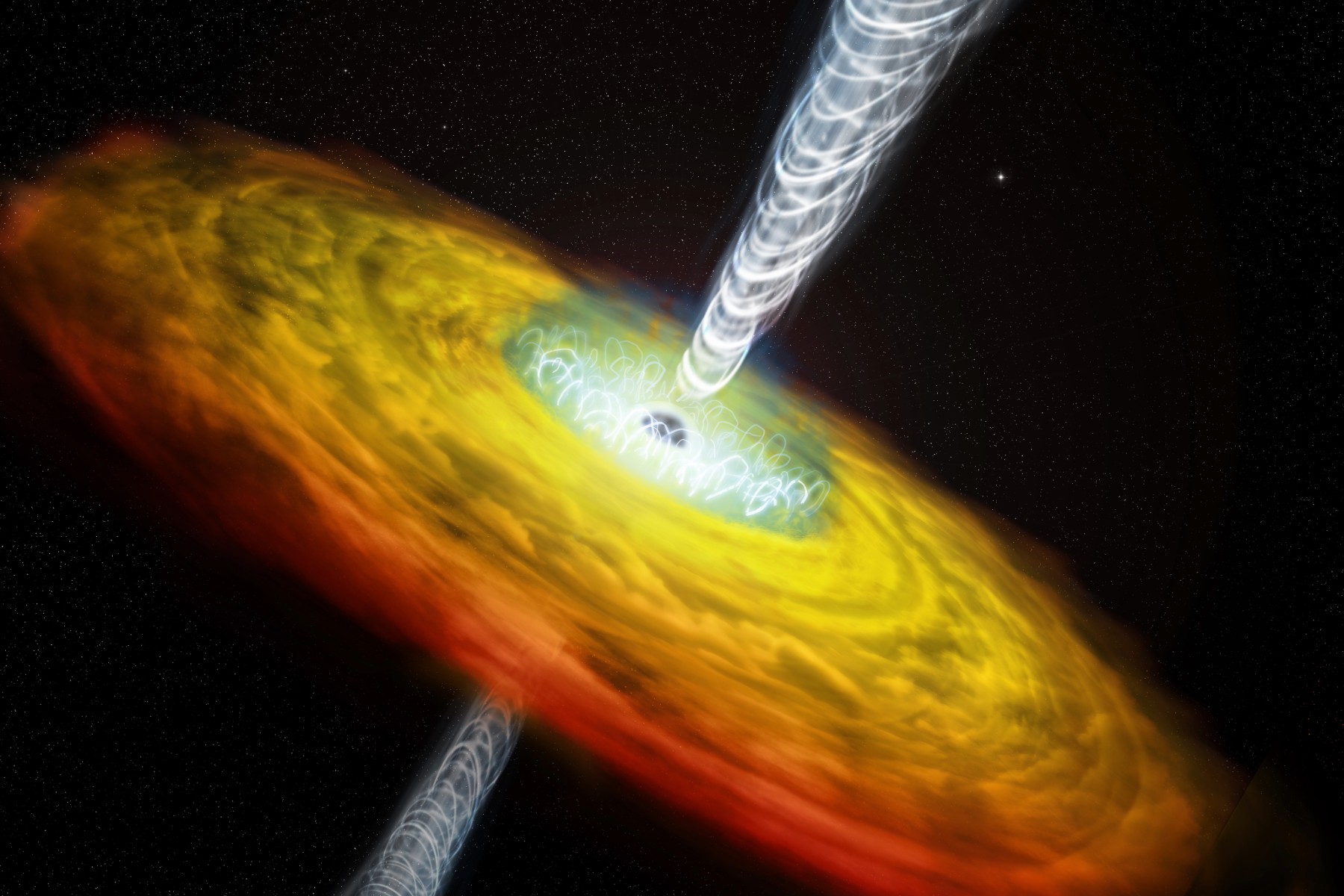
“A very strong magnetic field will strip 80 solar masses, so the black hole will only grow to 70 solar masses,” says Gottlieb. “A weaker magnetic field will only strip 20 solar masses, and the black hole will grow to 130 solar masses.”
In either case, such black holes could have enough mass to fall into the ‘forbidden gap’.
As an additional point in the theory’s favour, massive stars tend to form in binary pairs with a very similar twin. If one ends up creating a black hole this way, the other one is likely to follow the same fate, leaving two giant black holes close enough to each other to eventually merge.
If astronomers can find more black holes in the gap, then it should be possible to test Gottlieb’s theory. Smaller black holes should have stronger magnetic fields and vice versa. As measuring such magnetic fields is very difficult, Gottlieb instead suggests looking at the spin rates of these black holes.
“The black hole is basically slowed down by the magnetic field anchored to the disc,” says Gottlieb. “If we have weaker fields, we expect more massive black holes, but also faster spinning ones, because there is nothing to slow them down.
“If this correlation exists in the data, it definitely supports this model for black hole formation.”
A certain uncertainty
Of course, a lot of this discussion is very precarious. GW231123 was right on the cusp of what the detector could pick up.
“There’s a range of frequencies that the detectors are sensitive to,” says Hannam. GW231123 was right on the cusp of that range.
Before black holes merge, they spiral in towards each other. As they get closer, the frequency of the gravitational waves they produce increases, before peaking in a distinctive ‘chirp’ just before they combine into one, final object.
For smaller black holes, both the waves created during the in-spiral phase and the final merger are in LIGO’s sensitivity range.
But the larger the black holes are, the lower the frequency the waves they produce are.
“If you turn up the mass, then the only part of the signal that’s actually in the sensitive band of the detector is the merger part,” says Hannam. In other words, LIGO was only able to hear the final chirp from GW231123.
That makes it very difficult to pin down any specifics. While it’s certain the merger was between two very large black holes, the total mass could be anywhere between 190 and 265 solar masses.
“That’s the biggest uncertainty we’ve ever had in one of these measurements,” says Hannam. “That’s a kind of ridiculous level of uncertainty in the mass.”
It’s also possible that the mass might not be split between the two black holes exactly like the researchers think, or that they’re not spinning as fast as they appear.
Whatever GW231123’s exact mass, though, it was definitely the largest merger ever detected.
Is this actually a significant event that requires overturning ideas about how black holes grow, or just a fuzzy data point? Answering that will require finding more like it and doing so with even bigger detectors capable of picking up the lower-frequency waves these mergers create.
Fortunately, the next generation of gravitational wave observatories are already in the works. A European consortium is currently deciding where to put the 15km (9 miles) long Einstein Telescope, while the US aims to build the 40km (25 miles) long Cosmic Explorer. Both of these hope to be operational by the mid-2030s, ready to detect even more black hole mergers.
“A decade ago, we saw an event every few months,” says Hannam. “We’re now seeing a couple each week and with the detectors that will be coming online over the next 5 to 10 years, we’re going to be seeing events daily.”
So, it’s only a matter of time before we find out whether these black holes really are as forbidden as they first appeared.
Read more: