These may be the 15 greatest images of the Universe ever taken

From star‑forming pillars to colliding galaxies, Hubble’s most iconic images reveal how the universe is built, evolves and continues to surprise

Photo Credit: NASA, ESA, M. Livio and the Hubble 20th Anniversary Team (STScI)


For more than 35 years, the Hubble Space Telescope has transformed astronomy, delivering images that have reshaped our understanding of the cosmos.

Orbiting above Earth’s atmosphere, Hubble can capture light in visible, ultraviolet and near‑infrared wavelengths, producing views far sharper and deeper than ground‑based telescopes.

Hubble has measured how fast the Universe is expanding, revealed how stars are born and die, and uncovered galaxies forming just a few hundred million years after the Big Bang.

This gallery brings together some of Hubble’s most striking images, each offering both breathtaking detail and crucial scientific insight.

1. Pillars of Creation
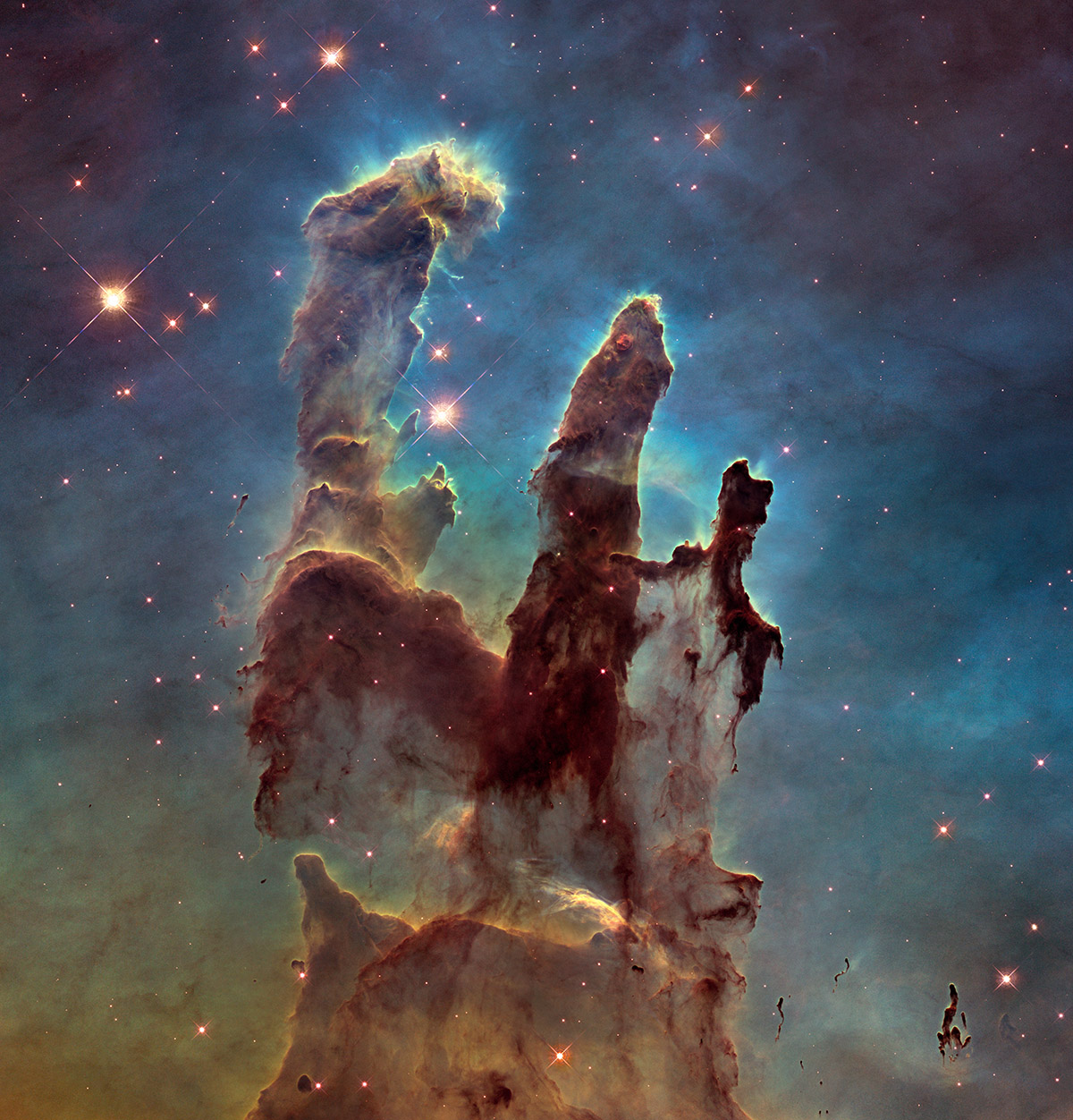
Hubble image showing three tall pillars of dark interstellar gas and dust, glowing at the edges under intense starlight, rising from a colourful nebula against a star‑filled background.
One of Hubble’s most popular and iconic images is of the Pillars of Creation in the Eagle Nebula. The telescope has revisited the site many times over the years. This image shows the pillars as seen in visible light, capturing the multi-coloured glow of gas clouds, wispy tendrils of dark cosmic dust and the rust-coloured elephants’ trunks of the nebula’s famous pillars. These latest images show better contrast and a clearer view for astronomers to study the structure of the pillars. - Photo Credit: NASA, ESA/Hubble and the Hubble Heritage Team

One of Hubble’s most popular and iconic images is of the Pillars of Creation in the Eagle Nebula. The telescope has revisited the site many times over the years.

This image shows the pillars as seen in visible light, capturing the multi-coloured glow of gas clouds, wispy tendrils of dark cosmic dust and the rust-coloured elephants’ trunks of the nebula’s famous pillars.

These latest images show better contrast and a clearer view for astronomers to study the structure of the pillars.

2. Saturn and its northern auroras
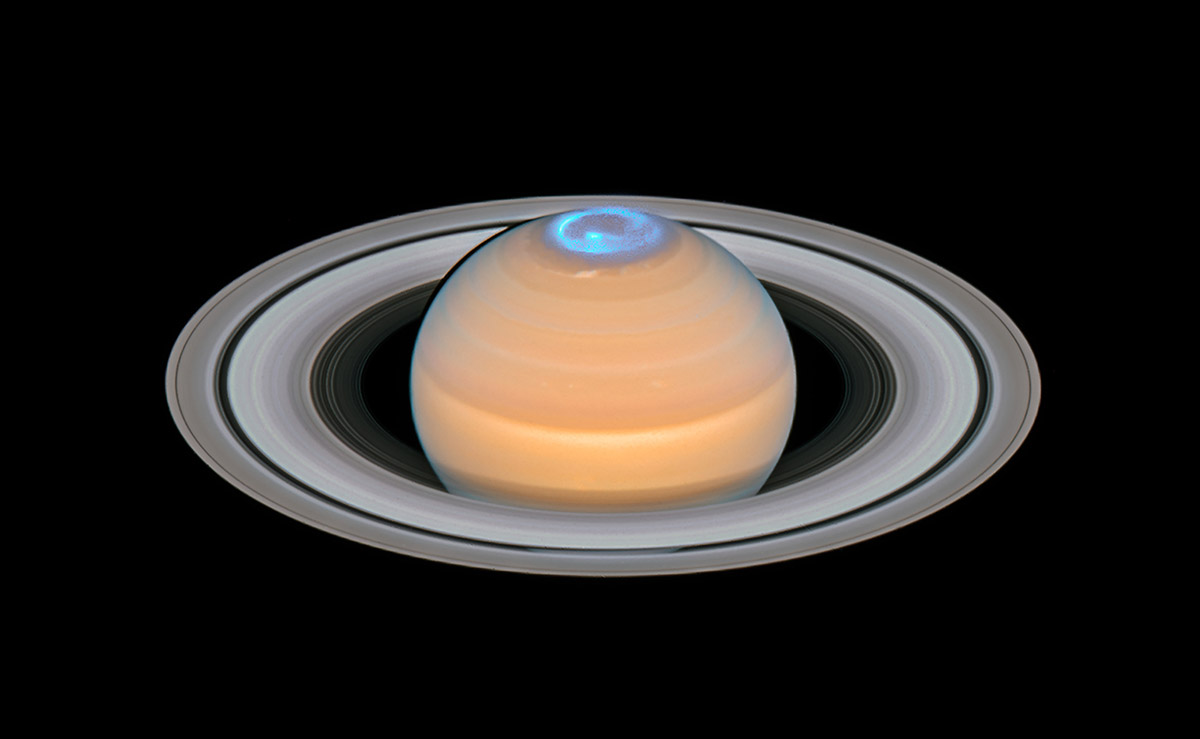
A satelite image of saturn in the centre of the frame in a beige colour with white rings and a blue glow on the top.
In contrast to the auroras on Earth, Saturn’s auroras are mainly visible in the ultraviolet. This part of the electromagnetic spectrum is blocked by Earth’s atmosphere, so astronomers have to rely on space telescopes like Hubble to capture it. This image is a composite of an image of Saturn captured in early 2018, overlaid with aurora observations taken around the planet’s northern pole in 2017. - Photo Credit: ESA/Hubble, NASA, A. Simon (GSFC) and the OPAL Team, J. DePasquale (STScI), L. Lamy (Observatoire de Paris)

In contrast to the auroras on Earth, Saturn’s auroras are mainly visible in the ultraviolet. This part of the electromagnetic spectrum is blocked by Earth’s atmosphere, so astronomers have to rely on space telescopes like Hubble to capture it.

This image is a composite of an image of Saturn captured in early 2018, overlaid with aurora observations taken around the planet’s northern pole in 2017.

3. Hubble Deep Field
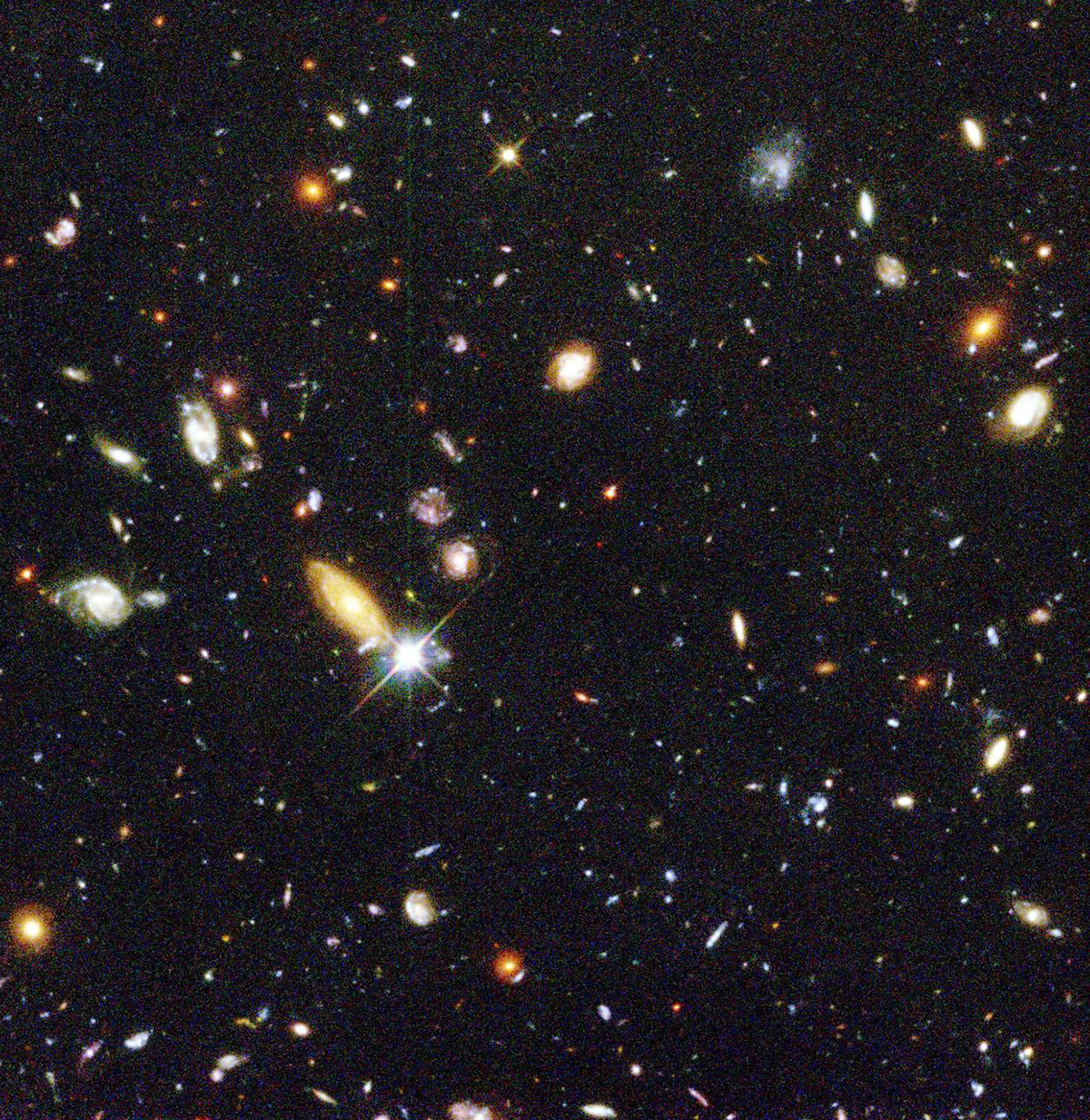
Hubble image showing thousands of distant galaxies, appearing as small dots and smudges in many colours, filling a tiny patch of deep space.
In 1995, Hubble spent 10 days observing a tiny patch of sky that was previously thought to be empty. The final image revealed nearly 3,000 distant galaxies. As it has taken the light from these galaxies billions of years to reach Earth, Hubble was seeing them as they were in the early days of the Universe. The image transformed our understanding of how the cosmos formed and evolved. - Photo Credit: NASA/JPL/STScI Hubble Deep Field Team

In 1995, Hubble spent 10 days observing a tiny patch of sky that was previously thought to be empty. The final image revealed nearly 3,000 distant galaxies.

As it has taken the light from these galaxies billions of years to reach Earth, Hubble was seeing them as they were in the early days of the Universe. The image transformed our understanding of how the cosmos formed and evolved.

4. Cat's Eye Nebula
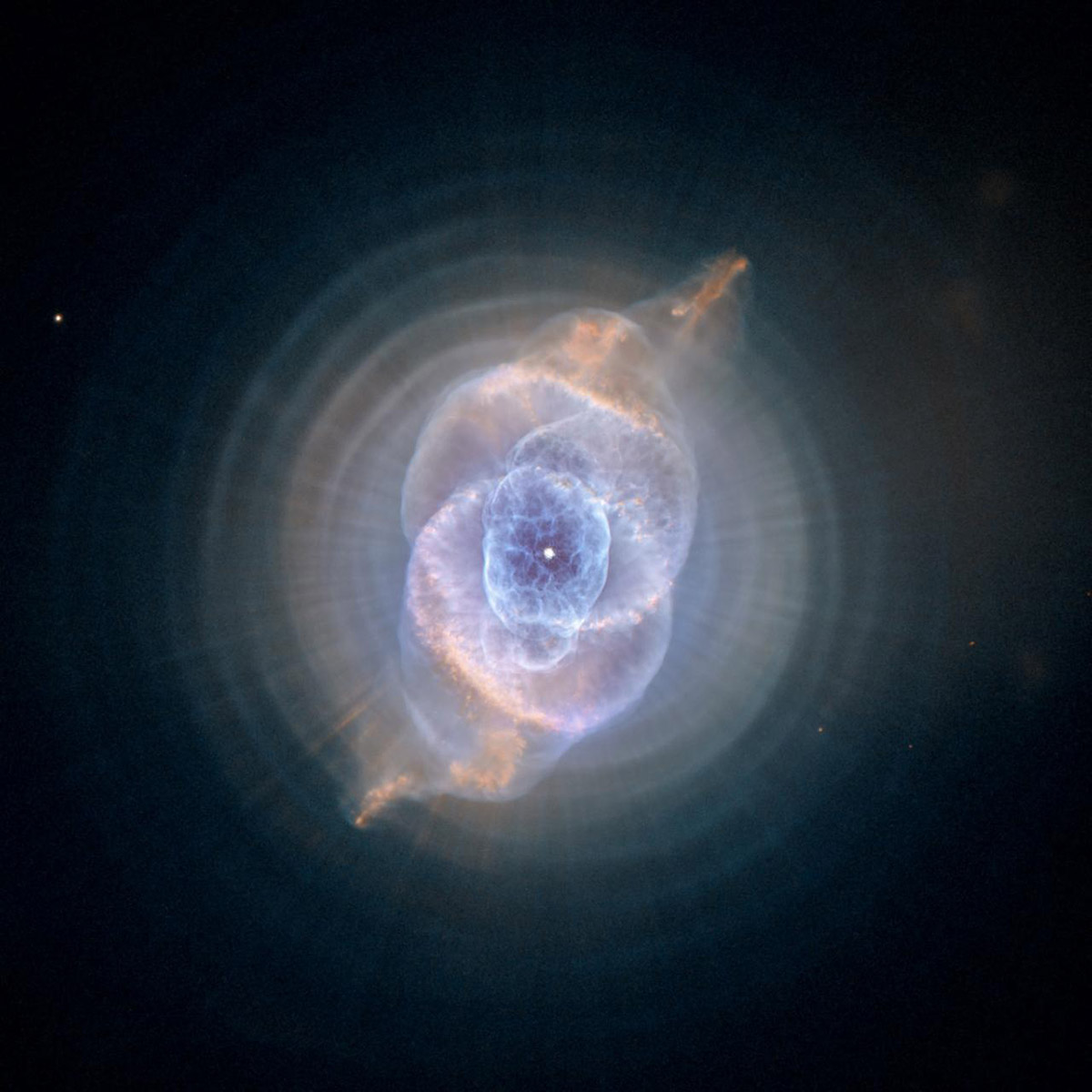
The Cat's Eye Nebula, one of the first planetary nebulae discovered, also has one of the most complex forms known to this kind of nebula. Eleven rings, or shells, of gas make up the Cat's Eye.
The Cat’s Eye Nebula is one of the first planetary nebulae ever discovered. It is also one of the most complex, with eleven rings, or shells, of gas surrounding it. Despite the name, planetary nebulae have nothing to do with planets, but are instead created when a dying star casts off its outer layers. Observations suggest the star which created the Cat’s Eye ejected its mass in a series of pulses at 1,500-year intervals. These convulsions created dust shells, each of which contains as much mass as all of the planets in our Solar System combined. - Photo Credit: ESA, NASA, HEIC and The Hubble Heritage Team

The Cat’s Eye Nebula is one of the first planetary nebulae ever discovered. It is also one of the most complex, with eleven rings, or shells, of gas surrounding it.

Despite the name, planetary nebulae have nothing to do with planets, but are instead created when a dying star casts off its outer layers.

Observations suggest the star which created the Cat’s Eye ejected its mass in a series of pulses at 1,500-year intervals. These convulsions created dust shells, each of which contains as much mass as all of the planets in our Solar System combined.

5. Rings of relativity
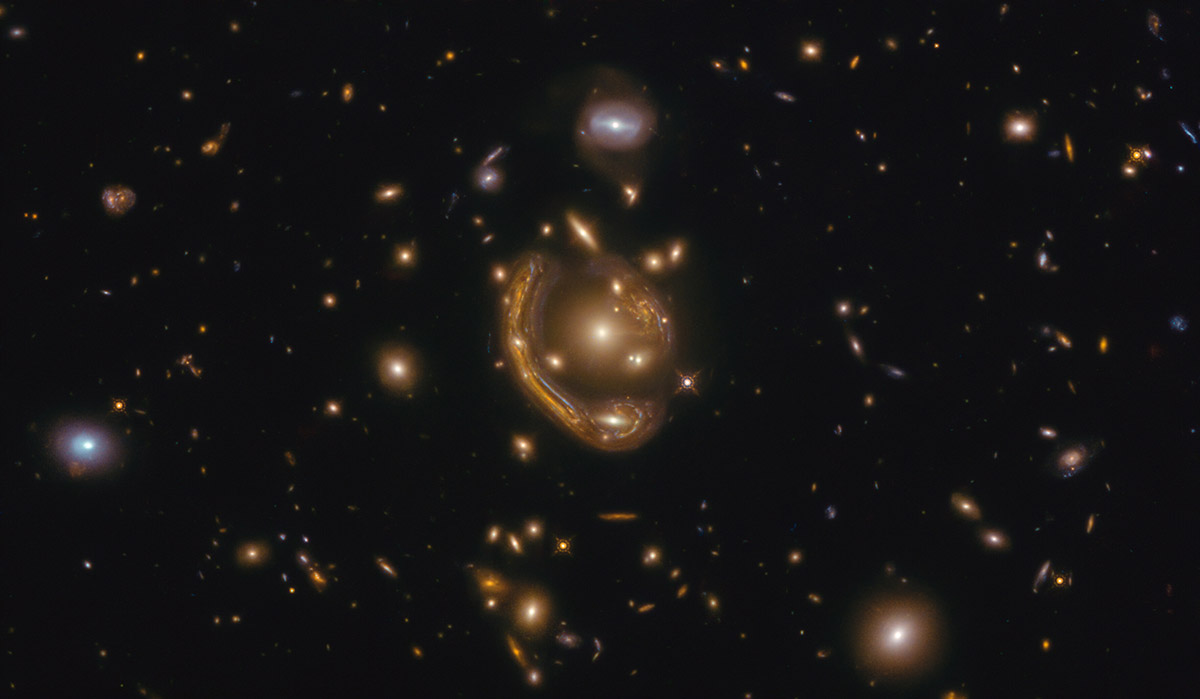
A Hubble image of space littered with stars with a seemingly glowing, metallic appearing orb in the centre.
This image shows one of the most complete ‘Einstein rings’ ever discovered, where a distant galaxy appears stretched into a near‑perfect circle. The ring forms when gravity from a massive galaxy in the foreground bends and magnifies light from a more distant galaxy behind it, smearing it into an arc. This acts like a natural cosmic lens, allowing astronomers to study galaxies that would otherwise be too faint and far away to see. - Photo Credit: ESA/Hubble & NASA, S. Jha, L. Shatz

This image shows one of the most complete ‘Einstein rings’ ever discovered, where a distant galaxy appears stretched into a near‑perfect circle.

The ring forms when gravity from a massive galaxy in the foreground bends and magnifies light from a more distant galaxy behind it, smearing it into an arc.

This acts like a natural cosmic lens, allowing astronomers to study galaxies that would otherwise be too faint and far away to see.

6. Pinwheel Galaxy
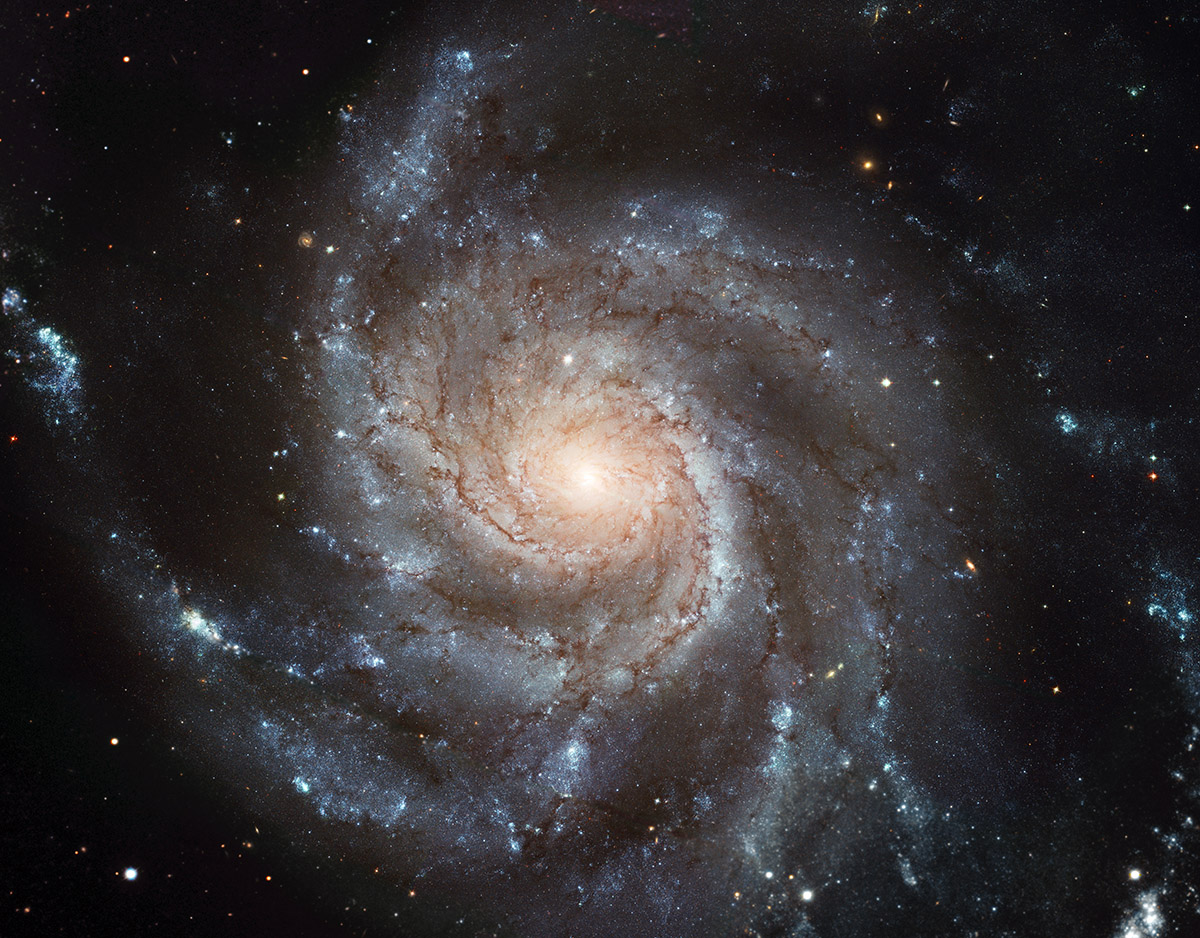
A pinwheel galaxy spiral with a bright centre in deep space scattered with surrounding stars.
This mosaic of the Pinwheel Galaxy (Messier 101) is one of the largest and most detailed images ever produced by Hubble, built from more than 50 individual observations taken over nearly a decade. Spanning around 170,000 light‑years, and almost twice the size of the Milky Way, the Pinwheel Galaxy’s spiral arms are filled with bright star‑forming regions and trillions of stars. By combining visible and infrared data, the image allows astronomers to trace how stars are born, as well as how vast galaxies grow and evolve. - Photo Credit: European Space Agency/NASA

This mosaic of the Pinwheel Galaxy (Messier 101) is one of the largest and most detailed images ever produced by Hubble, built from more than 50 individual observations taken over nearly a decade.

Spanning around 170,000 light‑years, and almost twice the size of the Milky Way, the Pinwheel Galaxy’s spiral arms are filled with bright star‑forming regions and trillions of stars.

By combining visible and infrared data, the image allows astronomers to trace how stars are born, as well as how vast galaxies grow and evolve.

7. Cone Nebula
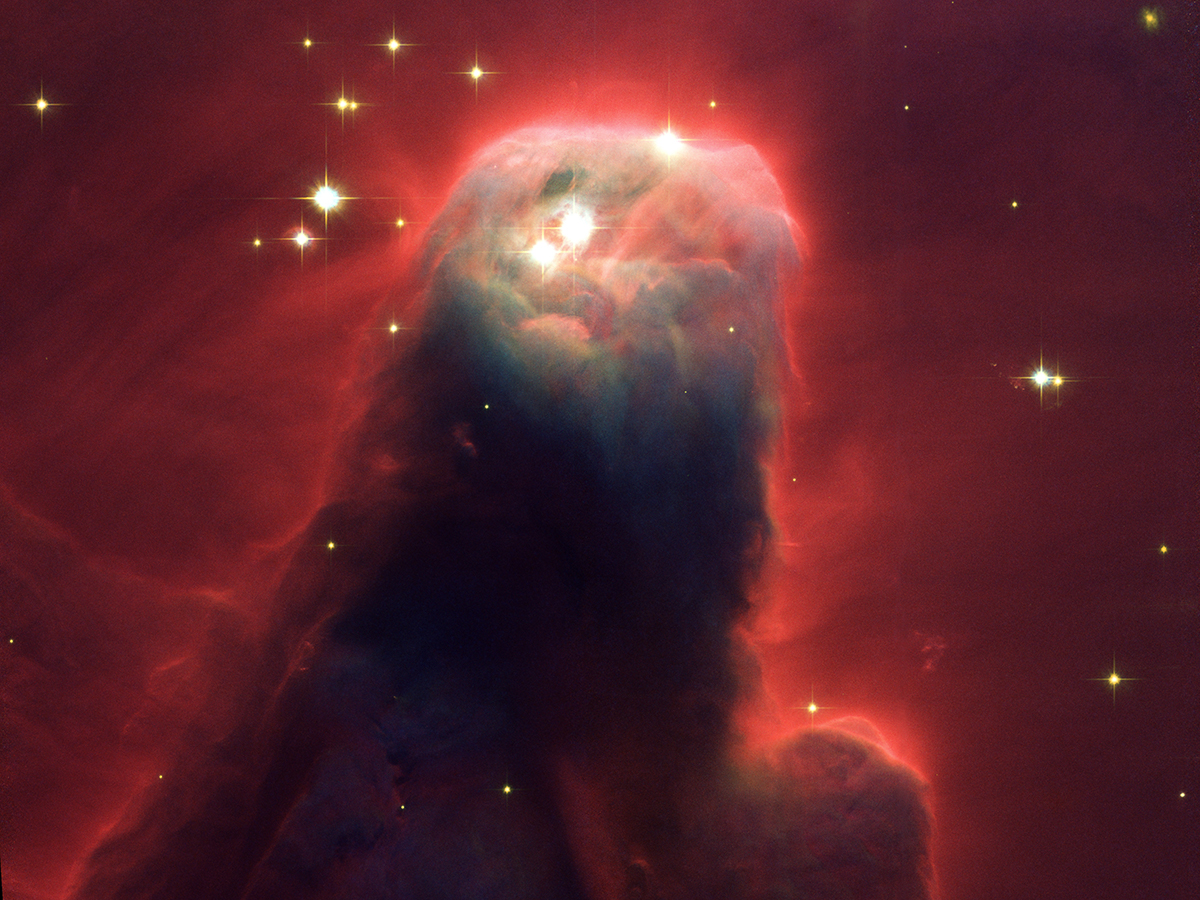
A conical cloud of dust is surrounded by a red glow with small glowing stars at the tip and surrounding it.
The Cone Nebula (in NGC 2264) shows the upper 2.5 light-years of the Cone – a height that equals 23 million round trips to the Moon. The entire pillar is seven light-years long. Sculpted and slowly eroded by intense radiation from nearby young stars, its glowing edges reveal a dynamic process unfolding over millions of years. Structures like this act as stellar nurseries, where dense pockets of gas and dust can collapse to form new stars and planets. - Photo Credit: NASA, Holland Ford (JHU), the ACS Science Team and ESA

The Cone Nebula (in NGC 2264) shows the upper 2.5 light-years of the Cone – a height that equals 23 million round trips to the Moon. The entire pillar is seven light-years long.

Sculpted and slowly eroded by intense radiation from nearby young stars, its glowing edges reveal a dynamic process unfolding over millions of years.

Structures like this act as stellar nurseries, where dense pockets of gas and dust can collapse to form new stars and planets.

8. Sombrero Galaxy
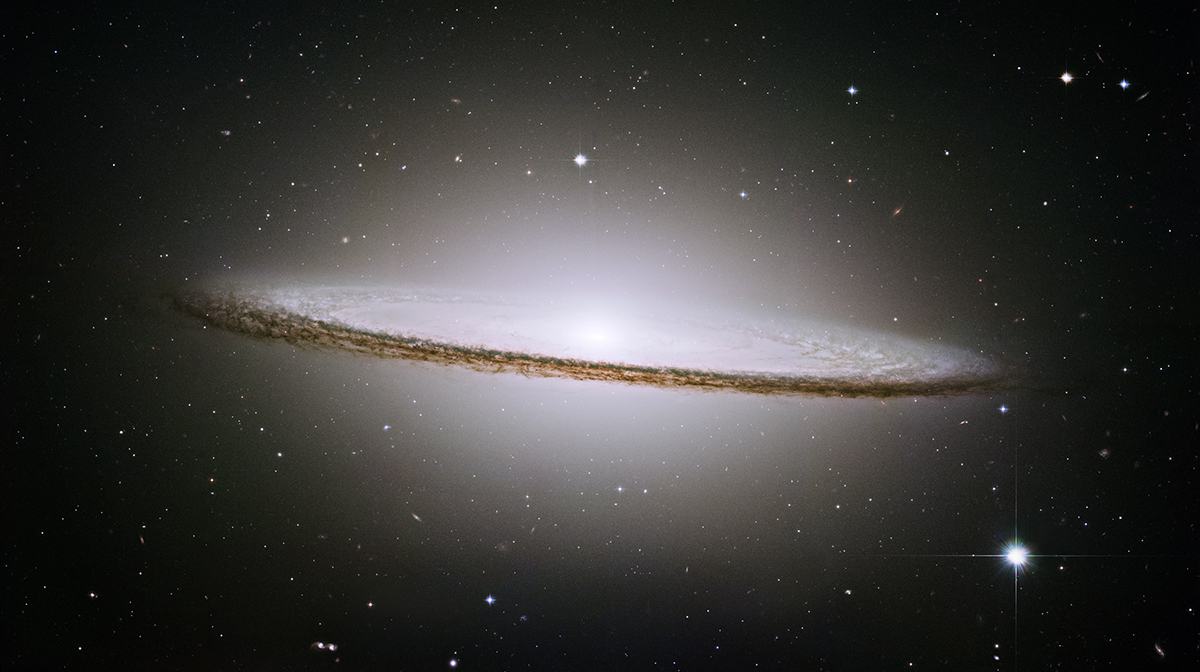
An edge‑on galaxy with a bright central bulge and a dark dust band forming a wide, flat disc against a black background of space.
The Sombrero Galaxy, Messier 104, has a bright, bulbous core encircled by thick dust lanes. It’s a spiral galaxy we see nearly edge-on from Earth, tilted by an angle of just six degrees. The dark ring around the galaxy is created by dust within the plane of the galaxy, blocking the starlight behind it. - Photo Credit: NASA/ESA and The Hubble Heritage Team

The Sombrero Galaxy, Messier 104, has a bright, bulbous core encircled by thick dust lanes. It’s a spiral galaxy we see nearly edge-on from Earth, tilted by an angle of just six degrees.

The dark ring around the galaxy is created by dust within the plane of the galaxy, blocking the starlight behind it.

9. Butterfly Nebula
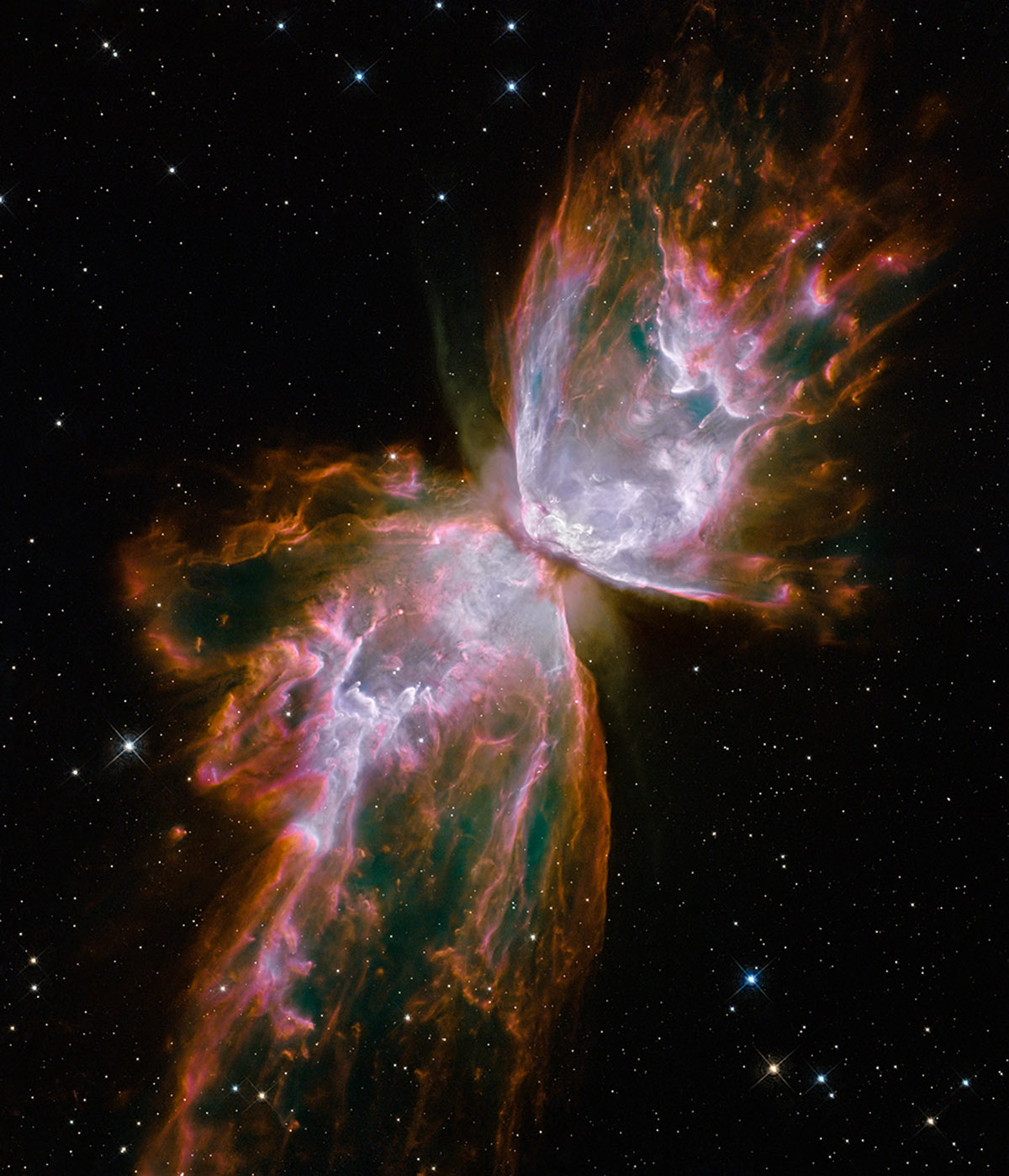
Hubble image of the Butterfly Nebula showing two large, wing‑like lobes of glowing gas and dust of a red and lilac hue, spreading out from a small dense centre into space, surrounded by small dotted stars.
Catalogued as NGC 6302, this planetary nebula is more popularly called the Bug or Butterfly Nebula. The glowing gas is the central star’s outer layers, expelled over about 2,200 years. The ‘butterfly’ stretches for more than two light-years, which is about half the distance from the Sun to the nearest neighbour, Proxima Centauri. The image was taken with the Wide Field Camera 3 (WFC3), which was installed by NASA astronauts in May 2009 during Hubble’s final Servicing Mission to upgrade and repair the then 19-year-old telescope. - Photo Credit: NASA, ESA and the Hubble SM4 ERO Team

Catalogued as NGC 6302, this planetary nebula is more popularly called the Bug or Butterfly Nebula. The glowing gas is the central star’s outer layers, expelled over about 2,200 years.

The ‘butterfly’ stretches for more than two light-years, which is about half the distance from the Sun to the nearest neighbour, Proxima Centauri.

The image was taken with the Wide Field Camera 3 (WFC3), which was installed by NASA astronauts in May 2009 during Hubble’s final Servicing Mission to upgrade and repair the then 19-year-old telescope.

10. Stephan's Quintet
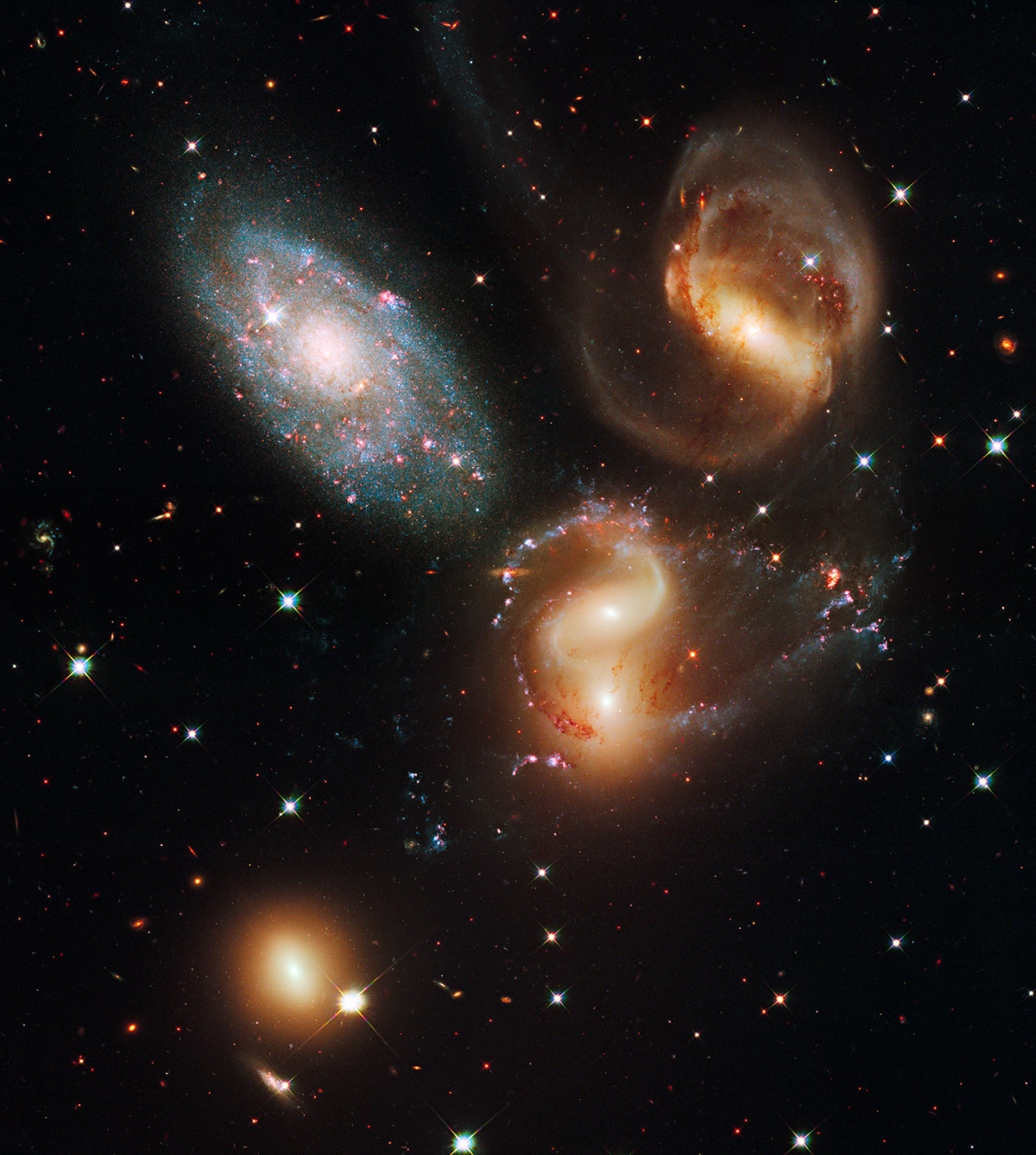
Hubble image showing a small group of galaxies, including two bright spiral galaxies with distorted arms and glowing regions, set against a dark background filled with scattered stars.
This portrait of Stephan’s Quintet, a compact group of five galaxies, was captured by Hubble’s Wide Field Camera 3, combining visible and near‑infrared light. Hubble used filters that isolate light from the blue, green and infrared portions of the spectrum, which were then combined to create a colour image. Stars change colour as they age, which astronomers can use to trace bursts of star formation spanning hundreds of millions of years. Meanwhile, the infrared imaging allows astronomers to peer through dust to uncover hidden regions. It also includes emission from ionised hydrogen gas in red, which highlights areas where stars are being born. - Photo Credit: NASA, ESA and the Hubble SM4 ERO Team

This portrait of Stephan’s Quintet, a compact group of five galaxies, was captured by Hubble’s Wide Field Camera 3, combining visible and near‑infrared light.

Hubble used filters that isolate light from the blue, green and infrared portions of the spectrum, which were then combined to create a colour image.

Stars change colour as they age, which astronomers can use to trace bursts of star formation spanning hundreds of millions of years. Meanwhile, the infrared imaging allows astronomers to peer through dust to uncover hidden regions.

It also includes emission from ionised hydrogen gas in red, which highlights areas where stars are being born.

11. Crab Nebula
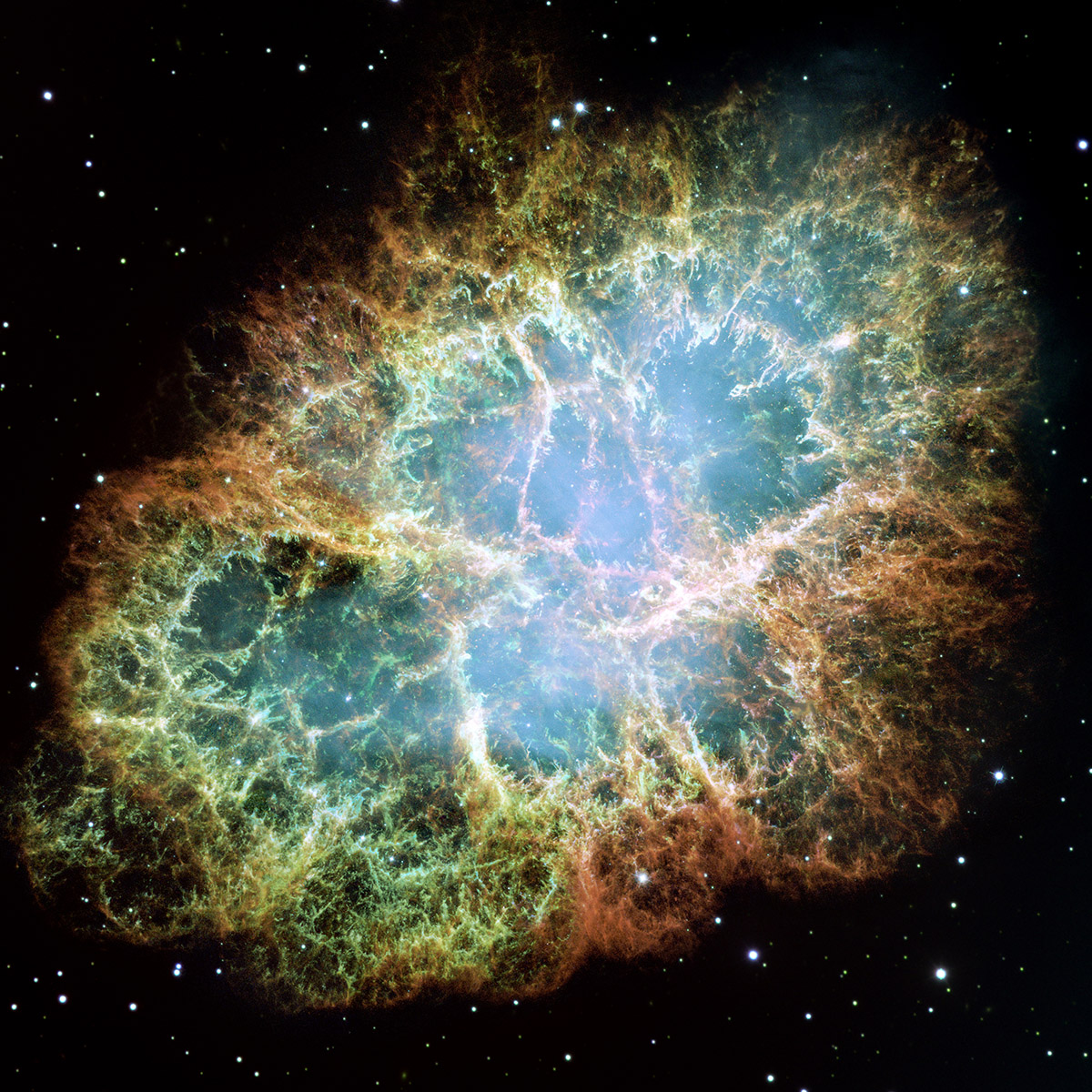
A Hubble image of a nebula with a web of red and blue filaments expanding from a bright central region, surrounded by scattered stars.
The Crab Nebula is among the most interesting and well-studied targets in astronomy. It is the expanding remains of a star that was seen going supernova in 1054, an event recorded by astronomers around the world. This image is the largest image ever taken with Hubble’s WFPC2 camera, assembled from 24 individual exposures. The result is the most detailed view of the Crab Nebula ever taken. - Photo Credit: NASA, ESA and Allison Loll/Jeff Hester (Arizona State University), Davide De Martin

The Crab Nebula is among the most interesting and well-studied targets in astronomy. It is the expanding remains of a star that was seen going supernova in 1054, an event recorded by astronomers around the world.

This image is the largest image ever taken with Hubble’s WFPC2 camera, assembled from 24 individual exposures. The result is the most detailed view of the Crab Nebula ever taken.

12. Rose of Galaxies
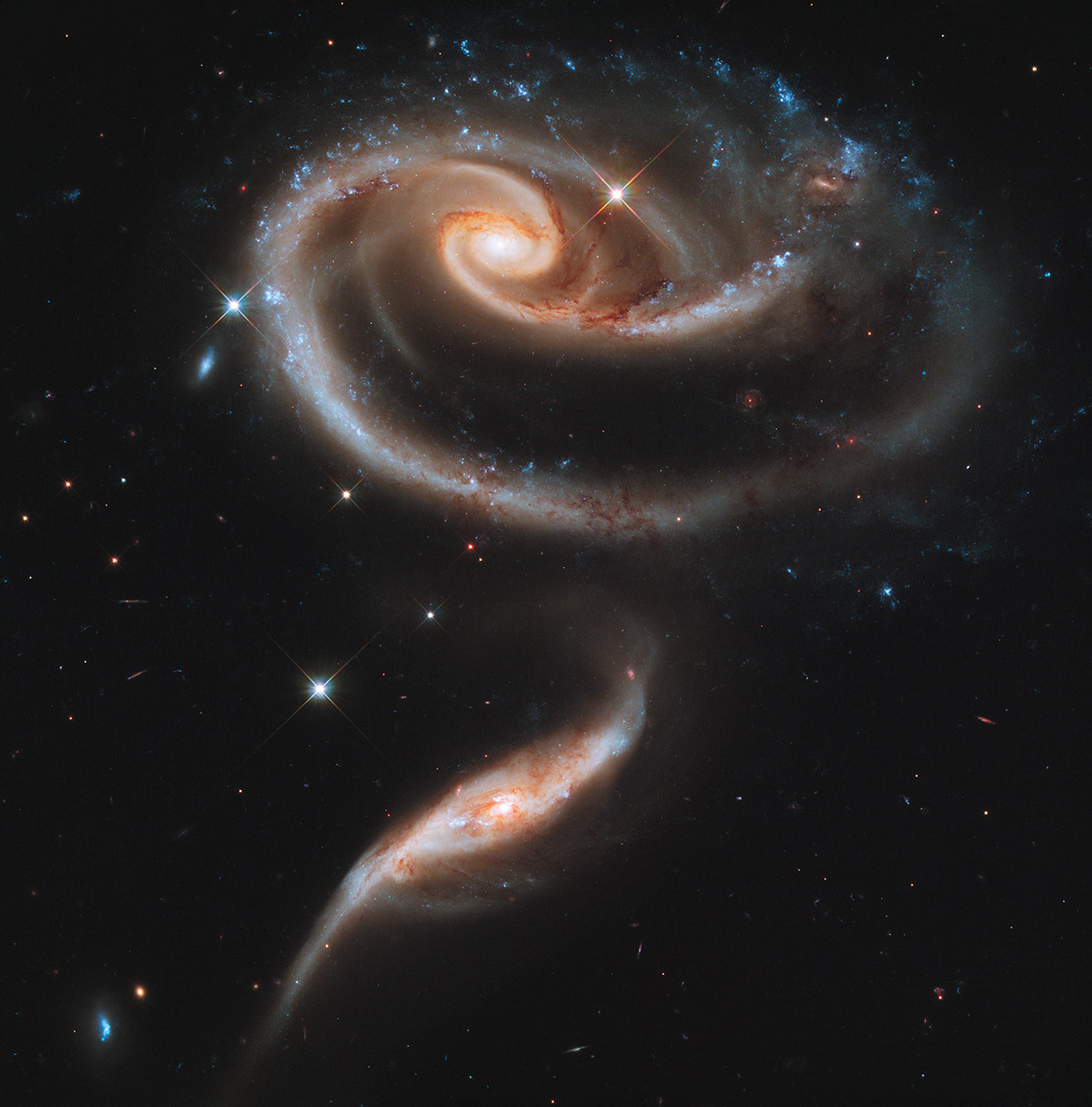
Hubble image of two interacting galaxies, with the larger spiral stretched into a rose‑like shape and a smaller companion just beneath it, surrounded by scattered stars.
This image of Arp 273, nicknamed the ‘Rose of Galaxies’, was captured to mark Hubble’s 21st anniversary in space. It shows a pair of interacting galaxies, the larger of which has been warped into a rose-like shape by the gravitational pull of its smaller companion. These collisions can reshape the structure of galaxies, mixing up the gas within them and potentially triggering new waves of star formation. The bright blue clusters along the disturbed arms show young stars, born from such upheavals. - Photo Credit: NASA, ESA and the Hubble Heritage Team (STScI/AURA)

This image of Arp 273, nicknamed the ‘Rose of Galaxies’, was captured to mark Hubble’s 21st anniversary in space.

It shows a pair of interacting galaxies, the larger of which has been warped into a rose-like shape by the gravitational pull of its smaller companion.

These collisions can reshape the structure of galaxies, mixing up the gas within them and potentially triggering new waves of star formation. The bright blue clusters along the disturbed arms show young stars, born from such upheavals.

13. Mystic Mountains
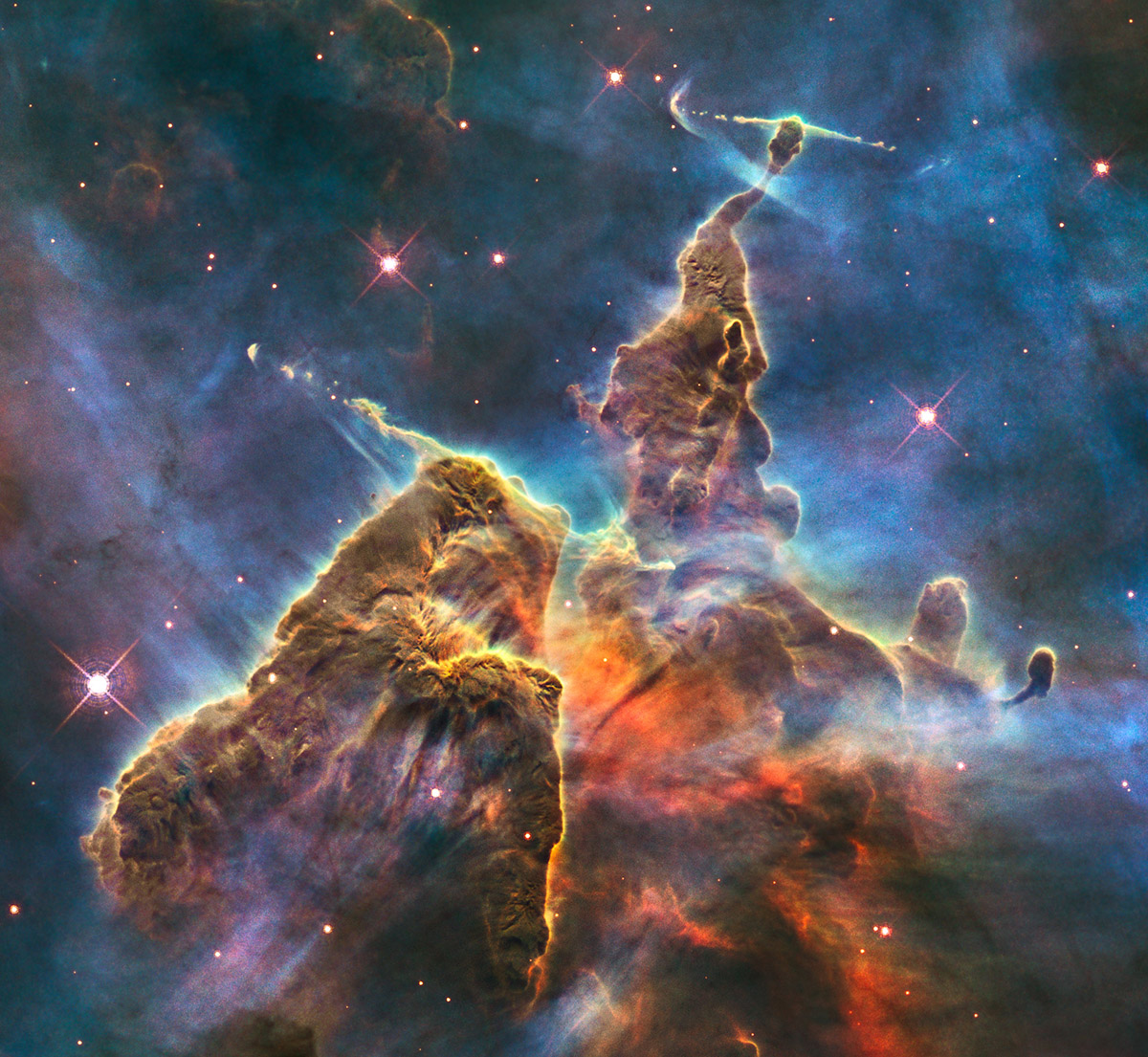
Hubble image of a tall, mountain‑like column of gas and dust with rough, sculpted edges glowing in blue and orange light, surrounded by stars in deep space.
This towering structure of gas and dust in the Carina Nebula, nicknamed ‘Mystic Mountain’, is a vast stellar nursery where new stars are actively forming. Intense radiation and stellar winds from nearby massive stars sculpt the clouds into pillars, triggering bursts of star birth within them. The bright light from these young stars then interacts with the environment around them, transforming the region once more. Hubble’s detailed view reveals this dynamic environment, offering insight into how stars both emerge from and reshape their cosmic surroundings. - Photo Credit: NASA, ESA, M. Livio and the Hubble 20th Anniversary Team (STScI)

This towering structure of gas and dust in the Carina Nebula, nicknamed ‘Mystic Mountain’, is a vast stellar nursery where new stars are actively forming.

Intense radiation and stellar winds from nearby massive stars sculpt the clouds into pillars, triggering bursts of star birth within them. The bright light from these young stars then interacts with the environment around them, transforming the region once more.

Hubble’s detailed view reveals this dynamic environment, offering insight into how stars both emerge from and reshape their cosmic surroundings.

14. Celestial Fireworks
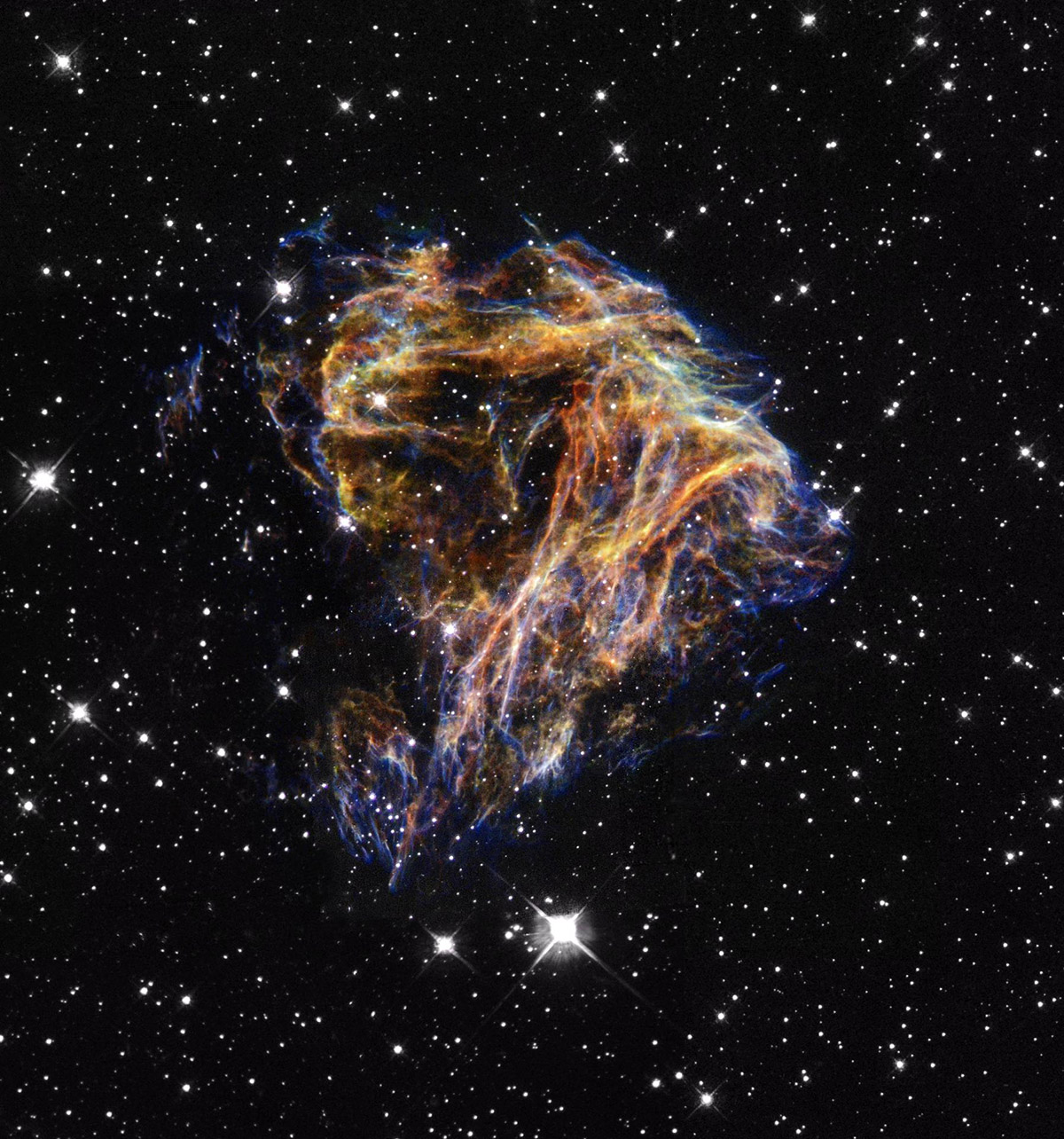
Fine, yellow and blue thread-like filaments of glowing gas spreading outward like sparks against a dark background of space.
Nicknamed ‘Celestial Fireworks’, this image shows the delicate filaments of debris left behind by a supernova in the Large Magellanic Cloud – a dwarf galaxy orbiting the Milky Way. The glowing strands of gas are expanding debris from the stellar explosion, resembling sparks frozen in space. By studying these intricate structures, astronomers can trace how exploding stars disperse their material and enrich the surrounding galaxy. - Photo Credit: NASA/JPL/Hubble Heritage Team STScI/AURA

Nicknamed ‘Celestial Fireworks’, this image shows the delicate filaments of debris left behind by a supernova in the Large Magellanic Cloud – a dwarf galaxy orbiting the Milky Way.

The glowing strands of gas are expanding debris from the stellar explosion, resembling sparks frozen in space.

By studying these intricate structures, astronomers can trace how exploding stars disperse their material and enrich the surrounding galaxy.

15. Messier 106
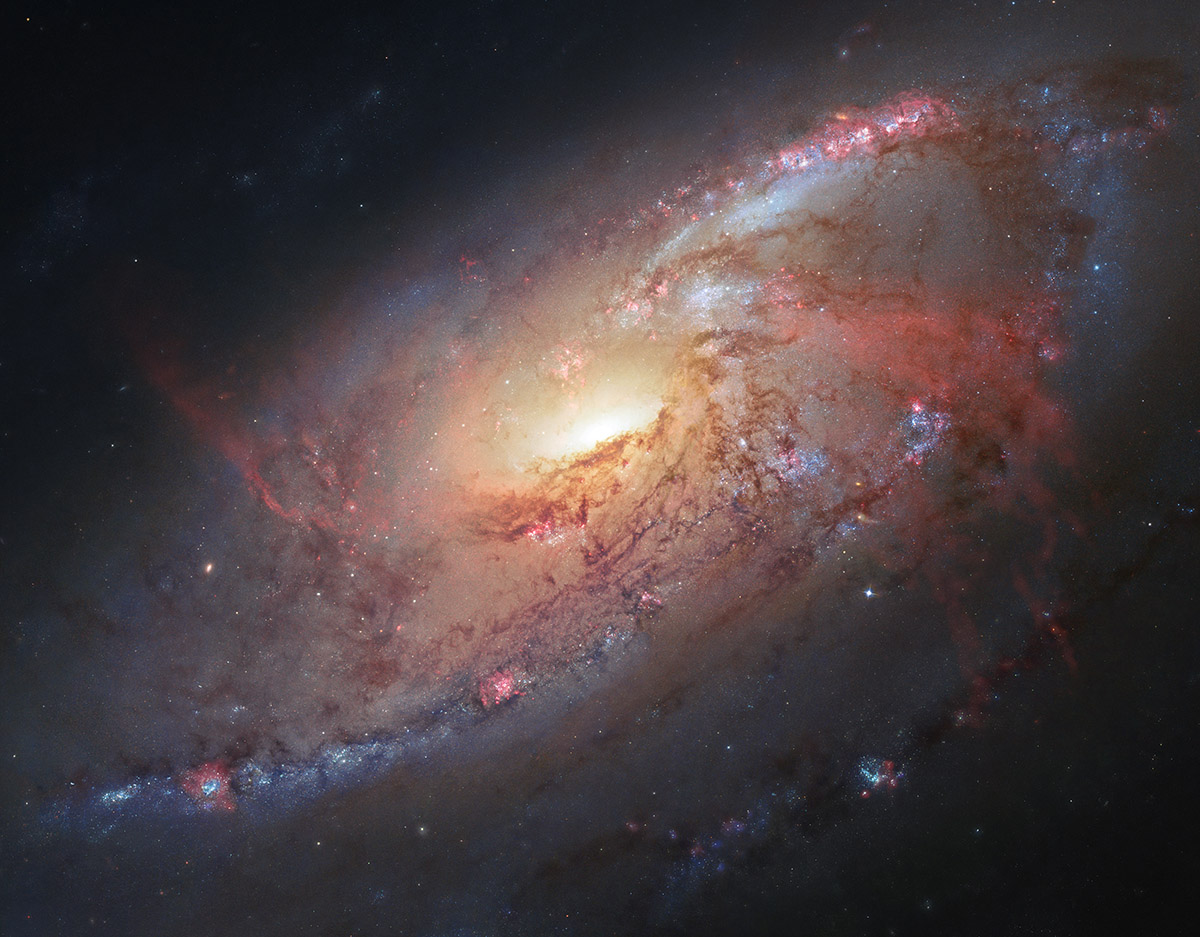
This image of Messier 106 combines Hubble observations with additional data from amateur astronomers Robert Gendler and Jay GaBan. It creates a richly detailed view of the nearby spiral galaxy, just over 20 million light‑years away, putting it among our nearest cosmic neighbours. Beyond its striking appearance, Messier 106 contains a maser – a strong source of microwave radiation – which astronomers can use to measure the distance to the galaxy with incredible accuracy. This provides a strong anchor point in the chain of measurements astronomers use to measure distances in the Universe, known as the cosmic distance ladder. - Photo Credit: NASA, ESA, the Hubble Heritage Team STScI/AURA, and R. Gendler/J. GaBany

This image of Messier 106 combines Hubble observations with additional data from amateur astronomers Robert Gendler and Jay GaBan.

It creates a richly detailed view of the nearby spiral galaxy, just over 20 million light‑years away, putting it among our nearest cosmic neighbours.

Beyond its striking appearance, Messier 106 contains a maser – a strong source of microwave radiation – which astronomers can use to measure the distance to the galaxy with incredible accuracy.

This provides a strong anchor point in the chain of measurements astronomers use to measure distances in the Universe, known as the cosmic distance ladder.


The story of Hubble
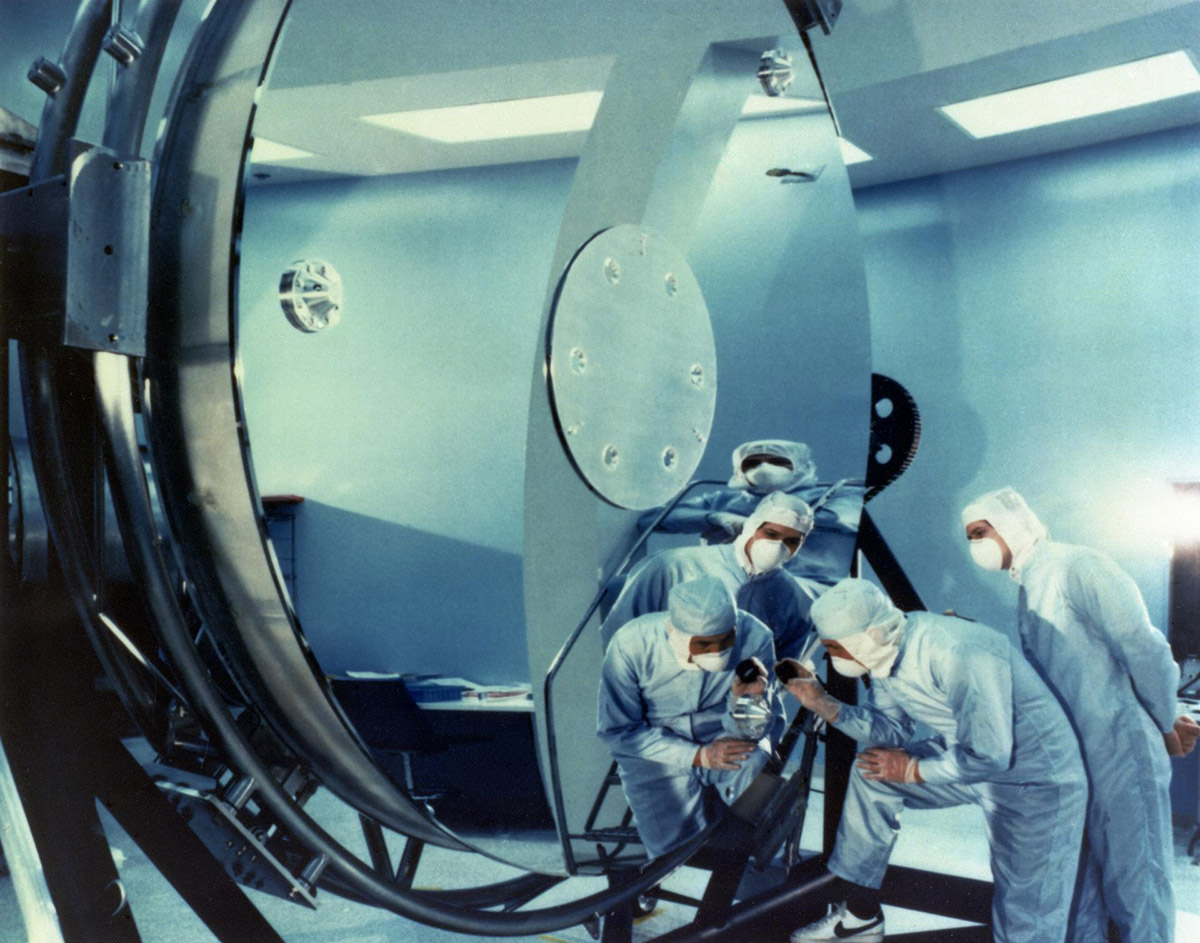
Several technicians in protective suits examining a large reflective cylindrical space instrument inside a clean room.
A joint endeavour between NASA and the European Space Agency (ESA), construction began on the Hubble Space Telescope in 1979. Its huge mirror measures 2.4m (7ft 10in) and was the largest ever put into space at the time. This large surface area means it can collect a huge amount of light, revealing things 10 billion times fainter than what the naked eye can see. - Photo Credit: NASA/MSFC

A joint endeavour between NASA and the European Space Agency (ESA), construction began on the Hubble Space Telescope in 1979.

Its huge mirror measures 2.4m (7ft 10in) and was the largest ever put into space at the time. This large surface area means it can collect a huge amount of light, revealing things 10 billion times fainter than what the naked eye can see.
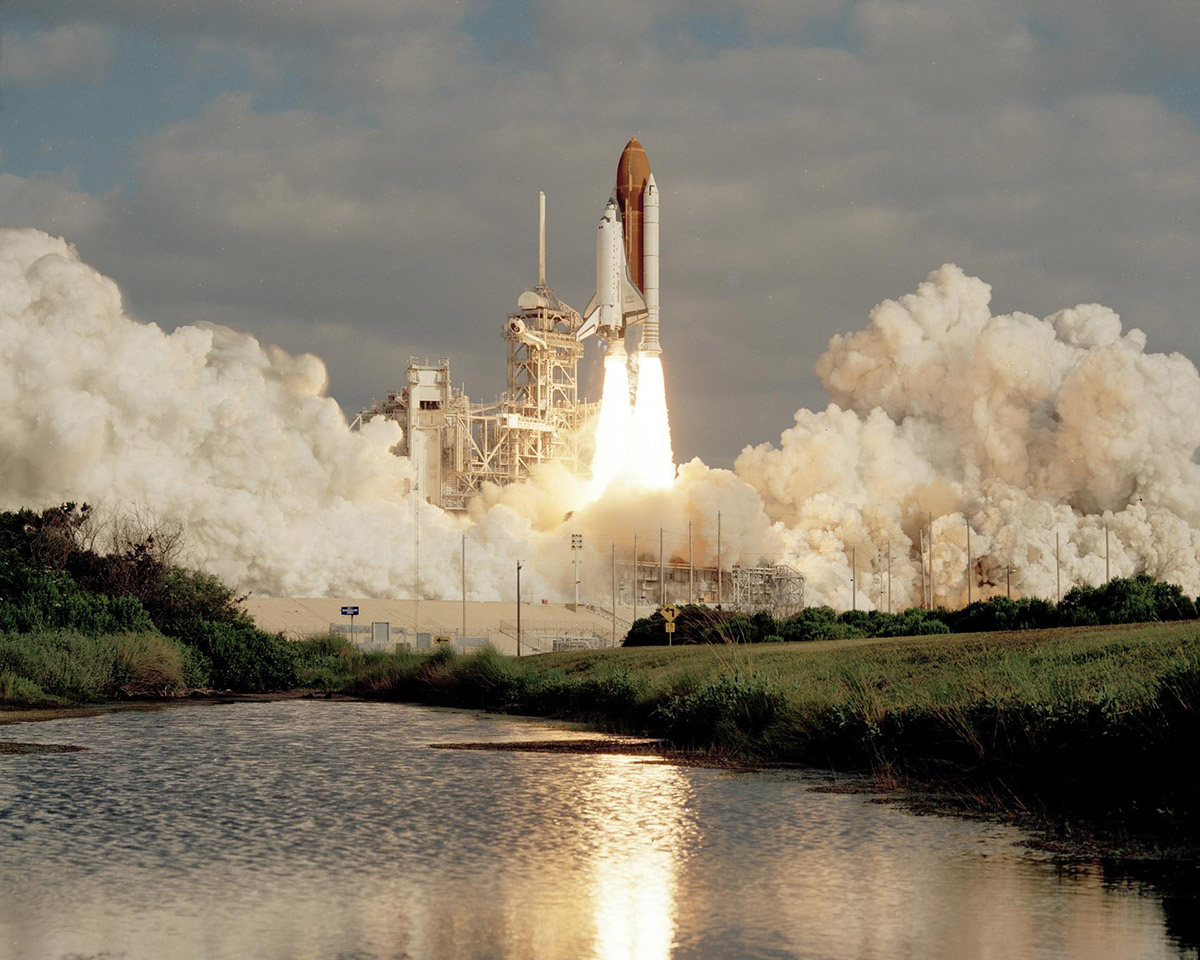
A space shuttle launches from the centre of the image, surrounded by plumes of white smoke and a river leading to the take off site from the foreground.
Hubble launched into space on 24 April 1990 on board Space Shuttle Discovery. The five crew members on board were Commander Loren Shriver, Pilot Charles Bolden and Mission Specialists Steven Hawley, Bruce McCandless II and Kathryn Sullivan. During their five-day mission, the crew deployed Hubble into orbit. It now sits roughly 500km (311 miles) above Earth’s surface, moving at 27,000km/h (17,000mph) and circles the planet every 95 minutes. - Photo Credit: NASA

Hubble launched into space on 24 April 1990 on board Space Shuttle Discovery. The five crew members on board were Commander Loren Shriver, Pilot Charles Bolden and Mission Specialists Steven Hawley, Bruce McCandless II and Kathryn Sullivan.

During their five-day mission, the crew deployed Hubble into orbit. It now sits roughly 500km (311 miles) above Earth’s surface, moving at 27,000km/h (17,000mph) and circles the planet every 95 minutes.
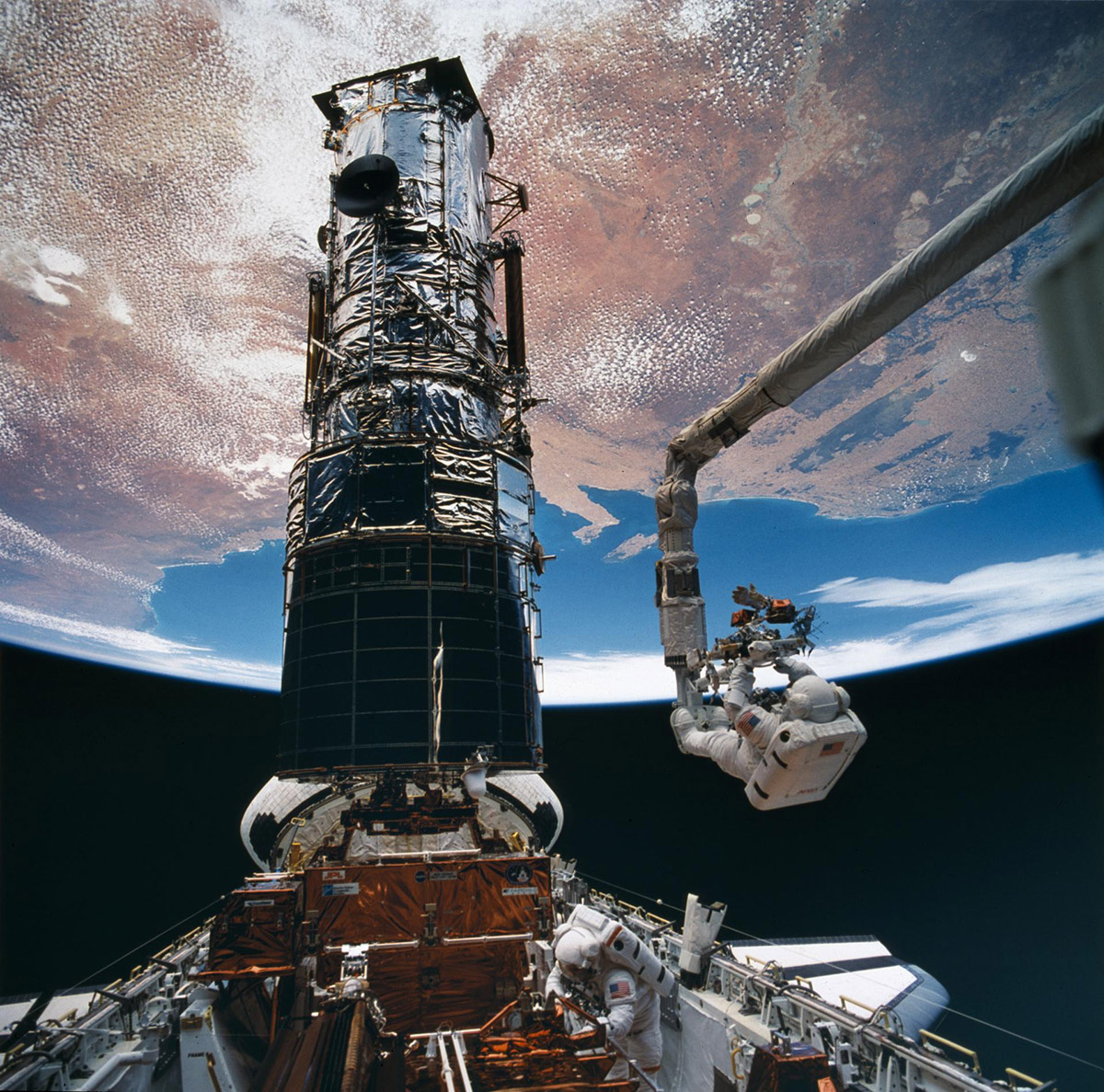
Soon after launch, it became apparent that Hubble’s images weren’t as clear as they should have been.

A problem in construction had left the mirror slightly too flat, preventing it from focusing properly. Fortunately, Hubble was designed to be upgraded and repaired. During the first Servicing Mission to the telescope in 1993, astronauts Story Musgrave and Jeffrey Hoffman installed COSTAR to correct the flaw. The modification dramatically increased the clarity of Hubble’s images, allowing it to capture some of the most incredible space images ever taken. - Photo Credit: NASA/MSFC

Soon after launch, it became apparent that Hubble’s images weren’t as clear as they should have been. A problem in construction had left the mirror slightly too flat, preventing it from focusing properly.

Fortunately, Hubble was designed to be upgraded and repaired. During the first Servicing Mission to the telescope in 1993, astronauts Story Musgrave and Jeffrey Hoffman installed COSTAR to correct the flaw.

The modification dramatically increased the clarity of Hubble’s images, allowing it to capture some of the most incredible space images ever taken.

Read more:

This website is owned and published by Our Media Ltd. www.ourmedia.co.uk
© Our Media 2026