Long before Earth formed, the Universe was awash with liquid. In the first second after the Big Bang, a scorching hot sea of light and particles filled the Universe.
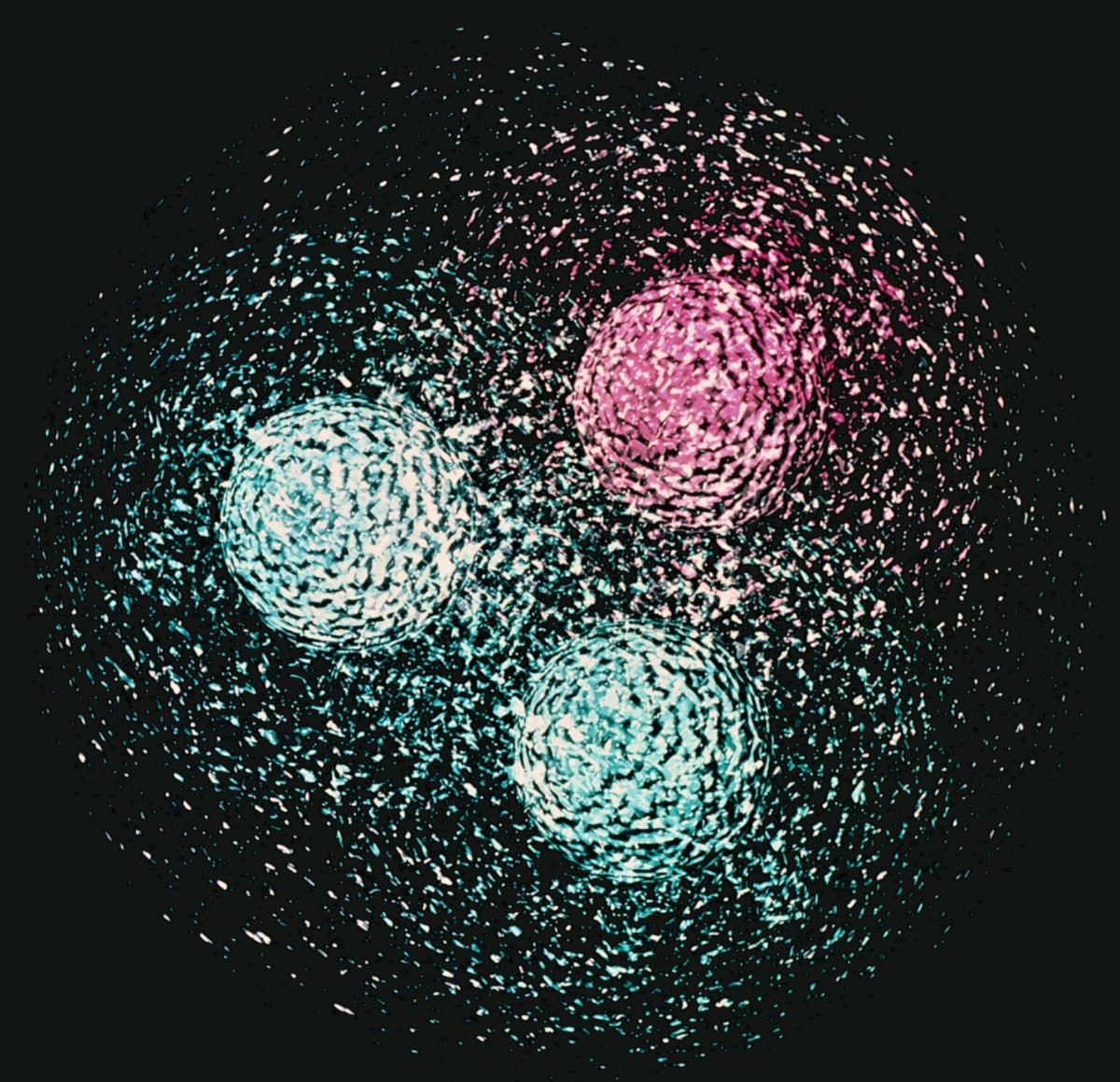
This primordial goo was made up of quarks, which are the building blocks of matter, and gluons, massless particles that bind quarks together.
Over the last two decades, scientists have managed to recreate this liquid light – known as quark-gluon plasma – and study its properties.
They’ve discovered that strong interactions between quarks and gluons meant that the plasma would have flowed like water. With low viscosity and almost no resistance to flow, this liquid was unlike any other substance known to science.
As the Universe expanded, the plasma gradually cooled, forming a hot, dense, ionised gas that scattered and trapped light for the next 370,000 years.
Within this fog, the first elements began to form, starting with the lightest: hydrogen, helium and lithium.
It would be another 10 billion years before anything we would recognise as an ocean emerged. When Earth formed, it was far too hot for liquid water to condense on the surface.
Scientists estimate that somewhere between 4.4 and 3.8 billion years ago, water vapour in the atmosphere began to condense into rainfall.
Although the surface temperature was still well above the boiling point of water at the earlier end of this estimate, the high concentration of CO2 in the atmosphere increased atmospheric pressure, allowing the first oceans to begin forming.
The debate over exactly where this water came from is ongoing.
One theory is that water was brought to Earth by icy comets and asteroids, but some scientists think it vapourised out of the rocks themselves, and both mechanisms may have contributed to the formation of Earth’s first seas.
This article is an answer to the question (asked by Roger Prasser, via email) 'What was the first ever 'sea' actually like?'
To submit your questions, email us at questions@sciencefocus.com, or message our Facebook, X, or Instagram pages (don't forget to include your name and location).
Check out our ultimate fun facts page for more mind-blowing science
Read more: