What causes Earth’s magnetic field?
Magnetic fields are generated by electric charges in motion. In a bar magnet, the moving charges are electrons orbiting in atoms. Inside Earth, they are electrons ferried around by circulating currents of molten iron.
The details are not well understood. Basically, hot material in Earth’s outer liquid iron core expands, becoming less dense than its surroundings, and therefore rises. Cooling and becoming more dense, it should sink back down again. But Earth’s rotation prevents this.
Consequently, liquid circulates around the core, and friction between its different layers charges them up – just like a plastic comb rubbing against a nylon sweater. It’s these moving charges that generate Earth’s magnetic field.
The two requirements for planetary magnetism are therefore a liquid core and rotation. We know this because Venus, though roughly Earth’s size, has essentially no magnetic field. The planet has a liquid core but rotates slowly – only once every 243 Earth days.
Why do Earth’s magnetic poles move?

Though Earth’s magnetic field is very similar to that of a bar magnet, with a north and south pole, it is not as stable because it is generated by complex processes inside Earth. These cause the magnetic poles to wander.
Historically, the North Pole has moved at about 15 km (9 miles) per year. But since the 1990s it has sped up, and now is moving at about 55 km (34 miles) per year towards Siberia. It is speculation, but this might foreshadow a ‘magnetic reversal’ in which the magnetic north and south poles change locations. This has happened 171 times in the past 71 million years – and we are overdue a flip.
Models of Earth’s magnetic field based on satellite observations have shown that the present wandering is the result of a battle between blobs of unusually intense magnetic fields deep inside the planet. As for the flipping of Earth’s poles, nobody is 100 per cent sure why this happens.
What would happen if the magnetic field disappeared?

Scientists discovered magnetic reversals by measuring the magnetic field on either side of Mid-Atlantic Ridges from which molten rock is extruded like toothpaste from a tube. As it solidifies, its crystals align along the direction of Earth’s magnetic field at the time, leaving a ‘tape recording’ of reversals.
Reversals are believed to take place over 1,000 to 10,000 years, during which time the field shrinks to zero before growing again with the opposite polarity. There were therefore times – maybe even centuries – when Earth had essentially no magnetic field.
This is dangerous for life since the planet’s magnetic field extends far into space and creates a protective bubble around Earth, shielding the planet’s surface from the hurricane of particles of the Sun’s solar wind and higher-energy cosmic ray particles from deep space.
Normally, these are safely funnelled down at the poles, creating the auroras. Without a protective field, such deadly radiation would increase the mutation rate of living cells, leading to cancers in animals. Nevertheless, life has weathered large numbers of such events before without being wiped out.
How stable is Earth’s magnetic field?
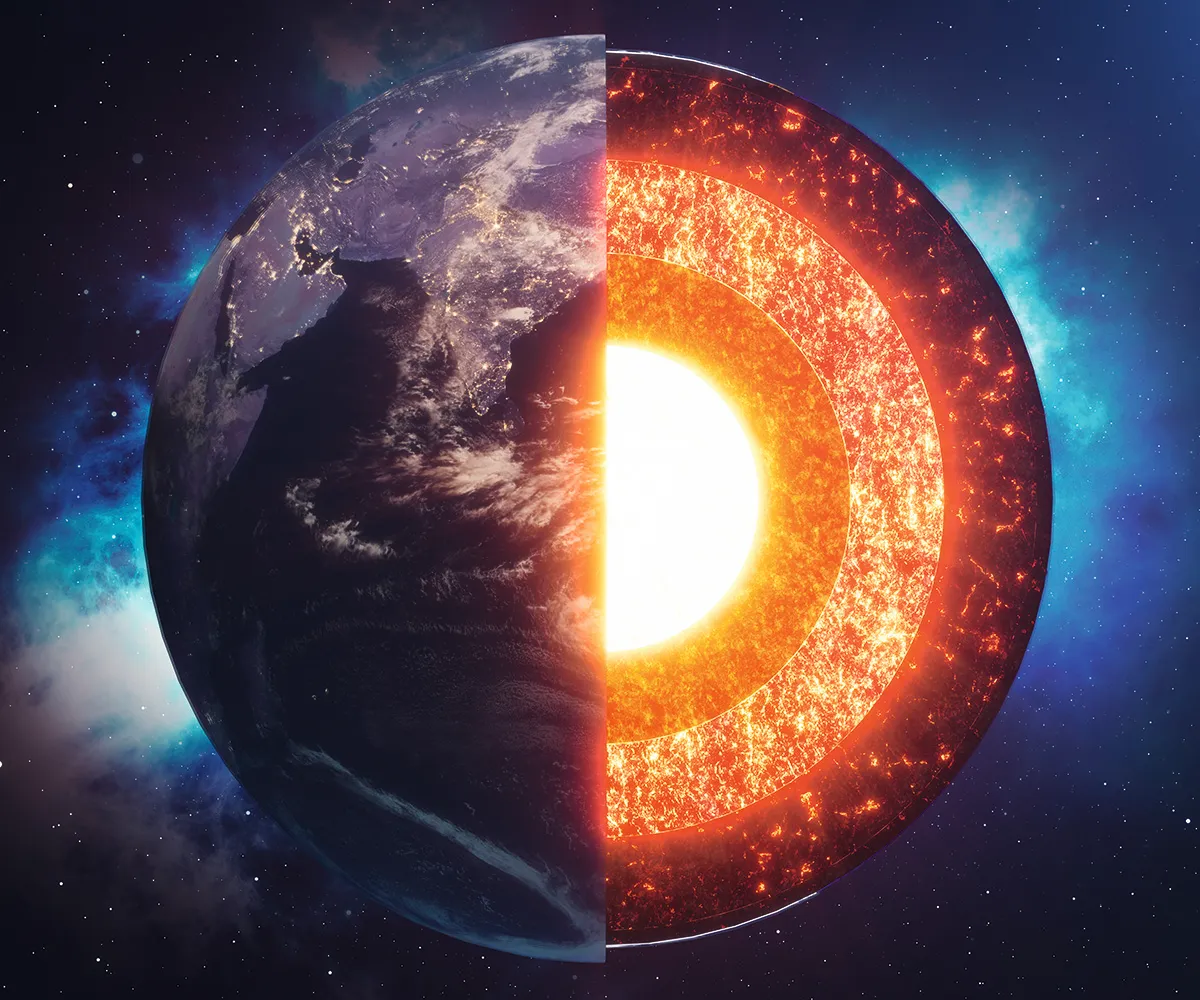
The fact that Earth’s magnetic field depends on electric currents carried by molten material circulating in the planet’s turbulent interior means it is inherently variable, as demonstrated by the present wandering of the magnetic north pole (the magnetic south pole is, surprisingly, not wandering as fast).
But what is remarkable is that the magnetic field generated by such violent internal convulsions is relatively stable 99.9 per cent of the time. It is the stability of Earth’s magnetic field, and the reliability of the protection it has provided, that has enabled life on Earth to persist for almost 3.8 billion years.
How do animals use the magnetic field to navigate?

Many creatures demonstrate remarkable feats of navigation. The suspicion has therefore arisen that they have some kind of magnetic sense, enabling them to detect the magnetic field lines between the poles. Pinpointing the mechanism, however, has proved difficult. But progress has been made by Japanese scientists investigating a process discovered many years ago.
In the 1970s, Richard Blakemore, a graduate student in the US, observed single-celled organisms streaming in a fixed direction in a muddy pond and showed they were responding to a magnetic field. Biologists later discovered that such single-celled organisms contain tiny bags of magnetic iron oxide or iron sulphide.
Now, Noboru Ikeya and Jonathan Woodward at the University of Tokyo have shown that a magnetic field causes chemical changes that can affect cellular behaviour. They achieved this with the aid of a cellular chemical that fluoresces depending on the external magnetic field. When they waved a magnet near cells, the chemical dimmed by up to 3.5 per cent.
Read more: