
It was pre-monsoon season and sweltering when Harvard University’s Prof Dan Schrag arrived in Delhi, India, to give the opening speech at a climate conference in March 2025.
The temperature was already creeping over 30ºC (86 ºF) – hot enough to feel the first swell of summer, especially in a country where, as Schrag notes, the vast majority live without air conditioning.
The previous summer, the heat in the city soared to 52ºC (126 ºF) – a temperature Schrag calls “insane”.
But what’s perhaps more insane is that these temperatures aren’t even as high as some predictions show they should be. Because, as Schrag pointed out in his speech, India’s climate trend isn’t tracking the same route as the rest of the world.
Bizarrely, recent research suggests India is actually warming slower than the global average.
Despite regularly recording temperatures around the mid-40s degrees celsius mark (110–117 ºF), its own average has shifted by less than 0.9ºC (1.62ºF) since the start of the 20th century.
Meanwhile, the overall planet has warmed by 1.4ºC (2.5ºF) in less than 50 years, since 1980.
Weird, right? The contrast is illustrated by a grainy, rainbow-coloured world map that NASA created to show how temperatures changed between 1980 and 2025. On this map, hot colours (reds and oranges) indicate temperature increases; blues and greens show decreases.
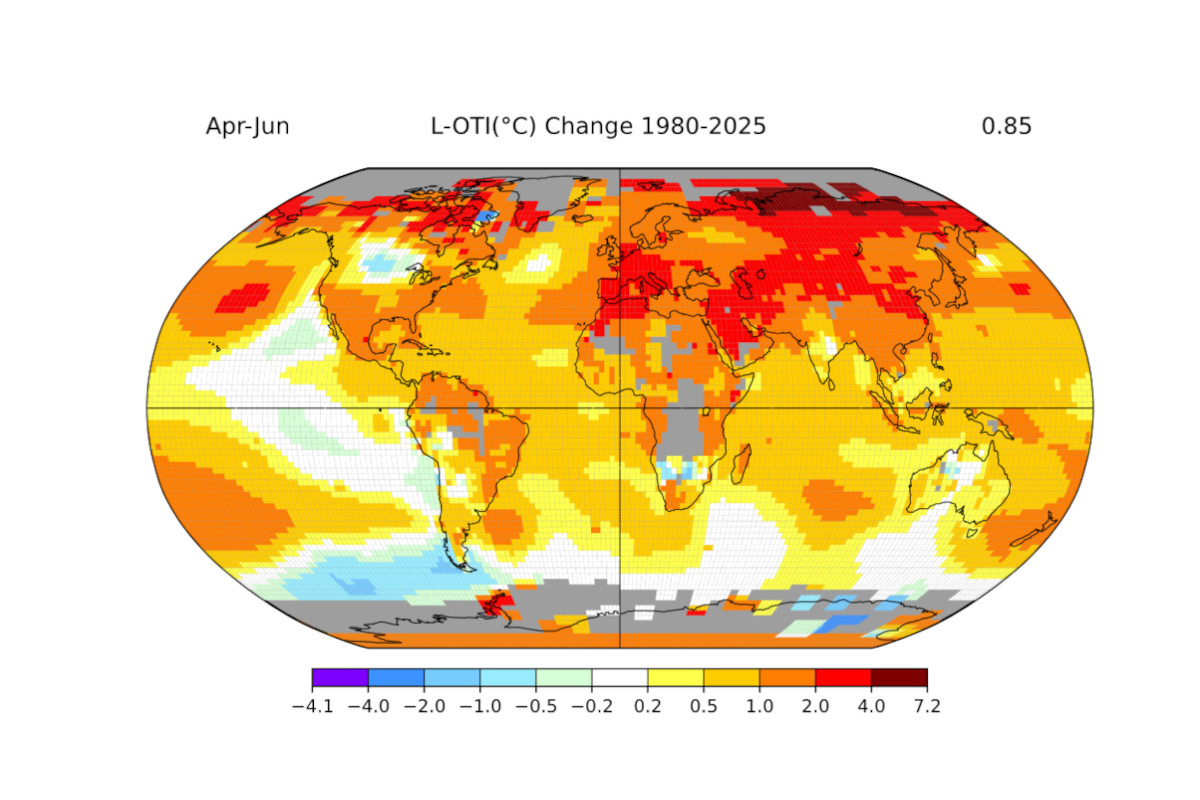
Unsurprisingly, there’s barely any blue. But while most of Europe, the Middle East and Asia are coloured deeper shades of red and orange (marking out big temperature hikes), India’s piece of the pie appears pale – a lemony yellow or white.
“You can see the much reduced, or even lack of, warming over India during this time period,” says Dr Benjamin Cook, a climate change researcher at NASA’s Goddard Institute for Space Studies and Columbia University, in the US.
The warming hole
Some experts now refer to this climate quirk as a ‘warming hole’, a phrase also adopted in a white paper recently published by Schrag’s Harvard colleagues.
The paper suggests the effect is driven largely by weak warming – and even cooling – in northern regions of the country through the dry Indian winter.
While no one knows exactly what’s causing it, there are some decent theories being batted about.
The reason it’s important, though, is this: right now, something is protecting India’s 1.5 billion people from the full force of climate change, and if that something suddenly goes away, today’s already stifling temperatures could become unsurvivable.
So, what’s behind the warming hole? Is there a good reason India is warming so slowly, or is it just a meaningless fluctuation – a mere blip in the climate data – that we can write off as ‘noise’?
Some experts have already ruled out noise as an explanation, including Cook, who says it’s “possible” but not likely. He doesn’t buy it.
Because if the phenomenon was – as some scientists have suggested – related to India’s location in the tropics, or its monsoon season, we’d be seeing it elsewhere.
“Like Southeast Asia, for example, or southern China,” Cook says. “These are other monsoonal regions in the tropics, in the same area as India, and we don’t see the same kind of warming hole.”
Which suggests there are more satisfactory explanations. And there are, in fact, several other candidates – though, for Schrag, only a couple of these are key contenders.
The first being farming, or more precisely, the vast amounts of water that farming sucks up.
Read more:
- You'll never guess which country is leading the world on sustainability
- Deadly 'fire thunderstorms' are forming across the US. And cities may be powerless to stop them
- Here's how much the richest 10% owe the planet for the environmental damage they've caused
Main suspects
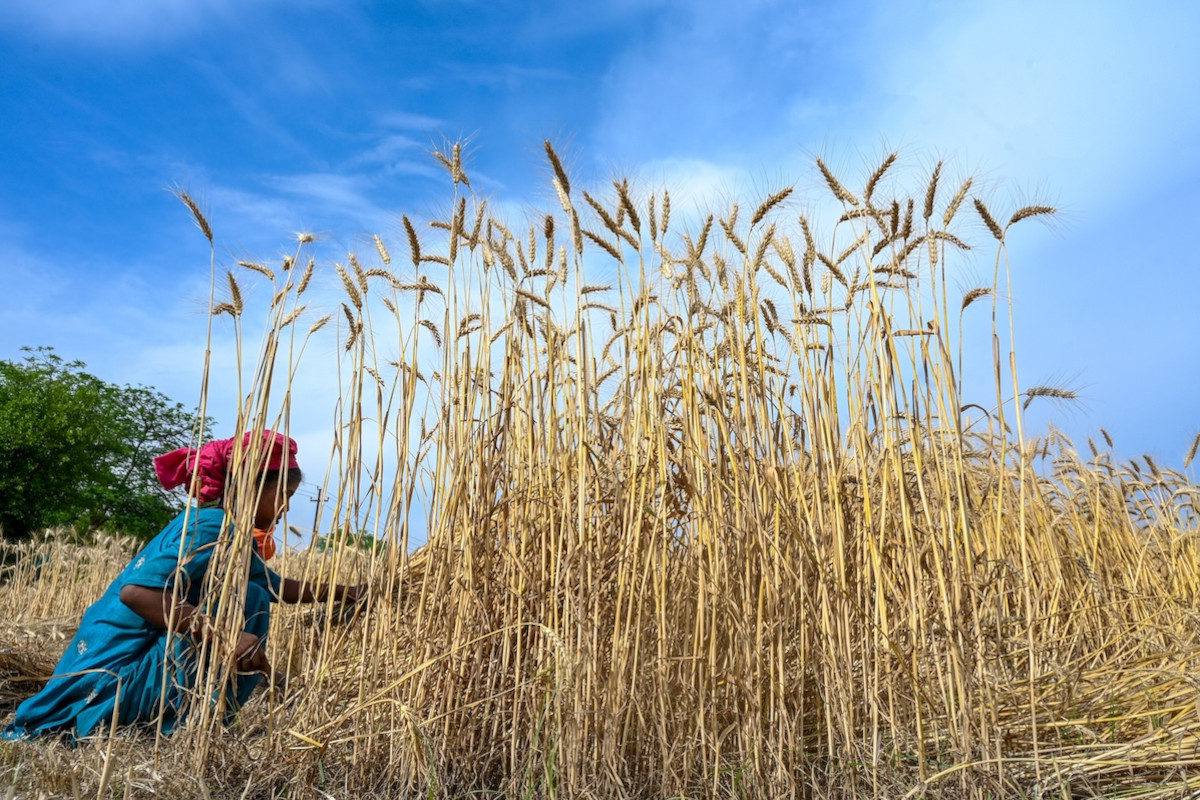
Across India, irrigation is vital to food production – especially in the rice and wheat fields dominating the agricultural landscapes of the north, sometimes referred to as India’s ‘breadbasket’.
Since the 1960s, water has been widely pumped up from underground to quench dry soils that scarcely see a drop of rainwater outside of the monsoon season.
But this groundwater extraction leads to evaporating water drawing heat off the land.
“The idea is you spread more water on the soils, more evaporation happens, air humidity goes up and it suppresses temperature increases,” explains Schrag, adding that a similar effect occurs across the ‘Corn Belt’ of America’s Midwest, where temperature data shows another large warming hole.
The second major contender is air pollution.
Aerosol-type particles from traffic, industry and other sources clog up the atmosphere – which is bad, obviously, but these particles also reflect sunlight, effectively counteracting global warming (which happens when more of the Sun’s energy, or heat, is trapped than reflected).
The upshot is that cleaning up our skies, ironically, speeds up warming. Scientists suggest this is what’s causing accelerated warming in China, which has dramatically reduced its aerosol emissions in recent years.
Together, the tempering effects of irrigation and air pollution may be greater than the sum of their parts. At least that’s what the Harvard white paper suggests, based on as yet unpublished data.
This is what Schrag thinks, too. “In my view, at least based on what we [know] now, both explanations are probably contributing to the reduced warming relative to the rest of the world,” he says.
Cook, however, is slightly more inclined towards the irrigation hypothesis.
“Part of that is because this warming hole is happening during the drier time of year,” he says. “And when the background state is dry, that’s when the impacts of adding water to the system will be most amplified.”
Unlikely candidate
So. Intensive irrigation. Air pollution. Not so weird, right? But there are other, less-fancied theories too. One recently published by Chinese researchers, for example, suggests a particularly unlikely candidate for India’s weaker warming: CO2.
Hang on, you might say, isn’t CO2 usually the main offender when it comes to global warming? Well, yes indeed. Even the authors of the study were confused.
“Yes, when we first found that result, we felt surprised,” says Dr Xia Qu from the Chinese Academy of Sciences in Beijing.
And yet their study suggests that, due to the peculiarities of India’s geography, CO2 indirectly drives a cascade of effects resulting in “intense cloud formation”. And cloud, like pollution, reflects sunlight.
It’s complicated but, essentially, more CO2 increases the temperature difference between the land and the sea, which brings in monsoon winds that drag moisture off the Arabian Sea to the west.
The moisture is then forced up and over the Himalayas, producing clouds. A lot of them.
It’s not that the warming isn’t also happening. It’s that the net effect – supposedly – is cooling.
According to Cook, the mechanism sounds plausible. “But I don’t know if it would really be sufficient enough to completely cancel out the CO2 warming effect,” he says, especially as the monsoon season is “already pretty cloudy”.
According to Qu, the effect would be less than that from pollution, but “we cannot say whether it is smaller than irrigation”.
Behind the mask
Whatever its cause, the worry about the warming hole is that it suggests India’s ‘real’ temperature is being masked by features of land management and the local atmosphere that are subject to change.
It remains to be seen whether, through its upside-down physics, CO2 can counter fiercer warming. But the bigger hitters appear to be air pollution and irrigation, and both are likely to decline in the near future.
Air pollution must come down if India is to reduce its death toll of one million a year (from aerosols alone). Meanwhile, groundwater is simply running out.
“Those effects are going to be diminished in the next 50 years,” says Schrag. “And that means from India’s perspective, they’re likely to warm faster than the rest of the world, just because they’ve suppressed it.”
In 2024 – the year the mercury hit 52⁰C (126⁰F) – at least 84 people died from heatstroke in India, probably a lot more. Scientists stress that temperatures above 40ºC (104⁰F), or 35ºC (95⁰F) if humidity is high, can be deadly.
But due to poverty, a lack of air conditioning and the need to go outside to work, Schrag says most people in India, and South Asia more generally, have no choice but to suffer the heat.
So, India finds itself fighting for survival, warming hole or not.
Read more:
