
The Moon has been an object of fascination for as long as humanity has been gazing up at the heavens. Its proximity is such that our closest celestial neighbour not only seems to dominate the night sky, but also appears to be tantalisingly close.
It’s not, though. At the closest point in its elliptical orbit, the Moon lies more than 350,000km (over 220,000 miles) from Earth. It was only truly brought within our reach in the last 60 years.
Humans have landed on the Moon six times, all during NASA’s Apollo programme, which ran from 1969 to 1972. Each of those missions was brief, lasting no more than a few days.
It has been over half a century since anyone set foot on the lunar surface. But in the next few years, that could all be about to change.
The US and China have set targets to return to the lunar surface with missions that, initially, will last days, but later, weeks, and will hopefully lead to both nations establishing permanent bases on the Moon, giving us a continuous human presence on another world.
“Nobody has ever done long-duration stays on another celestial body,” says Anastasia Prosina, a commercial space habitat consultant based in California, US and founder of the space consultancy firm Stellar Amenities.
To achieve this new milestone in space exploration, we need rockets to launch people there, landers to set them down, and habitats for them to live in.
Significant progress is being made in all three of these areas, with the first humans expected to return to the Moon by the end of the decade.
But what will these Moon bases actually look like, where will they be, and does it matter who wins the Moon base race?
Touching down on the Moon
The first step on the road to a permanent lunar base is getting humans back on the Moon.
Both NASA and the Chinese Manned Space Agency (CMSA) have a roadmap for this – NASA is aiming for a 2028 return, while CMSA has set a target of 2030. From there, the two agencies have opted for contrasting approaches.
NASA is leaning heavily on help from commercial enterprise with its Artemis programme, particularly Jeff Bezos’s company Blue Origin and Elon Musk’s SpaceX.
“NASA is relying on commercial bodies to get them to the Moon,” says Dr Quentin Parker, an astronomy and astrophysics professor at the University of Hong Kong. “China isn’t. It’s using its national launch capacities.”
In April 2026, four astronauts flew around the Moon on the Artemis II mission. They travelled in NASA’s Orion spacecraft, launched on the mighty Space Launch System (SLS) rocket.
In 2027, the Artemis III mission will see another four astronauts launch into Earth orbit and practise docking with two commercial lunar landers being developed by Jeff Bezos’s Blue Origin and Elon Musk’s SpaceX: Blue Moon and Starship Human Landing System, respectively.
If all goes according to plan, the next mission in the programme, Artemis IV, might see two astronauts use one of the landers to touch down on the Moon in 2028.
It would be humanity’s first return to the lunar surface since Apollo 17 left it in December 1972.
China has opted for a different path. Its astronauts will be taken to the Moon in a Mengzhou capsule (a spacecraft of similar size to NASA’s Orion) launched aboard a giant Long March 10 rocket (currently under development).
The plan is for China’s astronauts to travel to low lunar orbit aboard Mengzhou. Once there, they’ll rendezvous with Lanyue, CMSA’s lunar lander, which will have launched aboard a separate Long March 10 rocket and travelled there autonomously.
The astronauts will transfer from Mengzhou to Lanyue before descending to the surface.
“Everything is going well” with the development of the rocket so far, says Parker, who remarks that China has been quite open about its plans for the Moon.
“[China’s] not as secretive as it used to be,” he says. “That’s off the back of a strong track record over the last few years of ongoing success.”
Read more:
- 6 mind-blowing space missions now set to launch after Artemis II
- 22 mind-blowing facts about NASA's Artemis II Moon mission
Building permanent Moon bases
Getting there is likely to be the easy part, though.
“The Moon is a challenging environment,” says Dr George Sowers, a professor of aerospace engineering at the Colorado School of Mines.
The lighting conditions are hard for a start, he says, noting a lunar day lasts 29.5 Earth days (meaning the surface is bathed in continuous sunlight for around 14 days, before being plunged into darkness for the following 14 days).
Surface temperatures can also swing wildly by hundreds of degrees, and harsh mountainous terrain awaits any future astronauts.
Early excursions by the US and China will be relatively basic. Each nation’s astronauts will land on the Moon, stay for a few days, and then return to lunar orbit before travelling back to Earth.
As the missions progress, however, they’ll get more complex, culminating in longer-duration stays on the lunar surface and eventually permanent bases.
For the first Artemis landing, NASA plans to include a rover, which astronauts will be able to use to travel longer distances across the surface.
Subsequent non-human landings will then dispatch equipment such as habitats, which astronauts will be able to live and work in, while on the Moon.
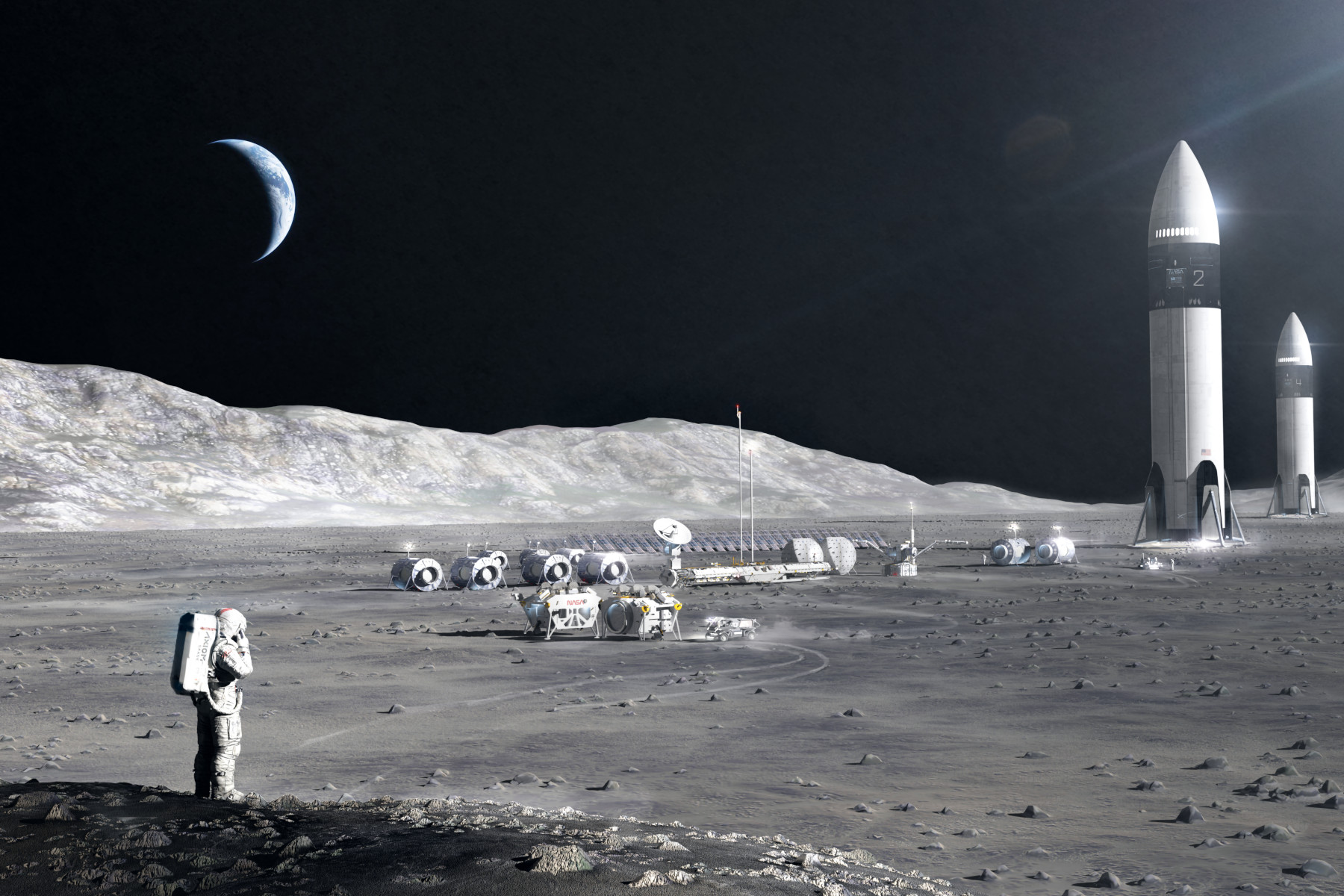
These habitats are still being designed, but might look quite similar to the cylindrical modules seen on the International Space Station.
They will be placed on the surface and possibly buried in lunar dust, or even hidden in caves underground, to protect occupants from solar radiation.
Designing habitats for the Moon is quite different from designing orbital space stations, though, says Prosina.
For one thing, in the weightless environment of Earth orbit, the direction of ‘up’ doesn’t matter so much.
“There are no walls or floors, just surfaces,” says Prosina. “The table and equipment can be positioned anywhere.”
On the Moon, however, it’s a different story. Even though the Moon only has one-sixth of Earth’s gravity, habitats will be more akin to the homes and laboratories on our planet.
China’s Moon base will be called the International Lunar Research Station. It’s being designed with a number of international partners, including Russia, and will be located at the Moon’s South Pole – the same destination as NASA’s intended Moon base.
“[China is] looking at full construction between 2030 and 2035,” says Parker. Like NASA’s Moon base, it will have a mixture of habitats scattered on the surface.
Both the US and China are developing nuclear fission reactors to supply their lunar sites with power, as well as autonomous rovers and other machinery to help build and operate their bases.
NASA is also planning to build landing pads where incoming rockets can touch down and take off without kicking up huge amounts of Moon dust, which can be sharp and dangerous to hardware and humans if they inhale it.
“It’s going to be a constant headache,” says Sowers.
At first, NASA’s Moon base will resemble something of a “junkyard”, the head of NASA, Jared Isaacman, told The New York Times in February 2026. It will be a loose collection of apparatus spread over the lunar surface.
Eventually, however, the site may begin to resemble the sleek Moon bases of science fiction.
This could include more advanced habitats, but also specially designed large-scale 3D printers, which can mix lunar dust with a small amount of plastic glue to make a variety of equipment, including bricks for building new habitats.
One company that’s set on demonstrating this technology soon is GRU Space, the California-based start-up that recently made headlines by announcing its plans to become the first to build a lunar hotel.
“We have a contract to land on the Moon as early as next year and make the world’s first bricks [there],” says Skyler Chan, the company’s founder and CEO.
He plans to launch a shoebox-sized piece of equipment on an upcoming mission to test the 3D-printing brick-making process.
If it works, GRU Space’s equipment could be scaled up and used to make bricks for “any structure essentially”, Chan says, from roads to warehouses. “Our mission is to build habitats, build cities, build structures for people to live in.”
China has also spoken about using lunar dust to make bricks to build its Moon bases.
There remain plenty of uncertainties in constructing Moon bases, however, says Jeff Nosanov, a space industry expert and former NASA proposal manager.
“There are still major unknowns that aren’t going to be resolved in the next few years – how we land large payloads on the Moon, for example,” he says. “That’s really the biggest obstacle. It’s like the space station, but a million times harder.”
The South Pole situation
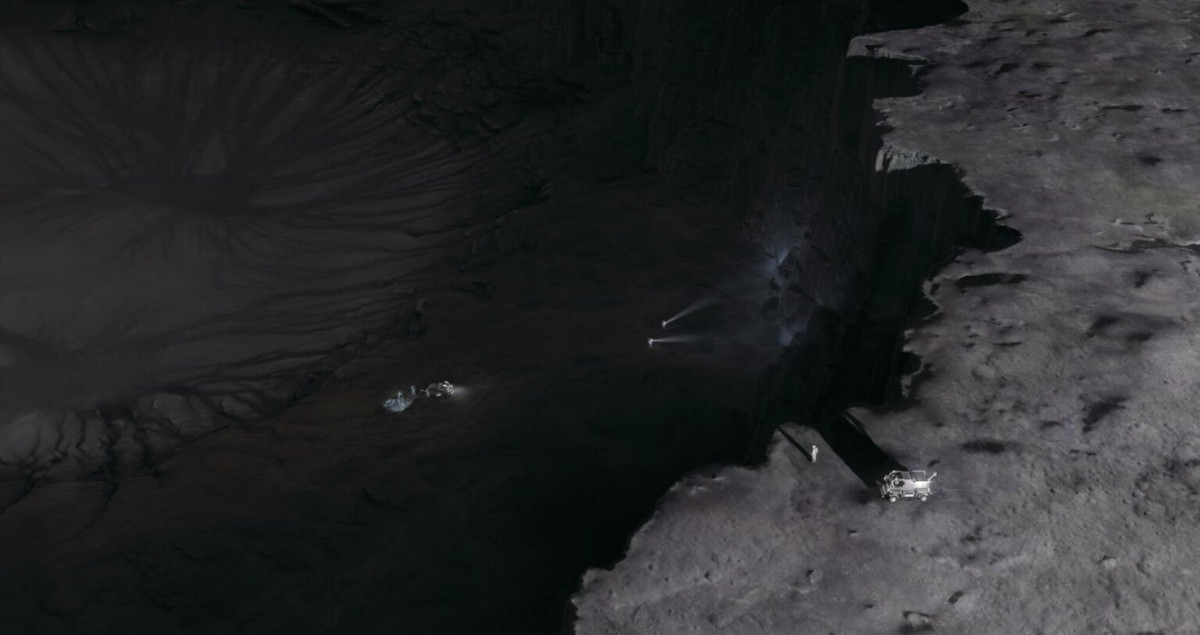
Both the US and China plan to build their bases at the Moon’s South Pole. Scientists think there is a vast amount of water there, trapped as ice inside pitch-black craters, and it could be an invaluable resource.
The Moon orbits Earth at a slight angle, tilted in such a way that some of the craters at its poles never see sunlight. They’re known as permanently shadowed regions (PSRs), or more radically, “craters of eternal darkness”.
Temperatures drop to near absolute zero (–273°C/–459°F) inside these PSRs, so they could be prime locations for ice to have built up and stayed stable over billions of years.
“The most important thing in this endeavour is finding the water,” explains Prosina. Both the US and China agree – they plan to send vehicles into these craters as soon as possible.
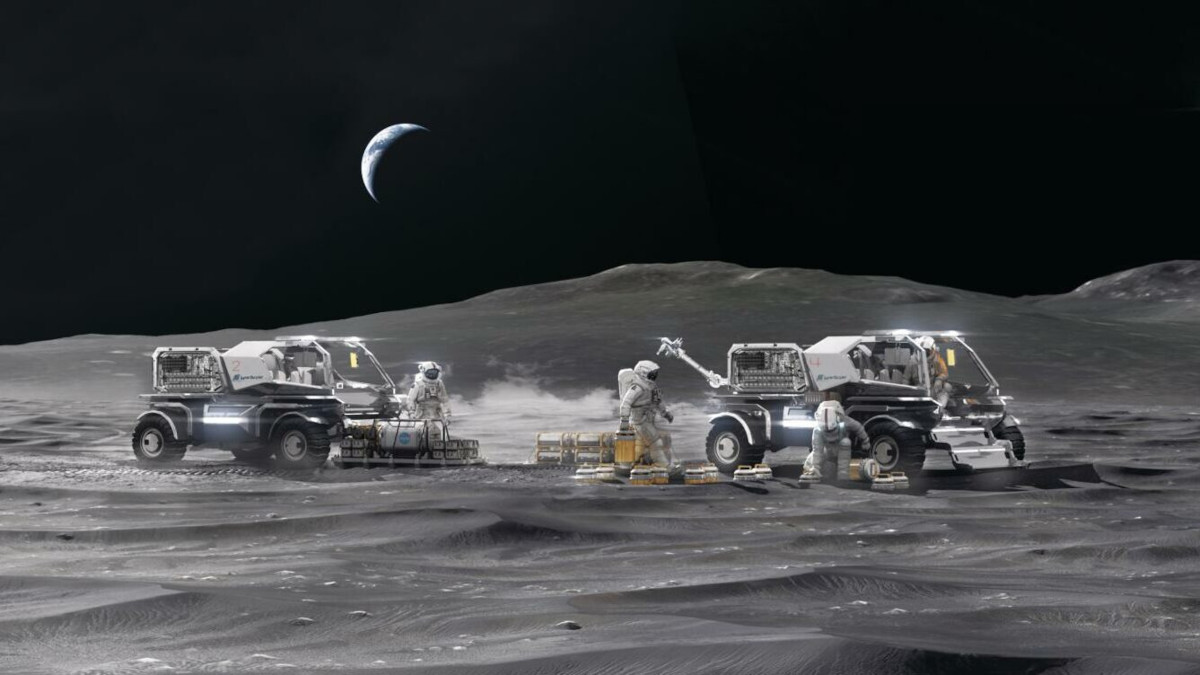
On the American side, the Volatiles Investigating Polar Exploration Rover (VIPER) will drive into one or more PSRs when it lands on the Moon in 2027.
China, meanwhile, plans on using a ‘hopper’ drone that will use thrusters to hop across the surface and drop into the craters.
One of these hopper drones was due to depart for the Moon in late August 2026 as part of China’s Chang’e-7 mission. Once there, it begins its search for ice by leaping into the 12km-wide (13 miles) Shackleton Crater.
If ice can be found, the next step will be to figure out how to collect it. One possibility is to cover a section inside a PSR with a large tent approximately the size of an Olympic swimming pool, explains Sowers, and then heat up the ground.
“The ice is mixed in with the lunar soil probably in the form of grains,” he says. Releasing this water is “conceptually very easy”, requiring temperatures of only –70°C (–94°F).
“Then the ice will sublimate – turn into vapour. You just have to have the ability to capture that vapour. So either you put a tent over it and heat it where it sits, or you can dig it up and put it in an oven.”
Water is made of hydrogen and oxygen, which are also key components of rocket fuel.
By collecting the Moon’s water and splitting it apart, it could therefore be possible to develop large amounts of propellant that could be used to refuel rockets on the lunar surface.
We could reduce the cost of a mission to Mars by $12bn (£9bn approx) using rocket fuel procured from the Moon, says Sowers. “Water can be easily electrolysed into hydrogen and oxygen, and then liquefied into rocket propellant, liquid hydrogen and liquid oxygen,” he explains.
With this ability, a future is envisioned in which spacecraft use the Moon as a staging outpost, landing there to refuel before launching out further into the Solar System.
That could make human missions to destinations such as Mars much more feasible, because you wouldn’t need to launch huge amounts of fuel from Earth to make the mission possible.
There are other resources on the Moon that might also be useful: helium-3, for example – a form of helium that could be used in nuclear fusion.
China has spoken of its desire to mine helium-3 from the surface, but it’s not yet known whether this is achievable.
Read more:
- NASA reveals absolutely bonkers new Moon rover
- Here's what Trump's space strategy means for future Mars landings
The prospect of lunar conflict
A near future where the US and China operate bases in the same region of the Moon poses some interesting geopolitical questions.
The US has been outspoken about its wariness of China’s lunar ambitions, making frequent comments about the need to beat China back to the Moon and establish a base there first.
Currently, under the Outer Space Treaty of 1967, no country can lay claim to anywhere in space. The US and China could not say they own any particular lunar crater or region, for example.
The Outer Space Treaty does make provisions for ensuring that a country’s hardware on another world is protected from damage, however.
As such, the first nation to get its equipment into a lunar crater containing large amounts of readily accessible ice could, hypothetically speaking, argue that it is theirs (since any attempts by another nation to operate in that crater could damage their hardware).
That raises the stakes of establishing a lunar presence first.
“Assessment of resources is going to be crucial,” says Parker. “If the Chinese get to [a valuable crater] first, what’s left? Will the Americans try to get [there] as well?”
There might be plenty of room around the rim of such a prospective crater, or there might not. “I don’t know what they’re going to do,” says Parker.
The US and China have also been steadily signing up countries to join their respective Moon base plans.
The US has signed up more than 60 nations including the UK, France, Australia and India, while China has Russia, South Africa, Pakistan and Senegal on its smaller list of less than 20 nations. Some countries have signed up to both plans, including Thailand and the UAE.
It’s unlikely there will be any sort of open conflict on the Moon as each country builds its bases, but there are unanswered regulatory questions.
What if a Chinese mission accidentally landed near a US lunar base, for example, or vice versa? What if they both landed at a valuable location at the same time?
These questions will become increasingly important in the coming years as this Moon race ramps up. But perhaps there is another possibility: that the US and China will put aside their differences and decide to cooperate, instead of compete.
Whatever the future may hold, it is clear that the new Moon race has very much begun. In the coming years, we will likely see humans return to the Moon.
How much appetite there will then be to build permanent lunar bases beyond those initial sorties remains to be seen, but the plans to do so are already materialising quickly.
With the International Space Station also set to be retired around 2031 after more than 30 years of operation, it might well be that the future of humanity in space takes another giant leap forward.
We could go from inhabiting space stations in orbit around Earth to performing research and mining for resources on the surface of the Moon.
Read more:
