
The two latest social media trends for getting the best night’s sleep seem to be diametrically opposed.
One is sleepmaxxing. It’s popular on TikTok and involves various approaches to help you get longer, better and more restorative sleep. These include mouth taping (to encourage nasal breathing), listening to white noise and using weighted blankets.
The other is sleep training, which aims to reduce the amount of sleep you need, so you can maximise productivity through the day. It’s promoted by fitness influencers advocating six hours, with some sleeping for as little as three.
Both are examples of biohacking – attempts to adjust our biology to help us meet the demands of modern life. But can either of them actually help?
Is more sleep better?
Social media is packed with sleep influencers offering all sorts of sleepmaxxing advice. But experts from Harvard Medical School say much of it is overhyped with little evidence.
Dr Tom Chambers, a European Sleep Research Society-certified somnologist, is one of them.
“‘Sleepmaxxing’ is not yet [and may never be] a recognised treatment or advice in the sleep medicine world. If you look for any terms related to it in [the literature] you’ll find nothing,” he says.
What’s more, some experts are concerned it could lead some people to develop an anxious preoccupation with achieving ‘perfect’ sleep (a condition called orthosomnia, which is usually driven by data from wearable sleep trackers or smartwatches).
The most invasive sleepmaxxing technique is nocturnal mouth taping. It relies on porous tape to keep the mouth closed and, according to the influencers promoting it, promises to prevent snoring (which one review of the available evidence tentatively supports) as well as increase energy and improve dental health.
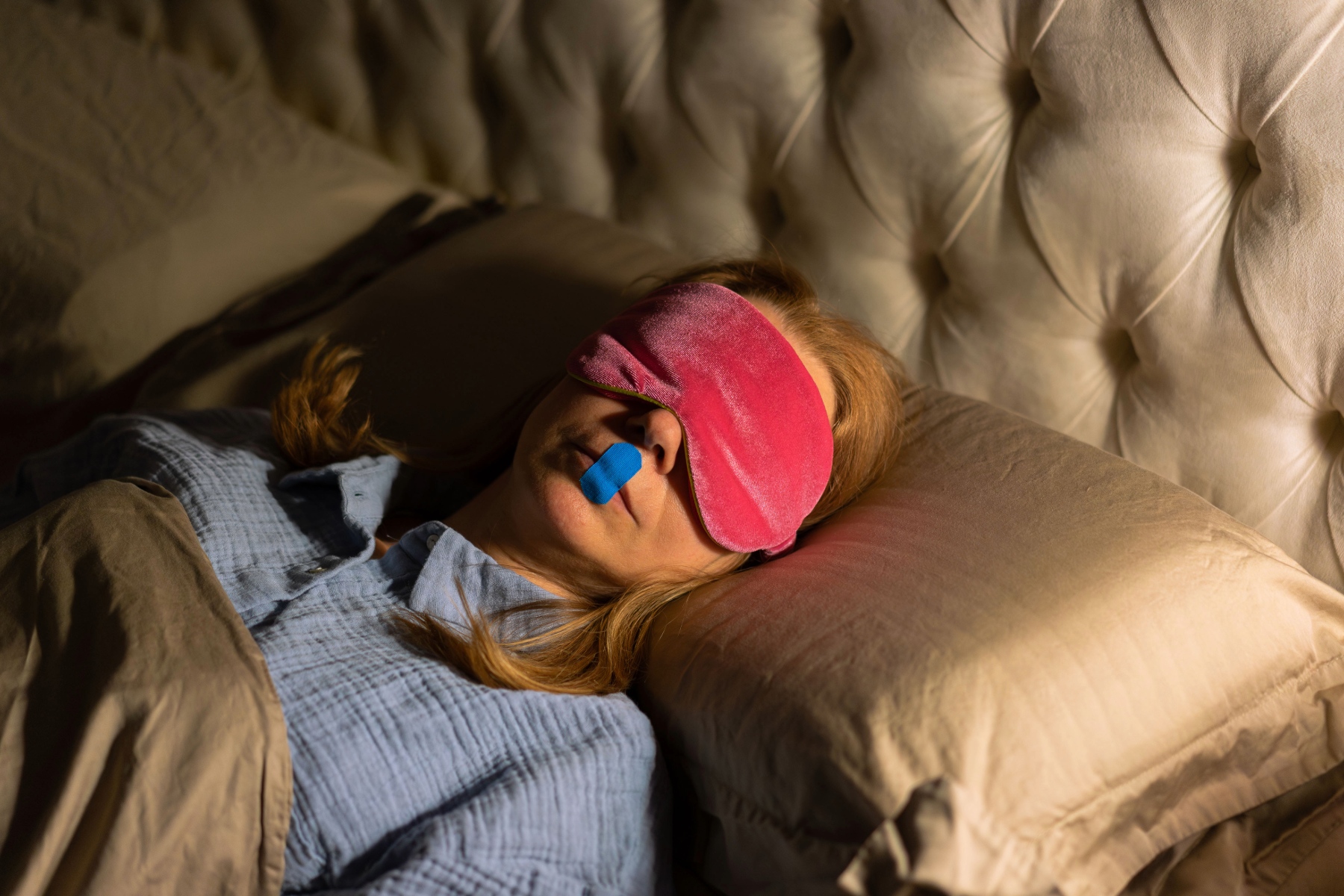
Dr Anna Joyce, a psychologist and sleep therapist at Regent’s University London, says it’s sensible to breathe through your nose generally, but forcing it through mouth taping removes your ability to switch if your nasal airway gets blocked during sleep.
“Mouth taping isn’t right for everyone, such as people with nasal congestion, a deviated septum or allergies. If someone can’t breathe easily through their nose, and they’re taping their mouth shut, they could be doing more damage,” she explains.
“If they’ve got sleep apnoea, they’re blocking one of their airways. It can be dangerous if people are drunk or unwell and vomit in the night.”
White noise is another tip and is thought to work by masking disruptive environmental sound and raising the threshold needed to wake someone up.
According to Paul Hough, Lecturer in Sport and Exercise Physiology at the University of Westminster, the evidence is strongest for masking disruptive noise in noisy settings such as hospital wards rather than regular bedrooms, and for helping infants settle.
Read more:
- How some people sleep only four hours a night and still feel great
- The mysteries of sleep: everything we don't know about why we snooze
- How to become a morning person, according to science
It’s a similar case with weighted blankets, which are thought to have a calming effect on the nervous system. They’ve been described as potentially a “promising tool for sleep interventions” among people with sleep disorders in clinical settings, but precisely what effect they have is unknown. Experts say more research is needed.
Other instructions are much more sensible and fit into the usual sleep hygiene advice given by experts. These include having a cool, dark bedroom, showering one hour before bedtime, eliminating caffeine in the evening, reducing alcohol and getting 30 minutes of morning sunlight every day.
“Prioritising your sleep, developing good sleep habits and maintaining a consistent wind-down routine are all sensible ideas. Thinking that eating kiwis before bed will fix your insomnia is probably less sensible,” Chambers says.
Ultimately, forcing the brain to extend sleep unnecessarily won’t work.
Joyce says sleep is like pizza dough. “If you stretch it, it just becomes thinner and eventually has holes in it. If you try to sleep for nine hours and you only need seven, you’ll end up with lighter sleep, waking during the night, or have difficulty getting to sleep the next night.”
Can I get by on less sleep?
Sleep training is the opposite of sleepmaxxing. It involves reducing the number of hours you sleep, typically down to six hours a night, but some influencers claim to sleep for as little as three.
The technique has its roots in the fact that a minority of people are ‘natural’ short sleepers – they have a genetic mutation that enables them to get by on a few hours’ sleep.
The most recently discovered SIK3 variant joins others such as DEC2, ADRB1, NPSR1, and GRM1. They’re thought to be very rare, however, found in maybe one to three per cent of the population.
David Ray, a professor of endocrinology at the University of Oxford, explains that there’s an understandable imperative to want to reduce sleep time.
“Sleep imposes great risks to organisms because it leaves them vulnerable. Sperm whales have developed hemispheric sleep, so only half the brain is asleep at a time, to prevent drowning,” he explains.
“Large predators, for example lions and tigers in captivity, sleep up to 17 hours per 24 hours, whereas in the wild they don’t sleep anything like as much as that, so there’s some evidence that sleep requirements are subject to external factors.”
But can those of us without the genetic mutation train ourselves to need less sleep and still function? Prof Russell G Foster, chair of Circadian Neuroscience at the University of Oxford, says it’s a firm “no”.
“Sleep varies enormously between individuals, with societal, environmental and genetic interactions,” he says. “Your biology, to a large degree, dictates how much sleep you need. You can reduce it, or squeeze more into an overpacked day, but doing so comes at a cost.”
Some people, such as shift workers, attempt to override the biological prerogative of sleep by activating the stress axis, which throws more glucose into the circulation.
“This can increase alertness and the ‘fight or flight’ response, but it’s a bit like the gears of a car,” Foster says.
“If you shift into first gear, you can accelerate away, and that’s fantastic. But, if you leave the engine in first gear, you’re going to destroy it.”
He says 97 per cent of night-shift workers never fully adapt to the demands of working at night, leading to cognitive changes, lack of empathy, failure to interact with others appropriately and memory problems.
“In some sectors the divorce rate is six times higher in night-shift workers than it is in day-shift workers,” he says.
During sleep, your glymphatic system kicks in to get rid of toxins that have built up during the day. Toxins like beta amyloid, which predispose people to Alzheimer’s. Data show that poor sleep during middle age is a risk factor for dementia in later years.
Foster accepts that the DEC2 gene, which represses the release of orexin (a neuropeptide produced in the hypothalamus that regulates arousal, wakefulness and appetite), is important. But it’s unclear what impact the mutation has not only on sleep long term, but also on other bodily functions.
What researchers do know is that a tired brain craves calories, predisposing its owners to type 2 diabetes, metabolic abnormalities and cardiovascular disease.
Prof Marie-Pierre St Onge, the Director of the Center of Excellence for Sleep and Circadian Research at Columbia University New York, and colleagues have studied people with genetic predispositions for short sleep and found they had a higher risk of obesity and type 2 diabetes, as well as greater increases in weight and insulin over time.
“What was interesting from our analysis is that when we added actual sleep obtained, the association based on genetic risk was no longer there,” she says.
“So, how much you sleep is more important than your genetic predisposition for short sleep.”
What we really need
Received wisdom says that most of us should be aiming for seven to nine hours of sleep, with younger adults at the higher end and older adults at the lower end. But this is an average, not a standard. The National Sleep Foundation has said that the healthy sleep range is between six and 10.5, maybe even 11, hours.
Extremes appear to be the enemy here. A meta-analysis in 2010 found “an unambiguous and consistent pattern of increased risk of dying on either end of the distribution of sleep duration.”
A more recent study from 2023 found that sleep regularity is a stronger predictor of mortality risk than sleep duration.
Colin Espie, Professor of Sleep Medicine at the University of Oxford, says, “The simple truth is, you can’t outperform nature. Sleep is nature’s medicine, to be taken at your own personally required dosage.”
Read more:
