
Look at the Universe around us and you'll see a cosmos full of matter – planets, stars, galaxies, giant clouds of dust. There's matter everywhere.
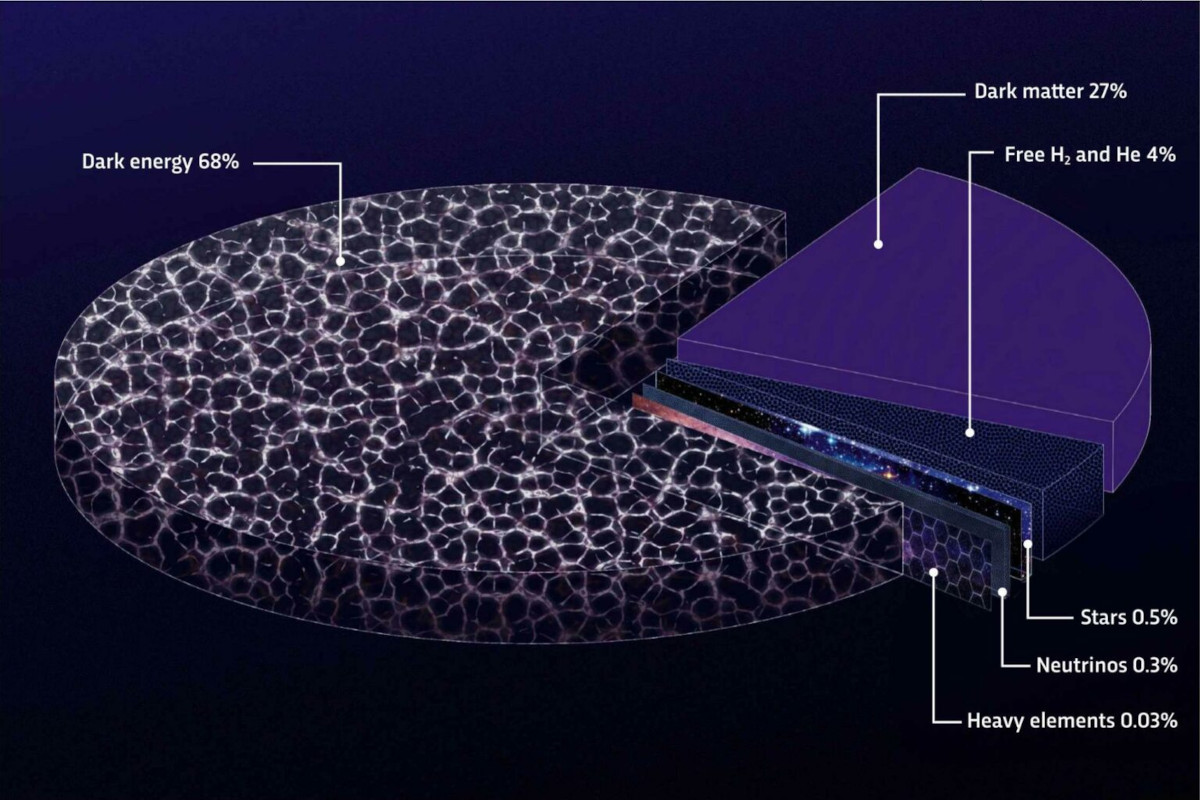
And yet, cosmologists know that all of it, taken together, makes up just five per cent of everything in the Universe.
The rest – 95 per cent of all that exists – consists of dark matter and dark energy.
Cosmologists have been studying both for decades, but since neither can be seen nor directly detected, they’re stuck with more questions than answers.
And it’s leading some of them to think an almost heretical thought: that maybe dark matter and dark energy don’t exist after all.
A century of searching
There have always been doubters when it came to the utility of dark matter as a concept.
Dark matter is a theoretical substance that we’ve never seen directly, as it doesn’t interact with light. It was first suggested in the 1930s, after astronomers noticed that galaxies were rotating so fast that they should be flinging themselves apart.
But the fact that they weren’t, indicated there must be something holding them together. And there had to be a lot of it because this invisible ‘dark’ mass had enough gravity to keep entire galaxies in one piece.
Since then, cosmologists have found signs of dark matter’s gravity shaping the Universe in all kinds of different ways.
Most think it’s probably made up of some currently unknown particle, but even after nearly a century of searching for it, we’re still not much closer to identifying a candidate.
While theories surrounding dark matter’s effects do match up well with observations, the inability to identify it has left many wondering if it actually exists. But if not, what else could be causing these effects?
Some have suggested that it’s our view of gravity that’s incorrect and that perhaps it might vary in strength relative to the acceleration of an object.
This approach, known as modified Newtonian dynamics, or MOND, has been around for decades, but remains a fringe idea among cosmologists, the majority of whom favour dark matter.
That’s partly because the unmodified theories of gravity developed by Newton and Einstein do such an exceptional job of describing the Universe and making accurate predictions about it.
The theory of gravity is elegant and pleasing, and the idea of modifying it to be less consistent seems to go against the preference for neat yet powerful explanations.
But who says that the Universe has to be pleasing or neat?
Perhaps gravity really is something that’s not as simple as we first thought. That’s the argument of the MOND camp, who say that their model fits the available data about the large-scale movement of objects, such as galaxies, better than the dark matter model.
The challenge, then, is to explain why gravity should behave one way in most scenarios at small, everyday scales, but then behave differently when we see its effects in a few instances at the very largest scales.
Even if modified gravity can explain the effects that others ascribe to dark matter, there’s still the problem of dark energy. About 30 years ago, astronomers discovered the Universe was expanding faster than they thought.
To explain this, they hypothesised dark energy, which acts as a force driving the Universe apart, though it’s still not clear exactly where this force comes from.
It has been suggested that the energy could come from the vacuum of space itself – that it’s essentially the energy of empty space.
Some astrophysicists have pioneered a concept called quintessence, which suggests that dark energy is basically a kind of inverse of normal matter – a field that can change according to the amount of ordinary matter around it.
This field could be related to both dark matter and dark energy, linking the two together. However, it has been difficult to create experimental predictions to test this idea, meaning there’s no way to verify it.
So what’s a cosmologist to do?
The dark dimension
One of the more radical approaches that has arisen recently is the idea that rather than being two separate entities, dark energy and dark matter might both be effects of the same underlying structure, known as the dark dimension.
As sci-fi as that name sounds, it is a neat fit.
The idea comes from a branch of physics known as string theory. One of the core ideas of string theory is that there are extra dimensions alongside our usual three dimensions of space (height, width and depth) and one of time.
These extra dimensions are so small that they’re essentially invisible, rolled up inside our regular dimensions.
In one of the most prominent versions of string theory, there are 10 dimensions and one of them is creating the effects we use dark matter and dark energy to explain.
To have these effects, the dark dimension would have to be much bigger than other micro dimensions – although in this context, big is relative.
“Very big, in this case, means of micron size, which is really a big number for cosmologists or for particle physics,” says Prof Dieter Lüst of the Max Planck Institute for Physics, who was part of the team that first proposed the idea of a dark dimension.
For reference, a human hair is around 50 microns in size, trillions of times larger than the sub-atomic scales that particle physics usually operates on.
What makes the idea even more appealing is that there are hints of observational evidence for it.
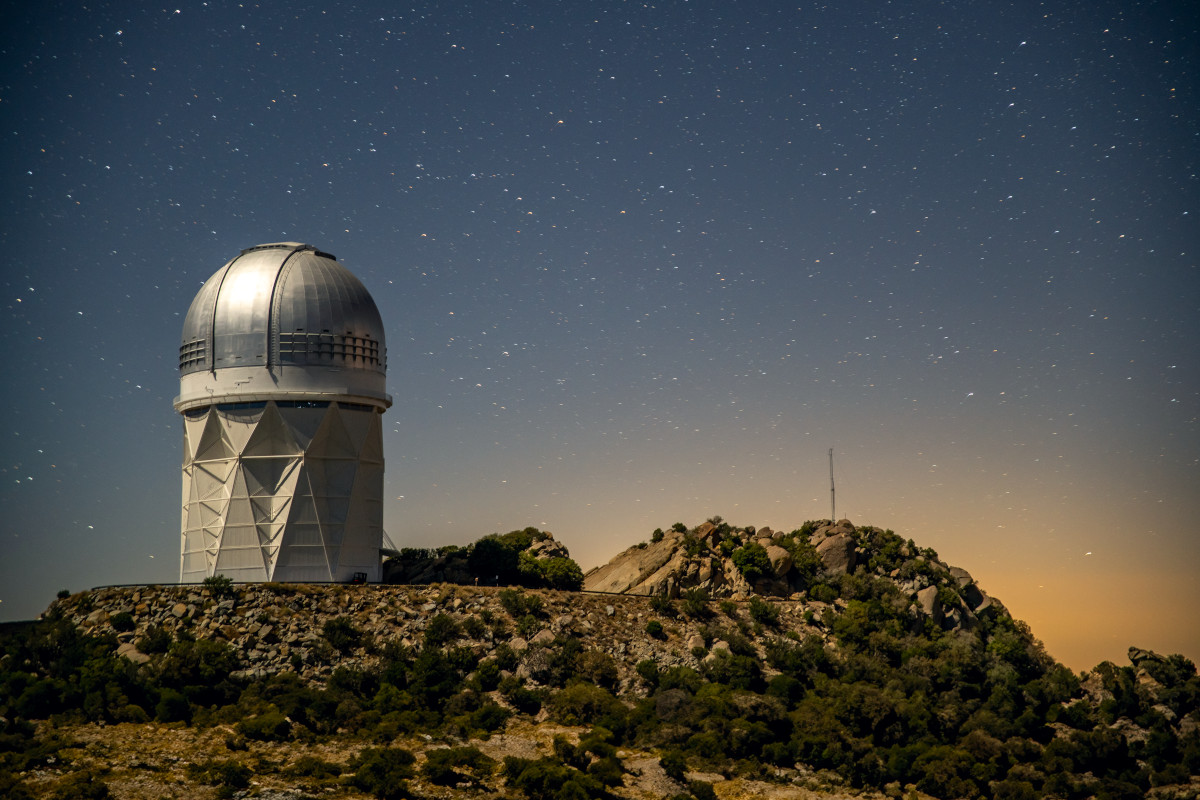
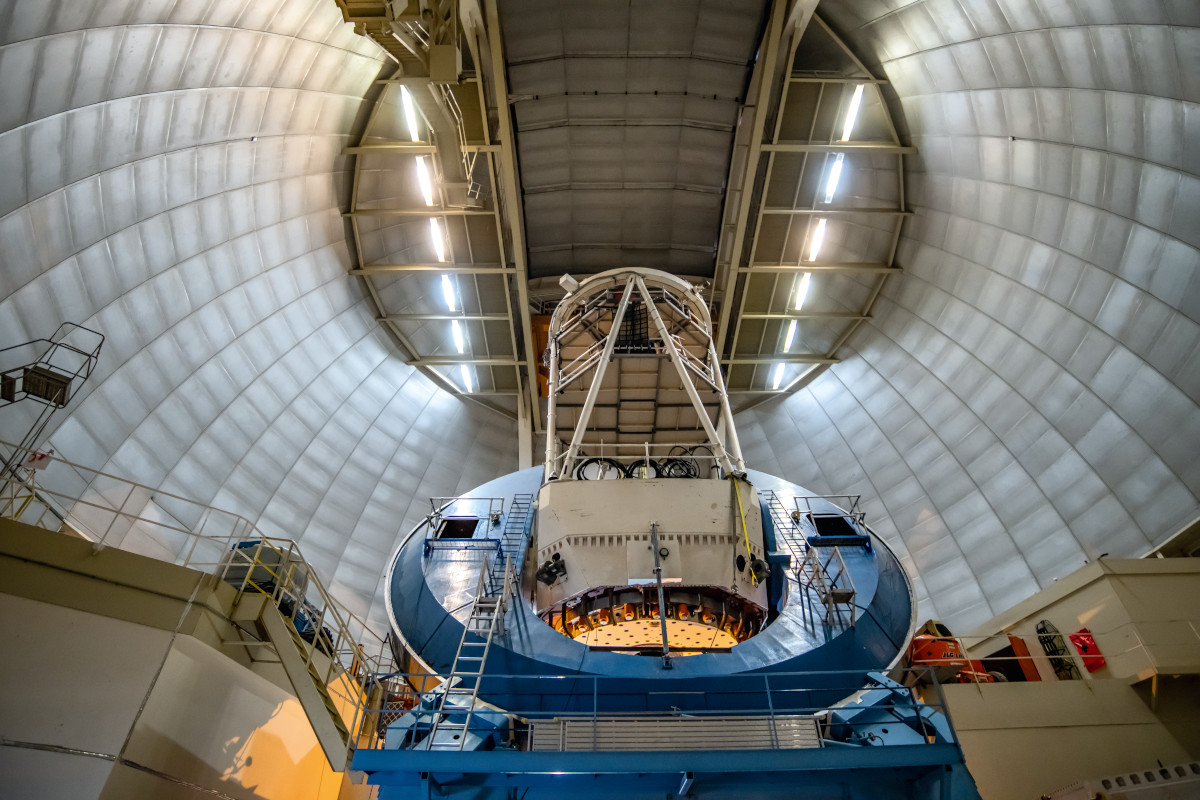
The Dark Energy Spectroscopic Instrument, or DESI, is attached to a telescope at the Kitt Peak National Observatory in southern Arizona. Astronomers are using DESI to measure the expansion of the Universe by creating a 3D map of the cosmos.
Using the huge quantities of data DESI is collecting, astronomers will be able to tell exactly how fast the Universe is expanding. And because the rate of expansion is linked to dark energy, they can then infer how strong the mysterious force is.
The idea that space should somehow generate energy is already rather odd, but the DESI data suggests that it gets odder still.
The observations seem to suggest the amount or strength of dark energy is changing over time – it’s weaker now than it was at earlier stages in the Universe.
At first glance, that might not seem like a problem. If there’s a fixed amount of dark energy, then as the Universe expands it would be stretched over a larger volume, making it appear weaker.
But the findings go beyond this. The amount of energy from a given region of space seems to be becoming less powerful.
Previously, dark energy was thought of as a cosmological constant – an unchanging factor that can simply be dropped into our equations about the Universe. The DESI observations suggest that this simply isn’t the case.
According to string theory, however, if the energy of the vacuum of space is positive, then not only can it change over time, it must.
“Decades of work have convinced us that when the vacuum energy is positive, there are no stable configurations,” says Prof Cumrun Vafa, a theoretical physicist at Harvard University. “There’s always an instability.”
It’s important to note that the DESI finding doesn’t equate to a smoking gun. The evidence isn’t “super strong,” according to cosmologist Prof Carsten van de Bruck of the University of Sheffield.
He does describe the results as “tantalising” though. “It’s not a strong hint, but it’s a good hint. Enough to say, ‘Okay, we should take these theories more seriously than we have done,’” he says.
Read more:
- Could there be a time particle?
- Most solar systems look nothing like ours. Here's why
- How old is the Universe, really?
Tiny black holes
As for what happens within this dark dimension, that’s still up for debate, and several models have been produced to explain how it can create dark matter and dark energy. But one intriguing idea is that the dark dimension is filled with tiny black holes.
These are primordial black holes, thought to have been created soon after the Big Bang.
While we’re more used to seeing black holes at a much bigger scale – many times the mass of our Sun – these tiny versions have “masses of a fraction of a gram,” Lüst says. “And they’ve survived [since the Big Bang] until now.”
According to this idea, it’s these tiny black holes, which can slip into the dark dimension and tuck themselves away, that are the real underlying creators of what we call dark matter and dark energy.
There’s an even more interesting consequence: over time, these black holes will decay due to Hawking radiation (particles emitted from just beyond a black hole’s event horizon).
This radiation could give off gamma rays or neutrinos, which we might be able to detect.
In fact, this radiation means something stranger too: the dark dimension would actually be growing.
As more and more energy from these black holes is emitted into the dark dimension instead of our own dimensions, “the size of the dark dimension would change a tiny amount over time,” Lüst says.
Theoretically, in the very far future, “we would end up in a Universe with no dark energy anymore.”
You needn’t worry about this happening any time soon – it’s a tiny process that happens in minuscule amounts over time scales much longer than the current age of the Universe.
But it could help shape experimental models that let us know where to look for clues of this dark dimension and its properties.
Other models of the dark dimension exist too.
Some theorists argue that it’s gravitons – the hypothetical particles that carry gravity – which have strayed out of our spatial dimensions, into the dark dimension. Under this model, it’s these wandering gravitons that become the thing we call dark matter.
Another idea is a hybrid system where dark matter and dark energy can both be described as fields, with energy passing from one to the other. That would mean dark matter could convert to dark energy.
Often in these models there must be “a new force of nature,” according to van de Bruck. “A fifth force mediated by the dark energy field,” which ties dark energy and matter together.
Let the data decide
What we really need to understand if the dark dimension is real (and, if so, which model best describes what’s inside it), is more observations and more data.
Data from large-scale surveys of the heavens, like those being carried out by the European Space Agency’s Euclid spacecraft, and from the tiny subatomic particles being investigated in experiments like those performed at CERN.
Any source of information on the expansion of the Universe or its subatomic constituents could be useful.
One potentially important source of data is looking at the way that galaxies interact. Galaxies are full of normal matter like stars and dust, but they also contain large amounts of dark matter.
When two galaxies pass close to each other, both types of matter determine how they interact.
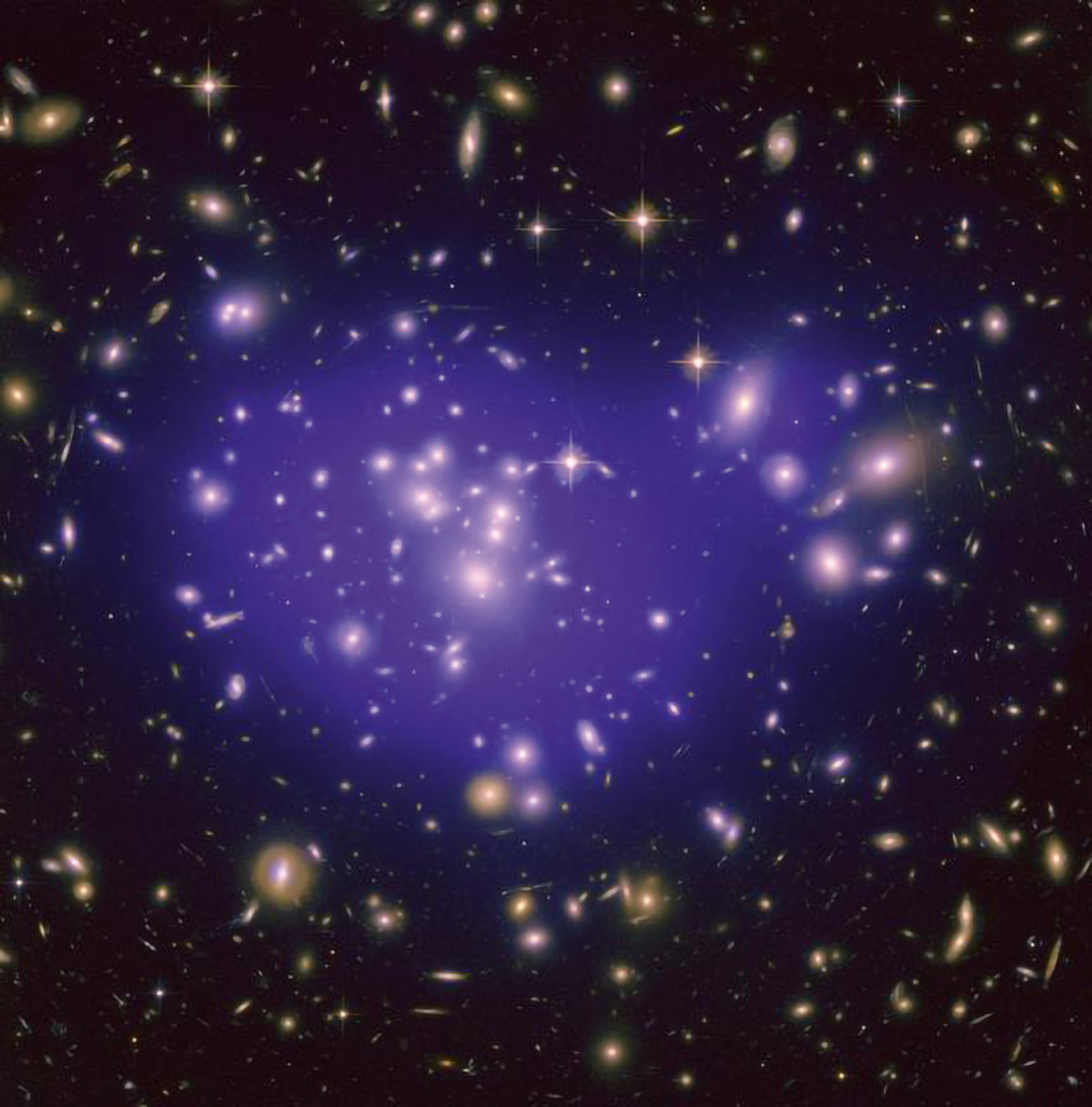
That’s important, because theories like the dark dimension model provide researchers with very precise predictions about how the matter they can see should behave, depending on the properties of the invisible dark matter.
And the more accurate a model’s predictions are, the more likely it is to be correct.
It’s an exciting aspect of this more recent work on string theory and dark matter. Historically, string theory has generated many abstract concepts that couldn’t be tested in the real world.
The dark dimension theory, however, does generate predictions that cosmologists can compare with actual observations.
In doing so, cosmologists could begin to unpick the biggest mystery at the heart of their field: what makes up that missing 95 per cent of the Universe.
Whether dark matter is a type of particle we haven’t seen yet, or a property of gravity we don’t know about, or a tiny dimension we don’t understand, we can begin to answer the questions of the dark Universe.
“Of course, at the end of the day, it’s the data that has to decide,” Lüst says. “We develop nice ideas and nice theories but, in physics, observations and data should tell us what is true and what isn’t.”
Read more:
