
How do you study the inside of a black hole, something that, by definition, can't be seen?
If there’s one thing everyone knows about black holes, it’s that nothing escapes their grasp – not even light. Even if you could send a probe into one, it’d never be able to return and report back on what it found.
Anything that crosses the event horizon – the external boundary of a black hole – vanishes, lost forever behind a high-gravity veil.
Whatever might lie beyond the event horizon is effectively invisible to us. But that hasn’t stopped us from wanting to find out. We still long to know what’s inside a black hole. What might be lying there, behind that veil. Why? Because we’re curious.
It’s human nature to want answers. But also because whatever’s hidden inside could help us solve a problem – a problem at the very heart of our understanding of physics.
Incompatible theories
The problem is that physics has two ways to describe how the Universe works: Einstein’s theory of gravity, otherwise known as General Relativity (GR), and quantum mechanics.
GR explains things that are big, such as the movements of stars and galaxies. Quantum mechanics, meanwhile, explains things that are small, like the behaviour of atoms and subatomic particles.
Both appear to be true, providing us with useful and predictive models of the Universe, but the two theories, as we currently understand them, are incompatible. Gravity, as described by GR, breaks down at the quantum level, and quantum mechanics simply doesn’t work with GR.
So far, no one has figured out a way to unite them.
The main obstacle is the fact that they work on such fundamentally different scales that it’s almost impossible to study them together. Almost, but not quite. And that’s where black holes come in.
They offer us a rare opportunity to study both theories when applied to the same object.
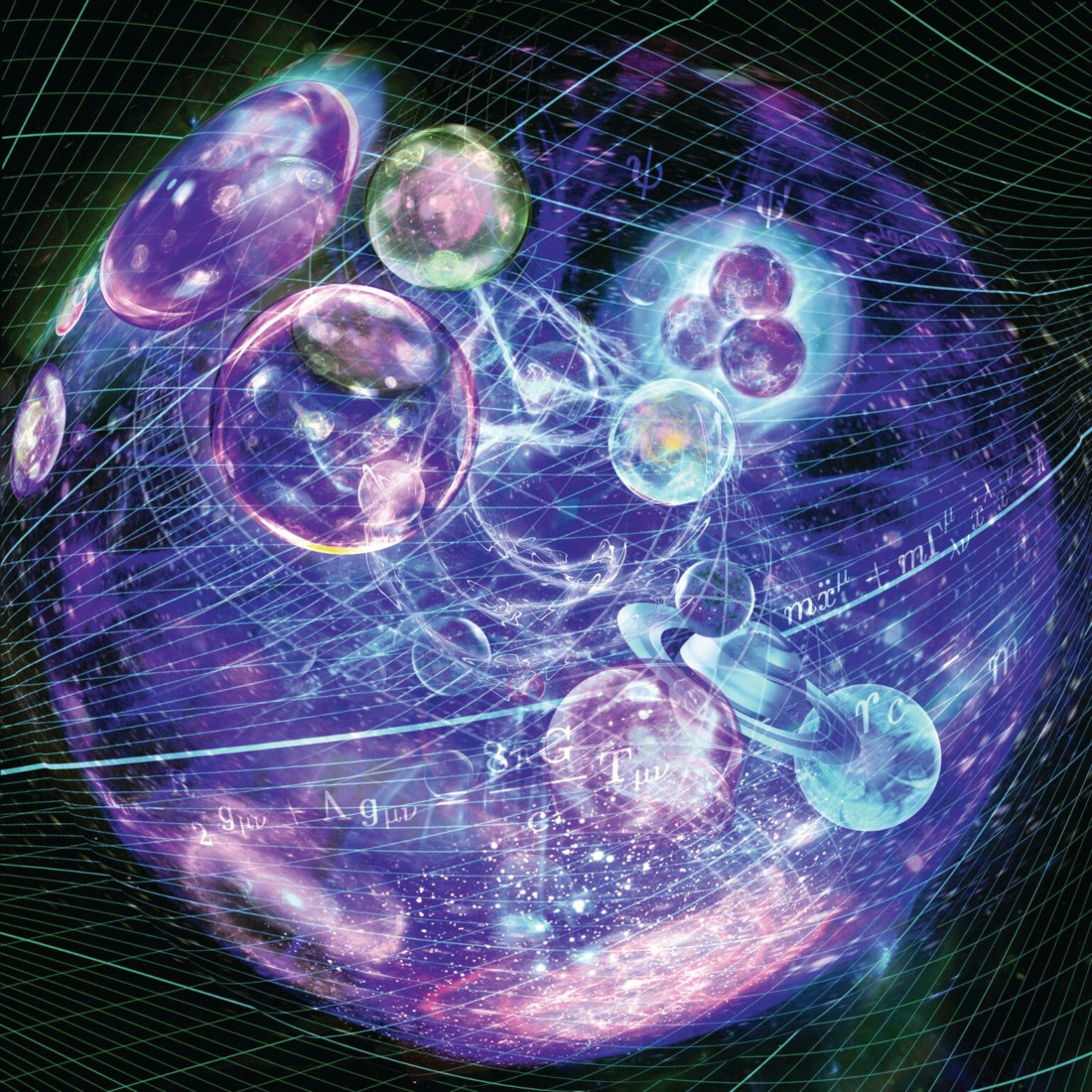
“You get all of that mass of a star, where [GR] is very relevant, shoved into an arbitrarily small region, where quantum mechanics would be very relevant,” explains Chris Akers, an assistant professor of physics at the University of Colorado Boulder, in the US, who studies the intersection of the two theories.
“So, you would have to use both to figure out what happens at that point.”
If we can find a way to study the inside of a black hole and figure out what’s going on beyond the event horizon, we might be able to solve the biggest problem in physics. We could unite GR and quantum mechanics and come up with a Theory of Everything.
But to do that, we’d need a way of visualising the inside of a black hole. In other words, we’d need a map.
Not what you think
We might not be able to look inside a black hole, but our best minds have tried to imagine what it might be like. And based on what we know about black holes already, those ideas get pretty weird.
For instance, given the forces of gravity at work, and the weirdness inherent in quantum mechanics, you’d quite rightly imagine the inside of a black hole to be bizarre. Maybe spacetime would become unrecognisable the moment you crossed the event horizon.
But in fact, that’s not the case. Depending on the size of the black hole, space just inside the event horizon could be almost indistinguishable from the space just outside it.
If you were to cross the event horizon, you would still be able to look out and see the stars around you, even though no one outside would be able to see you (light doesn’t escape, remember).
You might not even feel the extreme gravitational effects – at least, not immediately – if you’re far enough away from the singularity.
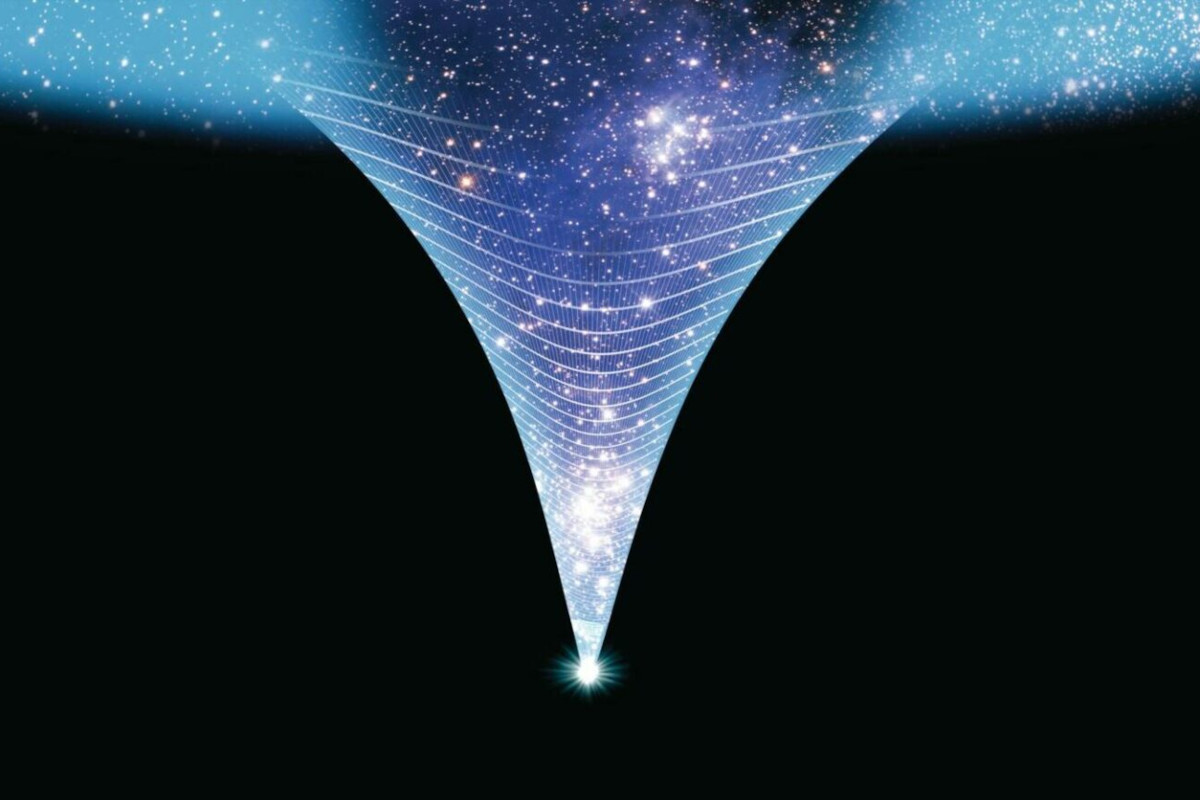
“There’s a sense in which we could be already inside an enormous black hole, and we wouldn’t know,” says Akers. Not because this is likely, but because space wouldn’t seem so different at first glance.
But the closer you get to the singularity, the more the effects would become apparent. Approaching the singularity, spacetime becomes increasingly curved, creating tidal forces that would rip you apart by pulling more strongly on the parts of you closer to the singularity.
‘No problem,’ you might think. ‘I’ll just avoid the singularity.’ Unfortunately, it’s not as simple as that.
“The singularity is a location in spacetime that’s always in the future of someone falling past the event horizon,” says Dr Luca Iliesiu, a theoretical physicist at the University of California, Berkeley, in the US. “So, in some sense, you falling into the singularity is inevitable.”
It’s hard to imagine that, because we intuitively understand a fixed location in space, but the concept of a location in spacetime that’s in the future is much harder to comprehend.
Think of spacetime as being curved, as we know that sufficiently massive objects affect the apparent passage of time.
Now think of that spacetime as getting more and more curved, approaching infinite curvature. You’re strapped into a roller-coaster car and you’re heading towards a wall.
But while an ordinary wall is located in space, this wall is located in time. However you move, there’s only one way that you’re headed: forward into your future, and into the singularity.
It doesn’t matter what you do or how you try to move, “anyone falling behind the event horizon is forced to eventually end up at that point,” Iliesiu says.
It might take more or less time depending on the size of the black hole, but once you pass the event horizon, your fate is sealed. Cross that boundary, and you have no choice but to encounter the singularity. It becomes unavoidable.
You’ll be drawn towards the singularity, and it won’t just bump you on the head. It’ll rip you apart.
Read more:
- How one (very strange) particle could soon rewrite our laws of gravity
- Experts are at war over two black holes that shouldn't exist
- We've just found the Universe's darkest galaxy – and it could solve one of the last, great mysteries in science
Drawing a map
As strange as the concept of infinitely curved spacetime is, there’s an even stranger approach that some researchers use to visualise a black hole: thinking of it as a two-dimensional surface.
That sounds odd, because it seems obvious that a black hole is essentially a sphere – a three-dimensional object. But the reason it’s compelling as an explanation has to do with a discovery by Professor Stephen Hawking.
Hawking showed that black holes emit radiation and have a characteristic temperature, which means they have entropy.
“Entropy is usually a measure of the number of states that an object could have,” Iliesiu says. “And the leap we can make nowadays is to say that the entropy Hawking computed actually is a count for the number of quantum states that the black hole has.”
Imagine a room full of gas, and all the different arrangements that could exist of the molecules in that room.
The bigger the room, the more possible arrangements – that’s what we call its entropy. More size means more entropy means more possible states, and this applies to black holes, too.
So far, so good: a larger black hole can have more quantum states than a smaller one. But where it gets weird is in how the entropy increases with size.
Because entropy doesn’t increase in proportion to the black hole’s volume (which would make sense if we’re thinking about a black hole in three dimensions), but rather in proportion to the surface area of its event horizon (which makes it more like something two-dimensional).
“It’s very weird, and it’s a very deep fact about gravity,” says Akers.
All of the black hole (all of its information), under this approach, is encoded on a two-dimensional surface that produces a three-dimensional image.
It’s an idea researchers call holography, since it’s similar to the hologram stickers you may have played with as a child, which were flat, but gave the illusion of showing a three-dimensional object.
“In that description, the black hole is just some stuff on the surface of the sphere,” Akers explains.
This description gives us a new way to approach black holes and their interiors, but it’s far from a complete explanation. After all, we still need a way to understand the relationship between these two descriptions of a black hole, and that’s a project referred to as mapping.
Think of it less like a conventional map, which is a representation of a geographical region, and more like a dictionary, which translates between observations in the spherical model and the equivalent observations in the surface model.
As abstract as this sounds, it helps theorists to work in a practical way – in recent developments on gravitational path integrals, for instance.
This work is a kind of pseudo-map between quantum mechanical theories and actual numbers, making it possible to make real predictions about the interiors of black holes, such as estimating how their volume changes with time.
This approach considers various possible spacetimes and sums them up, looking for the dominant path – a path that, in most cases, would be the one described by GR.
But for more complex spacetimes, GR might fail and other quantum explanations could be more likely. That’s a way of potentially explaining how GR and quantum mechanics can both be relevant and correct while being apparently contradictory.
It also raises the possibility that due to a phenomenon called quantum recurrence – the idea that, given enough time, dynamic systems eventually return to a state very close to their initial state – black hole interiors could actually change over time.
Unlike from the outside, where black holes appear the same regardless of their age, their interiors could behave differently as they get older.
This is still very much a matter of speculation, but it does demonstrate how theoretical advances can radically change the way we think about the black hole interiors we’ll never be able to observe.
An impenetrable boundary?
As useful as all this conceptualising might be, we’re still stuck with the unavoidable fact that we can’t actually see beyond the event horizon. Because nothing escapes a black hole, not even light. That’s the one thing everyone knows about black holes.
So, all of this is entirely abstract, right?
In practice, probably yes. We won’t be developing telescopes that allow us to peer into a black hole. As far as we know, such a thing is impossible.
It’s not quite true to say that nothing ever escapes a black hole, however, because, as previously mentioned, black holes emit faint amounts of radiation.
Known as Hawking radiation, the idea is that a small amount of energy is released from black holes due to the way spacetime is curved.
The traditional explanation is that the nature of spacetime means it spontaneously creates pairs of particles that annihilate each other, but sometimes, right at the edge of a black hole, one of the particles will fall into the black hole while the other escapes.
It’s these escaping particles that carry a small amount of energy away from the black hole.
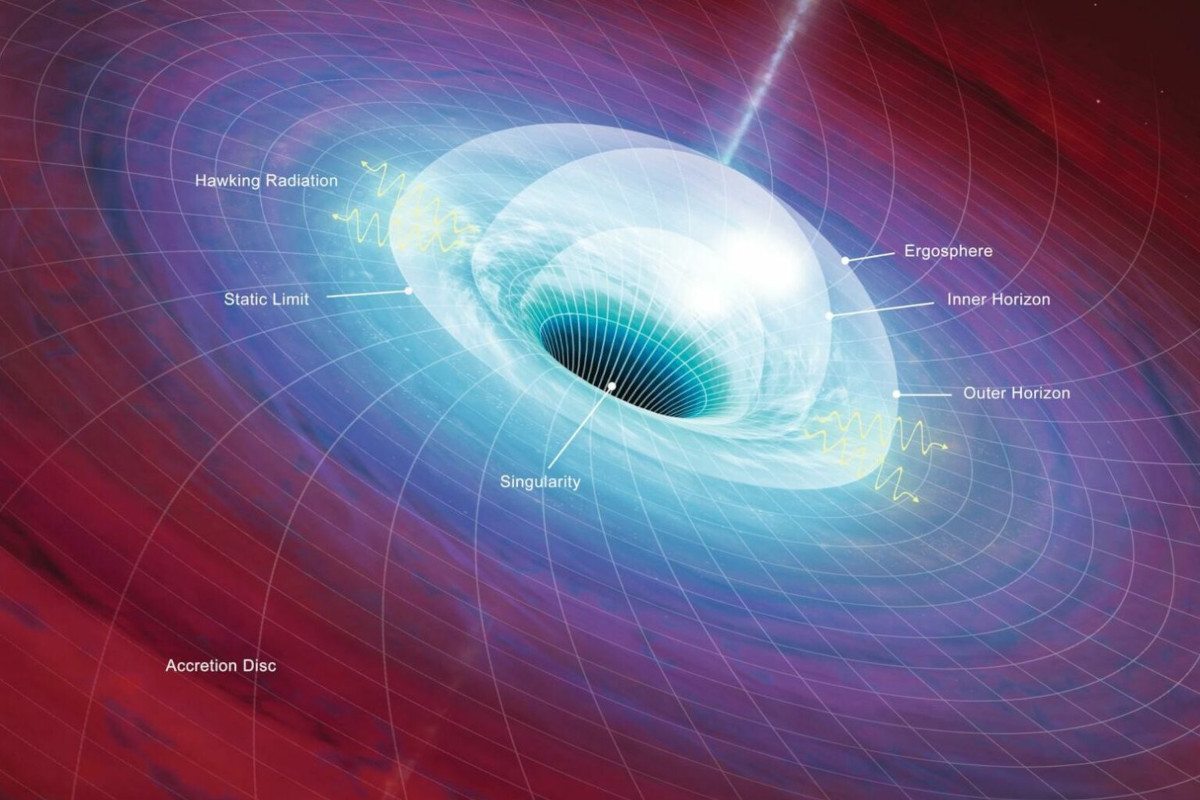
Hawking radiation is released from just outside the event horizon, and though the energy it carries away from the black hole is very small, it does mean that the black hole is shrinking (albeit very gradually over a very long time).
This radiation is generally thought to be totally random. But randomness is a slippery concept.
Eventually, once a black hole has finally evaporated, all that would be left of it is the Hawking radiation that escaped into space. Now, imagine you build a device that could collect all of that radiation.
“Suppose you had access to all the radiation,” Iliesiu says. “You knew exactly the state of each photon at every moment in time. You could then ask, would it be possible to reconstruct whatever happened in the black hole interior from that radiation?”
The upshot is that radiation being given off at any particular moment may seem random, but it’s possible that any differences we could detect could eventually indicate differences between early-stage and late-stage black holes, for example.
And that would prove that black hole interiors aren’t all the same, but change with the black hole’s age – a potentially huge breakthrough in our understanding of them.
We’re nowhere near being able to perform this kind of experiment yet, but it’s not inconceivable that something similar could be done in the future.
The biggest question
As mind-bending as black holes are, it’s their extreme nature that makes them so valuable to theoretical physics. “They’re uniquely useful, in the sense that they’re systems that are purely gravitational,” Iliesiu says.
If we want to think about the inside of black holes, we can’t rely on the tried-and-tested model of GR – we need to turn to quantum mechanics as well.
So, if we’re ever able to understand black holes, we’ll finally have the solution in our hands of how to unite GR and quantum mechanics, the biggest problem in physics today.
Or as Iliesiu puts it, “If you understand the quantum mechanics of a black hole, you essentially understand how gravity works at a quantum level.”
Read more:
