
Like many writers, I sometimes find myself facing creative frustration, particularly when a deadline is looming. And at times like these, the voice inside my head is rarely as encouraging as it could be.
“This is rubbish,” I find myself thinking when I’m struggling with a draft. “I’m an embarrassment. This piece is so bad it’ll sink my career. I’ve forgotten how to write.”
I tend to plough on through the self-doubt, but the experience has recently got me thinking about thinking. Specifically, where does this voice come from? What purpose does it serve? And what can we do when it starts to turn against us?
Delving into the scientific literature, I soon found that inner speech is far more important than I imagined.
When it’s working at its best, the voices in our heads can enhance our attention, memory, motivation and problem-solving ability.
“It has so many different functions and purposes,” says Charles Fernyhough, a professor of psychology at Durham University.
Unfortunately, internal chatter is often coloured by the emotions that we’re feeling, which can quickly leap into excessive self-criticism.
In the moment, these thoughts – sometimes called ‘cognitive distortions’ – can feel like the truth, but they are inherently deceptive.
So how can we know when to trust our inner speech? And what can we do to change the script when it starts to twist reality?
Incessant babbling
Our understanding of inner speech can be traced to a long-neglected Soviet psychologist named Lev Vygotsky. Born in Orsha (modern-day Belarus) in 1896, Vygotsky would live for just 37 years before dying of tuberculosis.
Over this short life, however, he made extraordinary contributions to our knowledge of the human mind, leading some to dub him the ‘Mozart of psychology’.
Among Vygotsky’s many achievements were his intimate observations of infants’ incessant babbling as they go about their business.
Before Vygotsky, scientists had considered language to be a purely social tool, but he observed that infants often direct their speech towards themselves.
When colouring a picture, for instance, one little boy started talking about his need for the blue pencil. Unable to find it, he started describing an alternative strategy.
“Instead of that I’ll colour it red and put water on it. That’ll make it more like blue.”
This chatter is a continuation of the conversations the child might have once had with their caregiver, Vygotsky proposed. “But the child comes to conduct that dialogue for themselves,” explains Fernyhough.
Vygotsky saw this ‘private speech’ as a psychological tool that allows the child to guide their thoughts and behaviour.
As we get older, we no longer need to voice the words out loud – though we may sometimes find ourselves doing that anyway – but we keep up the habit of talking to ourselves, maintaining a constant stream of silent inner speech as we navigate life’s challenges.

Political tensions meant that Vygotsky’s research was heavily censored in the Soviet Union. “He was deemed too bourgeois, so he fell afoul of Stalinist purges,” says Fernyhough.
Such suppression meant that his findings languished in relative obscurity.
The first full translations of Vygotsky’s work only started to become available in English in the 1980s and 1990s – books that caught the eye of Fernyhough, who was beginning his career as a developmental psychologist.
“I found his ideas mind-blowing,” he recalls. So, he set about testing some of Vygotsky’s claims.
Talk yourself through it
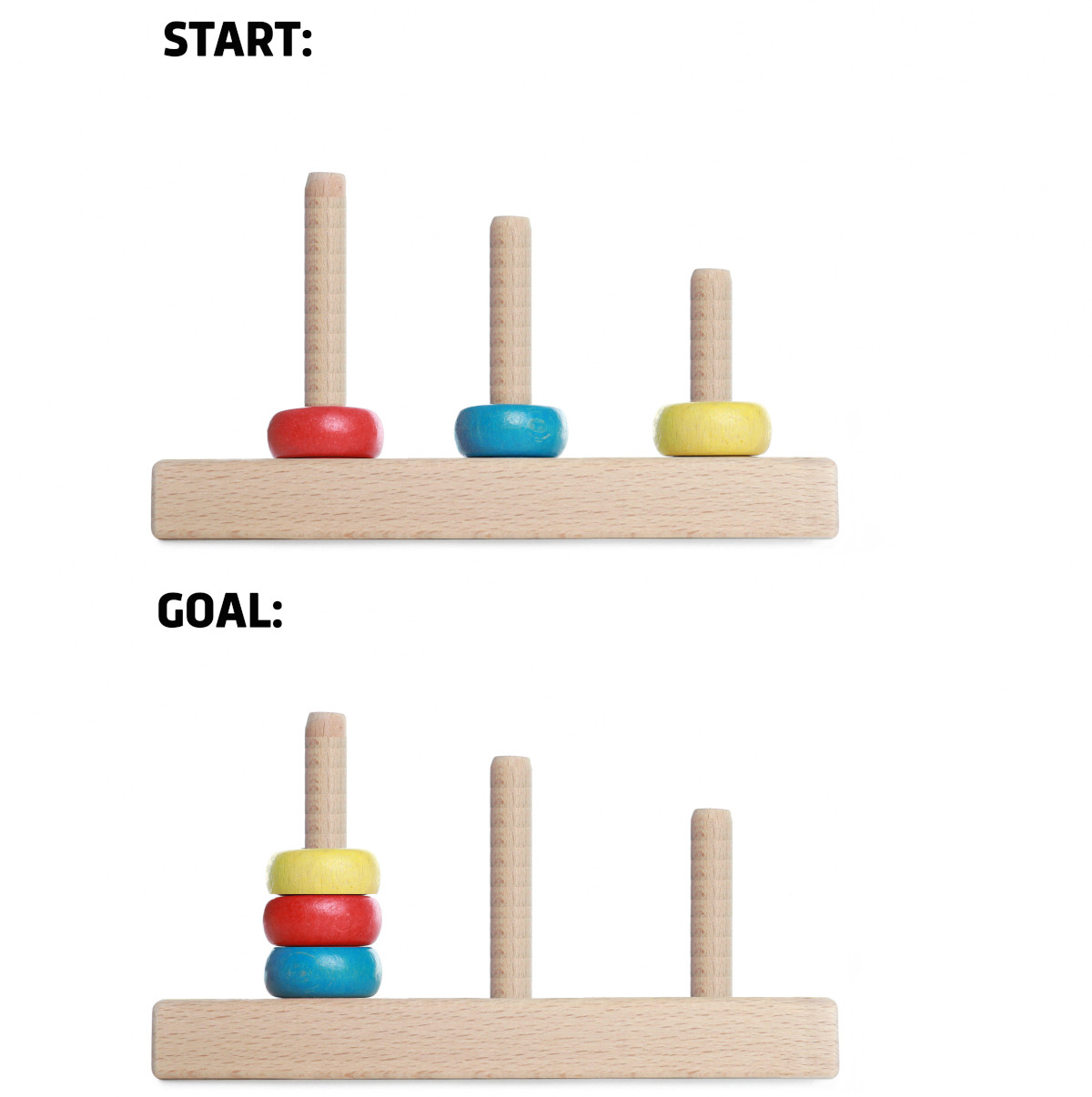
One of Fernyhough’s early studies asked a group of five- and six-year-olds to play the Tower of London game.
It requires the player to rearrange coloured balls between sticks of different heights – an exercise that requires some analytical thinking and forward planning.
As Vygotsky would have predicted, the children tended to talk themselves through their strategy.
They were more likely to do this on the harder rounds of the game and the more a child engaged in this private speech, the quicker they solved the problem – all of which supported the idea that self-talk helps us to organise our thoughts and behaviour.
Later experiments have confirmed that adults’ inner speech serves the same purpose.
People tend to be less efficient at finishing the Tower of London if they’re asked to repeat a word – ‘Monday’, for example – while they complete the task, since that occupies the voice in their head.
As this work evolved, it became clear that inner speech may differ in style from moment to moment and person to person, leading Fernyhough and his colleagues to develop a questionnaire that attempts to capture this variety.
Such research suggests it may take five different forms:
Evaluative “I think in inner speech about what I have done, and whether it was right or not”
Positive “I talk to myself silently in an encouraging way”
Dialogic “When I am talking to myself about things in my mind, it is like I am going back and forward asking myself questions and then answering them”
Condensed “I think to myself in words using brief phrases and single words rather than full sentences”
Other people “I hear the voice of another person in my head. For example, when I act in a certain way I hear my mother’s voice in my mind”
The first two forms may be especially helpful for focusing our attention.
German researchers, for instance, asked participants to take the flanker task, a visual exercise that requires them to wait for a series of arrows to appear, then say, as quickly as possible, which direction the central arrow is pointing, regardless of all the arrows around it.
The exercise requires considerable concentration, as participants must filter out all distractions.
The researchers found that people’s use of positive and evaluative self-talk could predict each person’s performance, even after the researchers had accounted for differences in general intelligence, measured with an IQ test.
Read more:
- 'Mental flexibility' is science's best predictor of lasting willpower. Here's how to improve yours
- 6 science-backed ways to protect and improve your memory
- The everyday nutrient a leading doctor says could help tame an anxious brain
Interrupting your inner voice
The power of the personal pep talk has long been known to athletes. It may take the form of practical instructions (“Play defence”) or complex emotion regulation.
For example, reducing anxiety when their nerves are getting the better of them (“It’s only a game”) or pumping up energy when it’s lagging (“Don’t give up!” or “Go! Go! Go!”).
Guiding self-talk is, in fact, a huge part of professional coaching. “It’s a whole industry,” says Dr Johanne Nedergaard, a researcher in linguistics, cognitive science and semiotics at Aarhus University in Denmark.
And silencing these affirmations may seriously impair an athlete’s performance – right down to their physical exertion.
A few years ago, Nedergaard and her colleagues asked around 50 participants to cycle as fast as possible for a series of 20 one-minute trials.
In some cases, they had to remember a stream of nonsense words as they pedalled – an activity designed to interrupt their inner speech as they rehearsed the words in their heads.
In other trials, they had to remember geometric shapes appearing on a screen – a visual task that should not affect their self-talk in the same way.
If inner speech were important for physical performance, Nedergaard expected that the type of mental task would influence their exertion – and that’s exactly what she found.
Without the voice in their head egging them on, the cyclists were less likely to push themselves as hard, reaching around 94 pedal revolutions per minute compared to 97.
“People need to talk to themselves to really push themselves,” Nedergaard says.

In this age of manifestation, you may have read that you can achieve impossible feats by simply willing them to be true.
Sportspeople who egg themselves on, however, are not lying to themselves about abilities they don’t possess, but encouraging themselves to perform better by raising their energy and remaining focused on the task at hand.
And it’s not just about physical performance that might benefit from a little inner encouragement. Fernyhough argues that inner speech is equally important in creative pursuits.
In his book The Voices Within, he points to Van Gogh’s letters and Virginia Woolf’s journals as records of this process, as they talk themselves through the artistic process and its results.
In many cases, our internal dialogue is refining what we’ve produced and telling us what we need to do to make it better.
“I don’t think you can be creative unless you have that inner critic,” says Fernyhough. He’s speaking from personal experience – besides being a psychologist, he’s also a novelist.
Learn to listen
Like a valued friend, we need our self-talk to be honest and insightful.
The problem, of course, comes when that voice becomes either a bully or a hype-man.
There’s a gulf between self-criticism (“You need a better idea!”) and self-sabotage (“You’re a failure”). Similarly, there’s a chasm between self-encouragement (“You can do it”) and self-aggrandisement (“You’re an absolute genius”).
And stress can easily lead to your voice leaping across those gaps.
Imagine you’ve just had some bad feedback from a colleague. Your inner speech may start to sound defeatist, listing all the reasons you’re hopeless at your job.
Alternatively, you may become overly defensive, denying your colleague’s point of view while describing exactly why you’ve been right all along.
Neither of these reactions will help you to learn and grow from the experience.
There will, of course, be instances when you might need to do a better job, but the consequences are unlikely to be as dire as that voice in your head is making them out to be.
Alternatively, you might be justified in resisting criticism, but your inner speech may be too determined in dismissing your colleague’s opinion without first considering its merits.
The challenge, then, is to recognise when your inner speech is exaggerating due to emotional pressure, and then account for that distortion.
“It’s all about moderation,” says Ethan Kross, professor of management and organizations at the University of Michigan, and author of Chatter. “You don’t want the emotional pendulum to swing too far in either direction for too long.”
Practices such as mindfulness have long acknowledged this fact, which is why meditators are often encouraged to observe their thoughts coming and going without getting caught up in them.
The philosophy has also entered Acceptance and Commitment Therapy (ACT), pioneered by Steven Hayes, a professor of psychology at the University of Nevada.
According to ACT, we typically become “fused” to our thoughts so that we’re unable to question whether they’re right and wrong.
To avoid this, we need to engage in ‘cognitive defusion’, which helps you to hold that inner speech at a bit more distance. One common technique is simple acknowledgement.
When the voice inside says “I’m going to fail”, you can turn that into “I’m having the thought that I’m going to fail”. Alternatively, you might repeat the phrase in a silly accent or sing it to the tune of Happy Birthday.
In one study, Hayes and his colleagues encouraged participants to pick out one word in a distressing thought and repeat it ad nauseam. (If someone thought “I’m too fat” they would repeat “fat” for 30 seconds, for instance.)
As disarmingly simple as this may seem, the strategy worked – reducing both the believability of those thoughts and their emotional impact.

Kross’s own research offers many other strategies to “uncloud our verbal stream”, many of which operate through a shift in perspective.
He has asked people to imagine that they’re a “fly on the wall” observing their problems – such as a recent argument with a friend – from a neutral vantage point, rather than through their own eyes.
The difference in their thinking was stark.
When some of the research participants were fully immersed in their problems, they tended to use very direct language. “Shamed. Stepped on. Sh***ed on,” is how one wrote about his experience.
The ‘flies on the wall’, in contrast, tended to be more balanced. “I initially empathised better with myself, but then I began to understand how my friend felt,” remembered another participant.
There are many other ways to achieve this. When faced with a dilemma, you could imagine that you’re advising a family member rather than yourself.
Kross has even found that changing the grammar of your self-talk can help: shifting from the first person (“I feel…”) to the third person (“David feels...”) leads us to think a little more wisely about the problems we face.
In each case, Kross has found that people’s thinking becomes less ruminative and more reflective, so that they’re less likely to fall into the traps of overgeneralisation or self-denial and more likely to work their way towards genuine insights.
Kross is keen to emphasise that these distancing techniques still allow us to process our feelings; we’re not disengaging from the situation at hand.
But, in times of stress, when emotions are riding high, “it should lead to a more muted response,” which allows our inner speech to become more constructive.
Distanced self-talk may be especially useful when we’re facing temptation.
Kross and his colleagues have found that persuading dieters to think in the third person can encourage them to make healthier choices of snacks, for instance.
Applying this to my writer’s block has done wonders.
As those doubts start creeping in, I make a conscious effort to talk to myself with the same understanding that I’d give to any colleague who needs a quick confidence boost.
By distancing myself from my thoughts, I find that the tone of my inner speech soon becomes more caring, as it shifts into the persona of a coach rather than critic.
“David, you’ve done this a hundred times before,” I find myself saying back to my inner critic. “You can do it again if you keep at it.” And knowing the power of our self-talk to shape our performance – I believe it.
Read more:
