
The animal kingdom is a weird, wonderful and sometimes quite gory place. There are ants that farm aphids and lizards that deter predators by squirting blood from their eyes.
Some mammals have the ability to delay pregnancy, giving offspring a better chance of survival, and some species of crabs walk around with sponges on their head.
While many of these behaviours are odd, there’s a reason. (The sponges, for example, are a unique but effective form of camouflage.) However, other behaviours continue to puzzle scientists – either because it’s not quite known why they’re doing it or it’s not quite known how they’re doing it. Here are five animal behaviours we still do not fully understand.
1. Mobula rays bellyflop
Mobulids – a family that includes three species of manta ray and seven species of devil ray – use their triangular fins to glide in and out of the water. These fish can leap two metres out of the ocean, twirl midair and bellyflop, returning to the water with a loud thud.
Occasionally, schools of rays put on a show. Dr Marta D Palacios from Mobula Conservation described one particularly spectacular event: “All of a sudden, you can see hundreds of them jumping at the same time and it is like popcorn,” she says. “It was like the water was boiling and they were just ready to pop.”
But why do they do this? Scientists aren’t so sure.
Some have suggested rays jump to demonstrate their physical prowess and seduce a mate. But the behaviour has been observed outside of breeding season and in juveniles and pregnant females, not just creatures which are sexually active.
Another explanation is that it’s a method of removing parasites, like suckerfish. The bellyflop may help dislodge parasites, either directly when the ray comes into contact with the water’s surface or indirectly by triggering a muscular reflex that causes the parasites to detach.
Still, Palacios says the best explanation is that mobula rays bellyflop to communicate – though it is not always clear what they are trying to say and it could vary depending on the group, the time of day or the season.
“It can be that there’s an abundance of zooplankton in a certain area,” says Palacios, pointing to the fact that many mobulas feed cooperatively. Alternatively, it can be a way to boost group numbers to reduce their vulnerability to predators, such as the hammerheads and orca. “It’s like a signal to other groups around, so that they can travel together,” says Palacios.
2. Whales wear wigs made of kelp
Whales have been spotted wearing hats and donning wigs made of seaweed. Scientists call this unusual behaviour kelping. It essentially involves a whale playing with, rolling in or rubbing against a piece of kelp. Sometimes it’s done solo. Sometimes it occurs in groups. And while footage shows whales can spend upwards of an hour being entertained by a clump of seaweed, it’s not understood why.
“Often when animals play, it’s because they’re practising a behaviour that will become important to them as adults,” Dr Luke Rendell, a Reader in Biology and expert in learning and behaviour in marine mammals at the University of St Andrews, explained. “But that doesn’t seem to be the case here.”
Indeed, recent research found that over 50 per cent of whales observed kelping were adults. While biologists haven’t pinned down a cause, multiple factors may be at play.
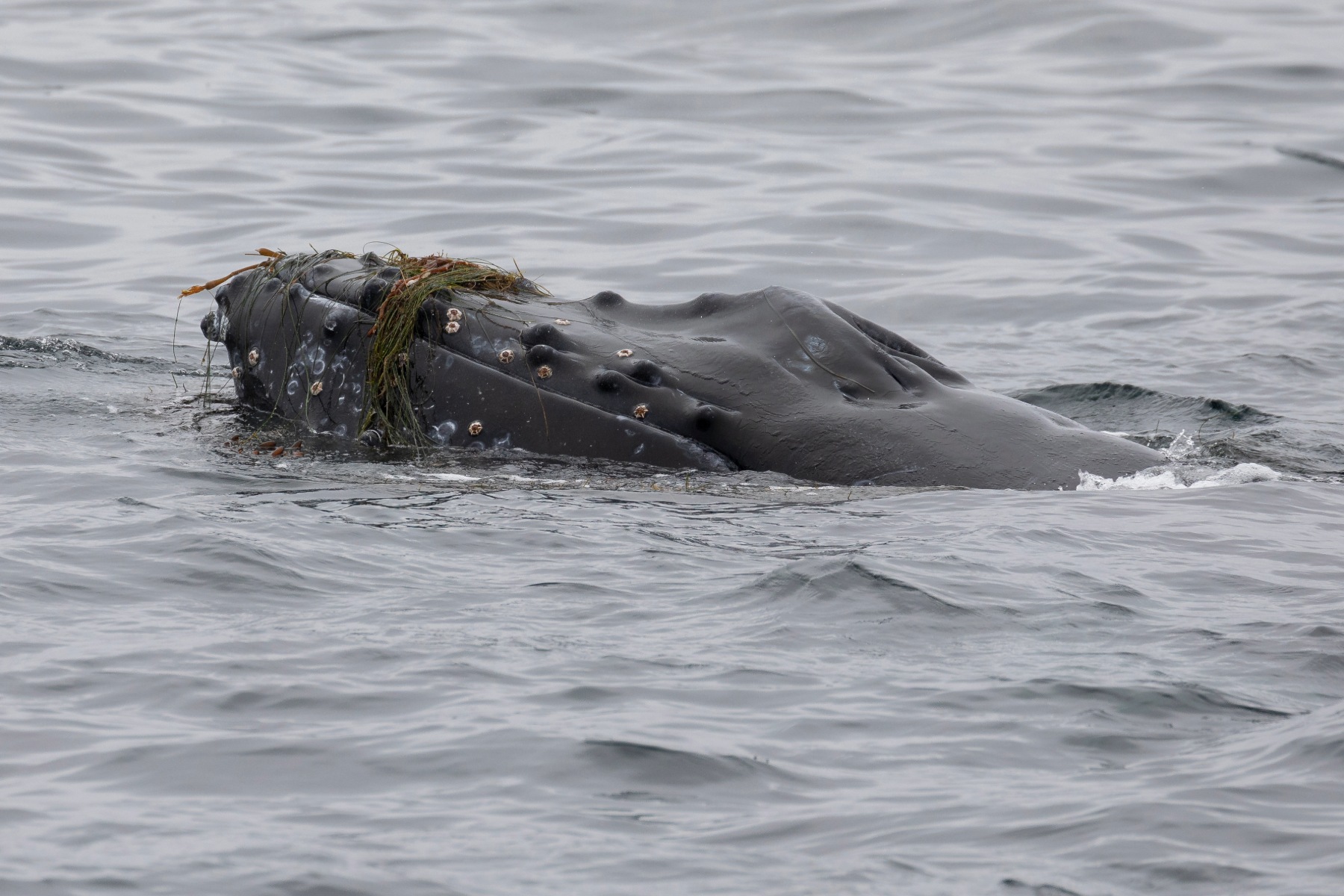
“I suspect it’s sensation, interaction and curiosity that are driving these things,” Rendell added. “We see that in lots of other examples.” (One being a community of orcas, who, in the 1980s, adopted a peculiar trend of balancing salmon on their heads.)
Humpbacks were involved in 95 per cent of the incidents cited in the research. Researchers suspect this may be because they are more likely to be caught on camera (the observation effect). They are also the hairiest baleen whale, with extremely sensitive whisker-like hairs. Do whales indulge in kelping simply because they enjoy the feeling?
There may also be medical benefits. It’s been suggested that kelping can help remove parasites, like barnacles, and that some types of seaweed may contain microbial compounds that soothe skin infections – think of it as a seaweed facial. Researchers studying kelping behaviour note it often appears strategic, rather than just playful.
Rendell wonders if there’s a social aspect, as it often occurs in groups. However, it can be hard to collect data on these animals who spend so little time at shore and so much time at sea, and – unless you are Dr Dolittle – it’s not like we can ask.
“We have such a limited window into their lives,” says Rendell. “These are complex animals and they have complex behaviour that we don’t always fully understand.”
3. Crows hold funerals
American crows can often be found gathered around dead peers – a process that kicks off when one bird discovers a carcass and releases an alarm call, prompting others to join.
It seems somewhat appropriate that these birds hold ‘funerals’. The collective term for a group of crows is murder after all. However, these gatherings are not the quiet, respectful events you might associate with funerals, but loud, cacophonous affairs, full of cawing, screeching and, sometimes, necrophilia.
Prof Claudia Wascher, a behavioural ecologist at Anglia Ruskin University, explains it’s “very similar to mobbing behaviour.” This may have something to do with the fact that scientists suspect its primary purpose is information-gathering. “It’s really a way to alert everybody in the group and raise attention to the situation,” says Wascher, explaining a dead crow signals a potential threat.
This is supported by research, which found areas of the brain linked to higher-order decision-making lit up when birds were shown a crow carcass or exposed to an alarm call. Other studies suggest crows are slower to approach food if a dead crow has been spotted nearby and will scold humans seen near the carcass. (It probably didn’t help that volunteers wore masks reminiscent of Halloween’s Michael Myers.)
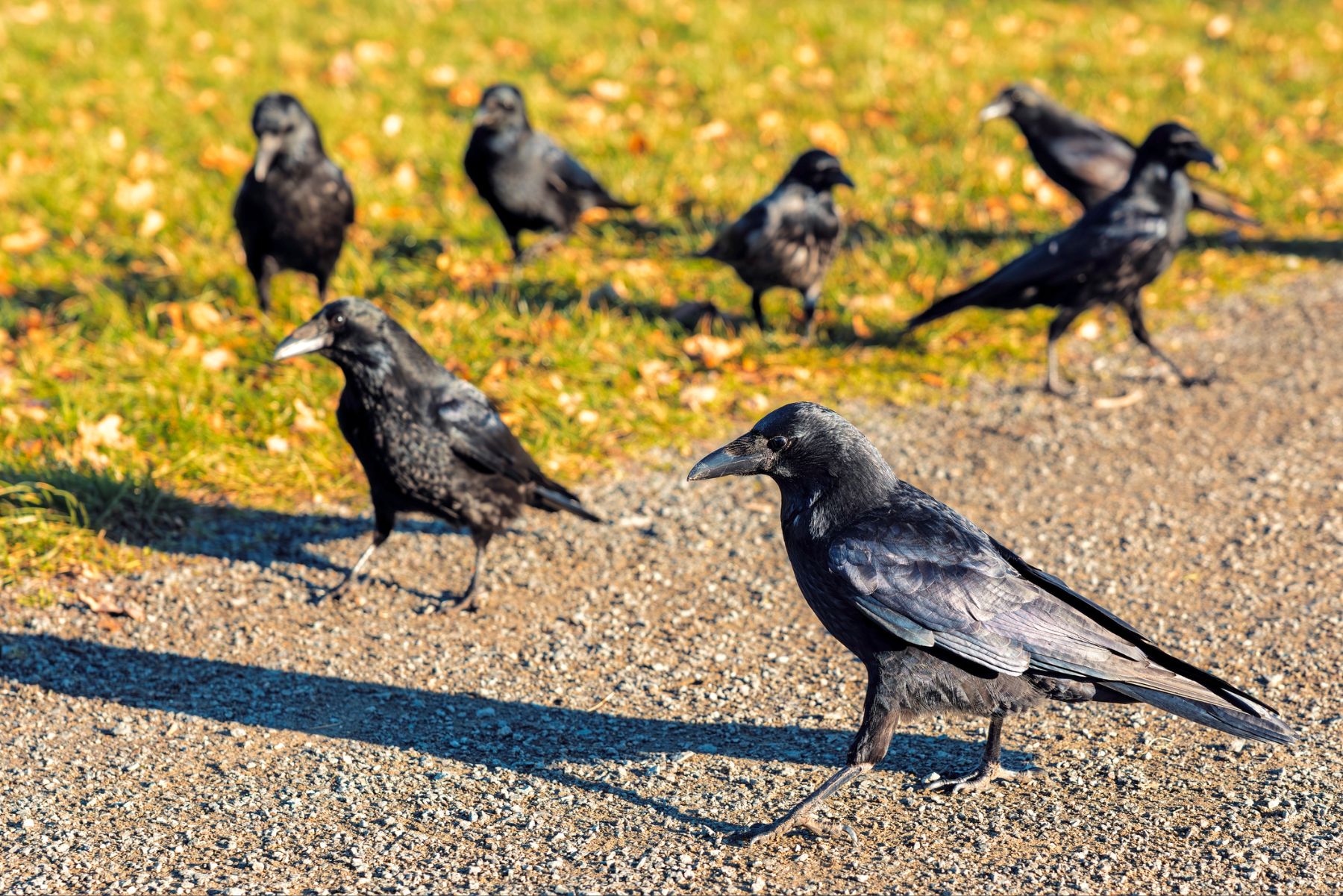
But while funerals are typically associated with mourning, it is too early to say if crows experience anything akin to grief.
“Certainly, elements of funerals are there in the corvids,” says Wascher, though she is careful not to anthropomorphise. “We can’t really tell about the function of the behaviour, so we can’t tell if the birds are mourning or sad.”
Corvids aren’t the only non-human species to respond to death. Several others, including elephants and dolphins, do too. What many of these animals have in common is their reliance on social bonds and long-term relationships.
“[Corvids] have complex social systems where they have friendships,” says Wascher. “They have partnerships in these groups and of course, if you lose a social partner, that’s a difficult situation and individuals respond behaviourally to it.”
Research to date has focused on birds’ reactions to unfamiliar dead crows, so it’s not clear if responses would differ if the bird in question was a social partner. Equally curious, perhaps, is why a handful of individuals respond by aggressively pecking or attempting to copulate with the carcass.
Read more:
- "Cold-blooded killer": The strange rise of Borneo's 'vampire squirrel'
- Experts tracked lions for four years and found something incredible
- Here’s how to tell if your dog actually loves you, according to science
4. Sloths risk death every time they poo
Sloths have earned a reputation for being slow and, well, sloth-ful. So it’s baffling that these creatures undertake a weekly pilgrimage just to use the bathroom. Though they live almost exclusively in the tree canopy, sloths venture to the ground to poo.
“The toilet is a huge mystery,” says Amelia Symeou, biologist and data analyst at The Sloth Conservation Foundation. “They only have a very limited amount of energy to expend each day and to spend that making their way down to the toilet and going back up again rather than a) conserving that energy and b) grooming, foraging, caring for offspring, it’s nonsensical to most of us.”
The entire endeavour can last three hours and risks the sloth becoming somebody else’s dinner. This begs the question, why bother when they could do their business from up high?
There are theories. The behaviour has been seen in two-toed sloths and three-toed sloths, both of whom are tree-dwelling descendants of ground sloths. Could the habit be an evolutionary holdover from terrestrial ancestors? It has also been suggested that a trip to the forest floor could aid digestion by supplementing their primary diet of leaves with soil.
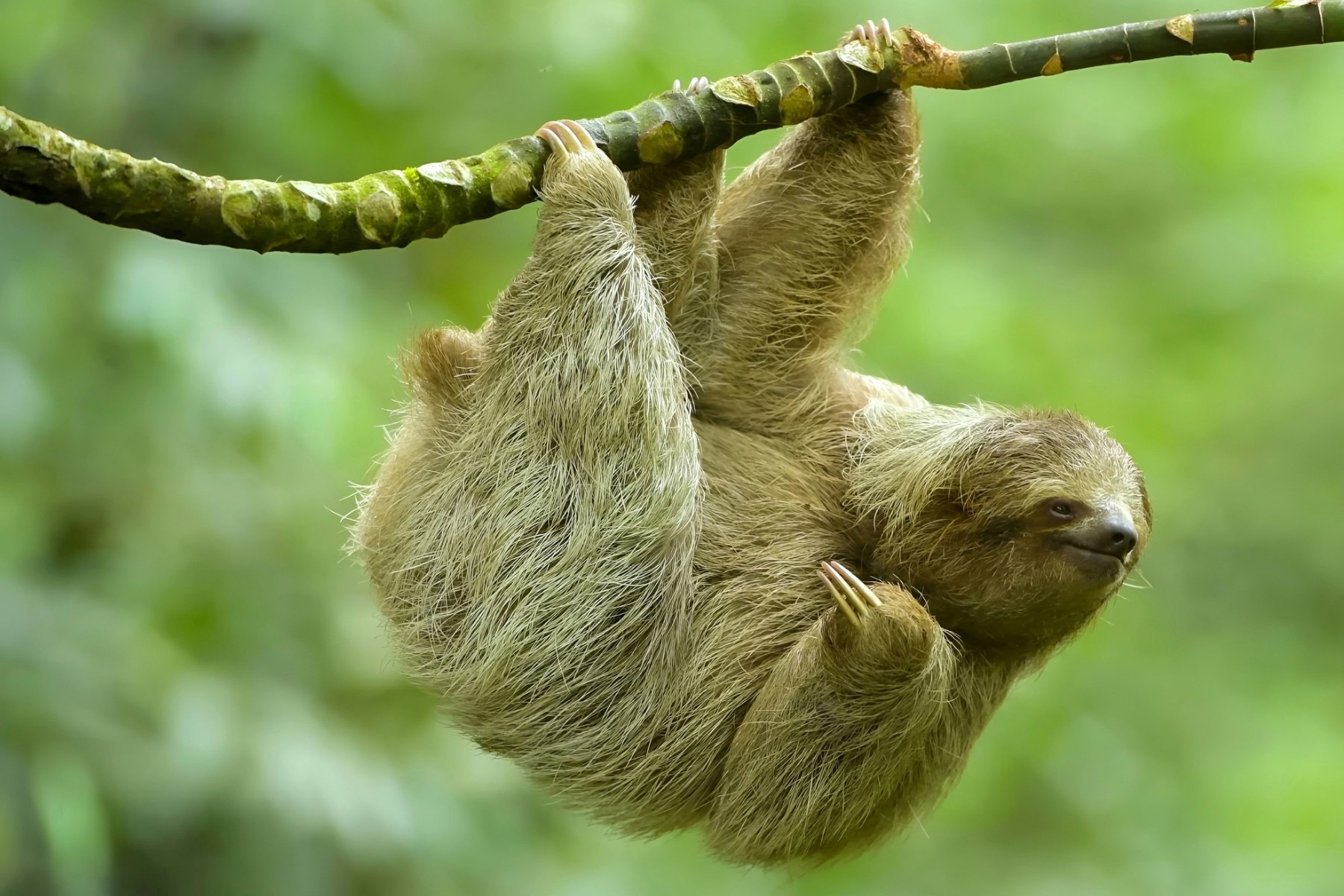
Some explanations link the behaviour to defence and communication. Defecating on the ground may be more discreet, thus less likely to catch the attention of a predator, especially as most of their natural predators are found in the trees. Alternatively, it may enable scent-marking. “When a female sloth is in heat, they will come down to the ground every single day,” says Symeou. “So we can only assume that it does have something to do with reproduction and signalling for a mate.”
There are other, more peculiar, theories. Could sloths be risking it all to fertilise their favourite tree? “I think that would suggest a level of cognition that we are pretty sure is not there,” says Symeou.
Or could it be explained by their symbiotic relationship with the sloth moth? The insects depend on sloth dung for reproduction, while sloths benefit from a healthy population of moths, who boost algae growth. “The moths most likely evolved to the sloth rather than the other way around,” says Symeou.
Whatever the reason, this isn’t a regular chore. The animal’s metabolism – like its general approach to life – is incredibly slow, meaning they only need make the journey once a week. Though, says Symeou, “Sloths are a lot more active than people give them credit for.”
5. Starlings form giant murmurations
Starling murmurations can appear otherworldly. At dusk, hundreds of thousands of starlings coalesce to form giant black clouds. The flock appears to move as one, with individuals seamlessly and effortlessly dipping, diving and turning while flying at breathtaking speeds and avoiding potentially catastrophic collisions.
“Some people refer to it as the ballet of the skies,” says Prof Anne Goodenough from the University of Gloucestershire.
“I tend to think of it a little bit more like a visual expression of what music can be like, where you end up with lots of individual notes that can be arranged and rearranged in almost infinite number of ways, so you will never see the same starling murmuration twice.”
These displays are so extraordinary and so sudden that one British ornithologist believed the birds to be telepathic.
Scientists today have a better understanding of how birds synchronise, the leading theory being they track the movements of seven neighbours. When a bird switches direction or changes speed, those nearby are quick to adapt, creating a near-instantaneous wave that ripples throughout the whole group and causes collective change.
Still, other theories have been put forward. Last year, researchers suggested neural networks enable starlings to orient themselves around others using features in the environment, and collective action occurs spontaneously when multiple birds interact in this way.
As to why murmurations form, it is widely thought these performances are an elaborate but effective means of deterring predators. “You are reducing your chance of being dinner for a short-eared owl or a peregrine falcon,” says Goodenough.
There are a few reasons why. The sheer number of birds slashes the odds that any one individual will be snapped up, while more eyes mean a higher likelihood predators will be spotted. It also confuses predatory birds, who lock onto a target. That becomes difficult when said target is one of a 750,000-strong flock moving erratically.
There are other theories, too. One is that more bodies create a warmer roost. In this sense, murmurations could be seen as advertisements, signposting a particular roosting spot.
“How individual murmurations work, how birds move between them, and how fluid that is – that's definitely something that we don't really know. We still don't know who finally pulls the trigger to go down to roost,” says Goodenough.
“Is that predictable in any way, or is it genuinely random?”
For now, we still don’t really know.
Read more:
