
Picture this: it’s the 1960s and three men are in a vehicle no bigger than a small car – and one of them needs the toilet. But instead of being on Earth, all three are in a spacecraft, where everything floats.
Urinating was straightforward enough. A hose with a condom-like fitting was deployed, whose contents were then vented overboard into space, generating a glistening cloud of frozen droplets nicknamed ‘The Constellation Urion’ by astronauts.
But the next bit proved trickier. For Moon-bound Apollo explorers, pooping (sorry to be crass) meant stripping half-naked in front of your crewmates in the tiny ship’s lower equipment bay. “It’s a lot easier,” one admitted, wryly, “to wipe faeces off your skin than it is to get it off your clothes!”
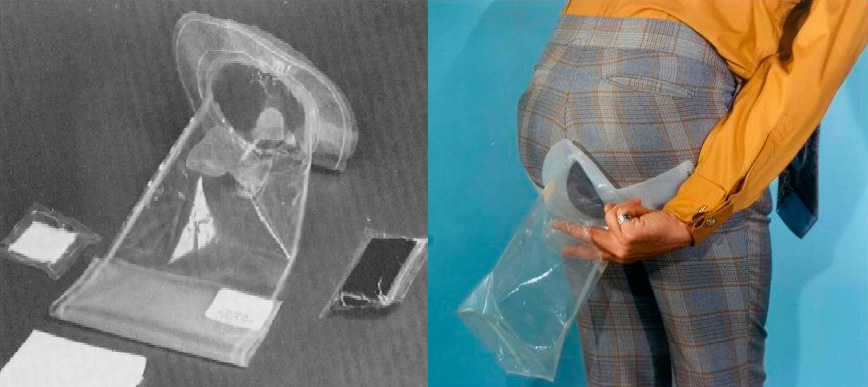
The astronaut then grabbed a plastic bag, its 15cm (6in) opening encircled by a rim of sticky tape. He flypapered the bag to his backside, reached in with his finger… and for the next several minutes probably wished he'd never bothered coming to space at all.
After cleaning up with tissues, he sealed the contents with a blue germicide capsule, kneaded them into a mush – “for as long as you can take it,” astronaut Walt Cunningham admitted – to mix them, then stored the bag for its later return to Earth.
Cunningham recommended at least 45 minutes and as much room as possible to complete this unsavoury deed. Other astronauts hated it, too. “It wasn’t pleasant,” wrote Alfred Worden, “to have someone float inches from your face with a bag stuck to his butt.”
Early space missions typically lasted only a few days. And the pioneers who flew them were hardened by years of military experience to cope with discomfort, lack of privacy and limited hygiene.
But since then, the length of spaceflights has grown vastly – as has their scope. It’s entirely possible that within our lifetimes, the first humans will set sail on a journey to Mars, a journey that will take three years or more to complete.
That’s a long time to be without a practical, workable and reliable deep-space toilet. Which is why, for over half a century, space agencies have put considerable money and engineering effort into producing space loos for this first cadre of Mars adventurers.
Bags and funnels
Going to the toilet in space has long fascinated us. How our most basic bodily functions happen in weightlessness is a frequently asked question of every space traveller and invariably generates eye-rolls and nervous giggles.
But space toilets have also been a touchstone for criticism thanks to their eye-watering multi-million-dollar cost and the immense engineering challenges faced when building a latrine that works without gravity.
“You always have trouble with the toilet,” said former NASA leader Chris Kraft. “Get criticised like the devil for it. ‘Spent $10 million and you don’t know how to build a toilet?‘ Well, we don’t.”
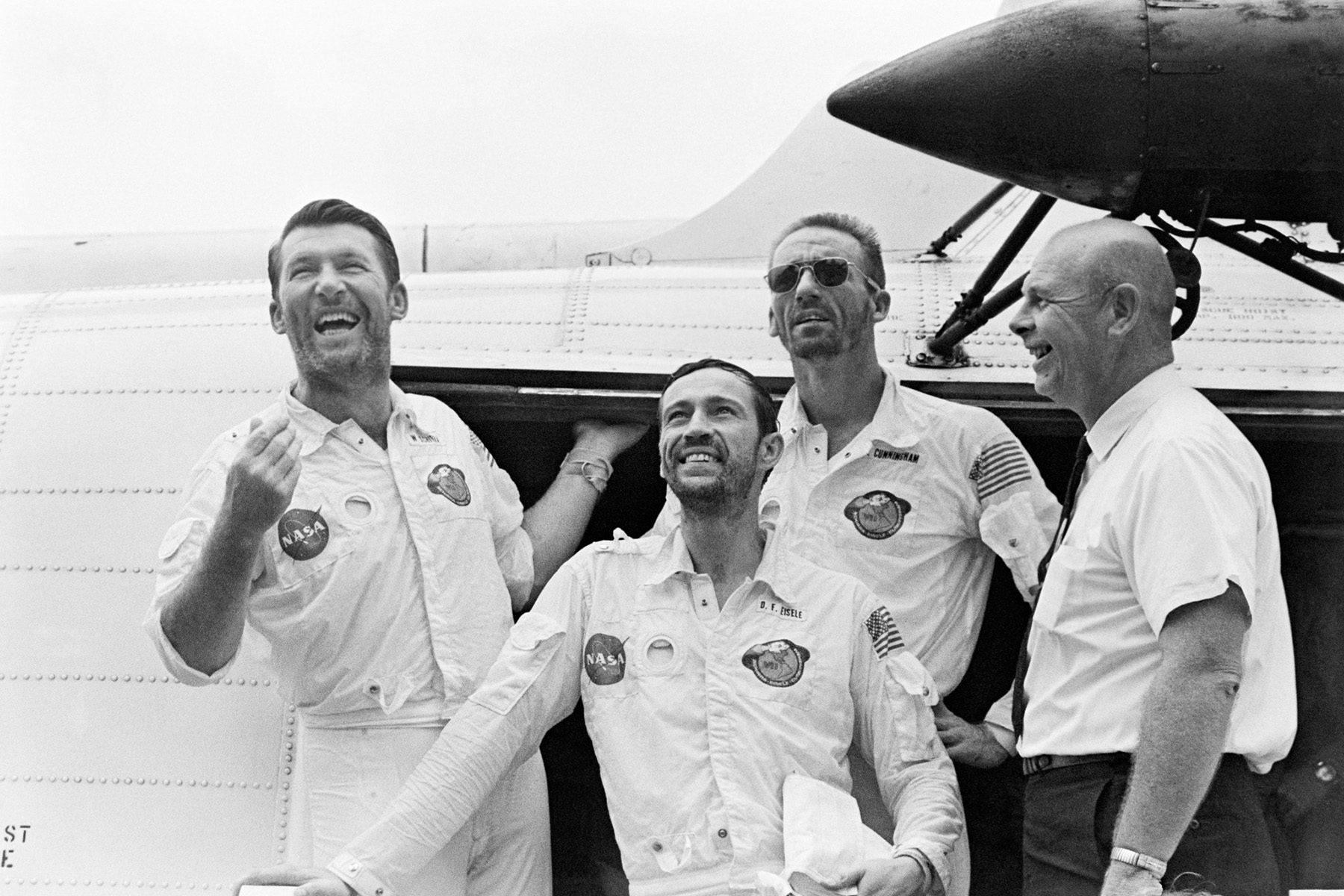
‘Real’ space toilets did not exist at the dawn of the space age. It’s unsurprising that those intrepid early space travellers delayed their ‘need to go’ as long as possible. They ate low-residue diets, took laxatives and enemas before launch and often consumed only half their food rations. Apollo 7’s three astronauts totalled just 12 poops over an 11-day mission.
The uncleanliness proved psychologically unpalatable and physically troublesome in a cramped, unsanitary spacecraft.
And accidents happened. One day during the two-week Gemini 7 mission, a urine bag burst in astronaut Frank Borman’s hands. “Before or after?” queried the flight surgeon. “After,” admitted Borman.
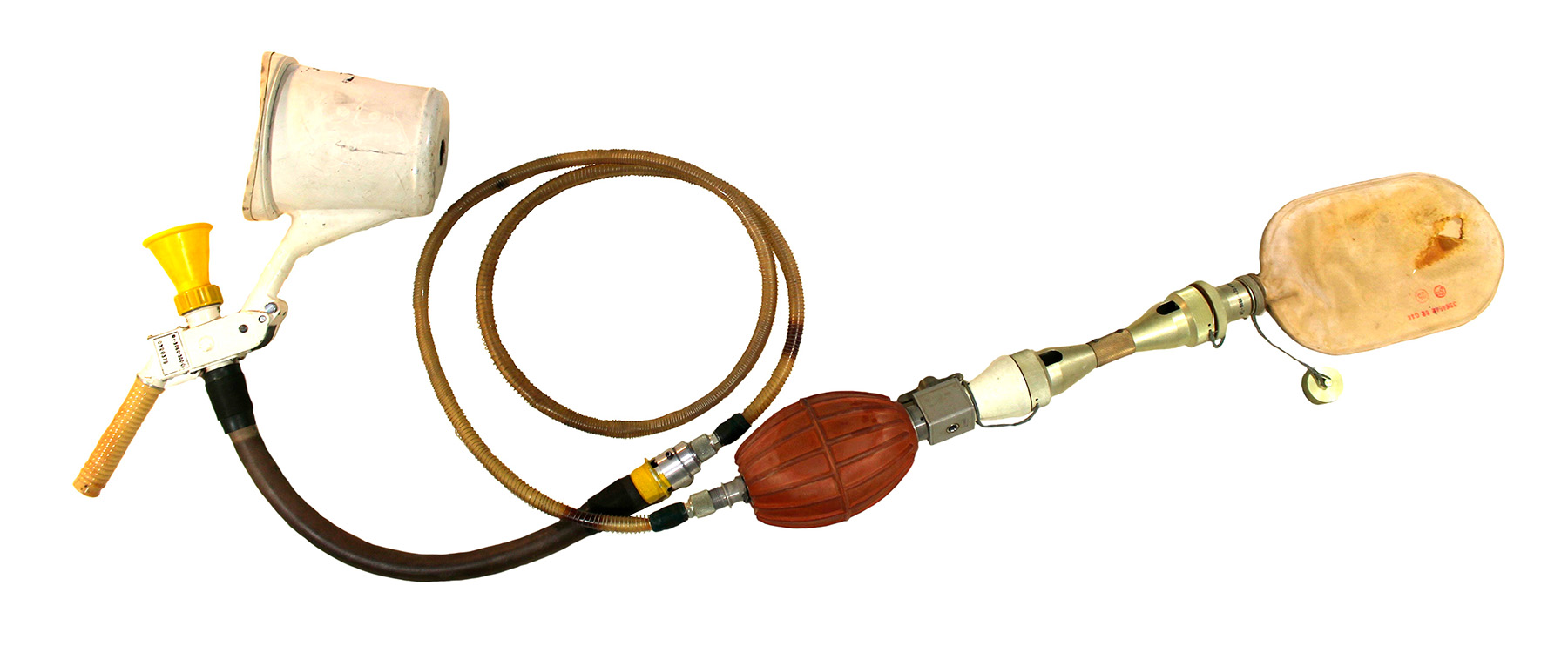
Russia’s Soyuz orbital spacecraft, in service since 1967, attempted to make the whole process a little more straightforward using a rudimentary funnel attached to a receptacle by a flexible hose.
While this made urination more straightforward, pooping in the Soyuz during its short-duration missions proved an ordeal too far for most. “Absolutely no privacy,” admitted US astronaut Norm Thagard, “so folks usually tried to get themselves in a position so they don’t have to defecate.”
Space station facilities
By the 1970s, space agencies moved away from short-term trips and were beginning to build space stations. Here, they could learn how to live and work in space not just for a few days, but for months at a time.
Pooping into bags just wasn’t going to cut it anymore. They needed a real toilet.
Russia’s Salyut 1, the first space station launched in 1971, had a makeshift loo that drew urine into a collector and stored faeces in hermetic tanks. Its successor, the Mir space station’s toilet, recycled urine into drinking water – a step that would become vital for sustaining astronauts during extended stays in space.
But during crew changeovers, with up to six cosmonauts temporarily aboard, a single set of conveniences proved decidedly inconvenient. “All of a sudden, it’s like being in the coach cabin on an airplane,” Thagard recalled, grimly.
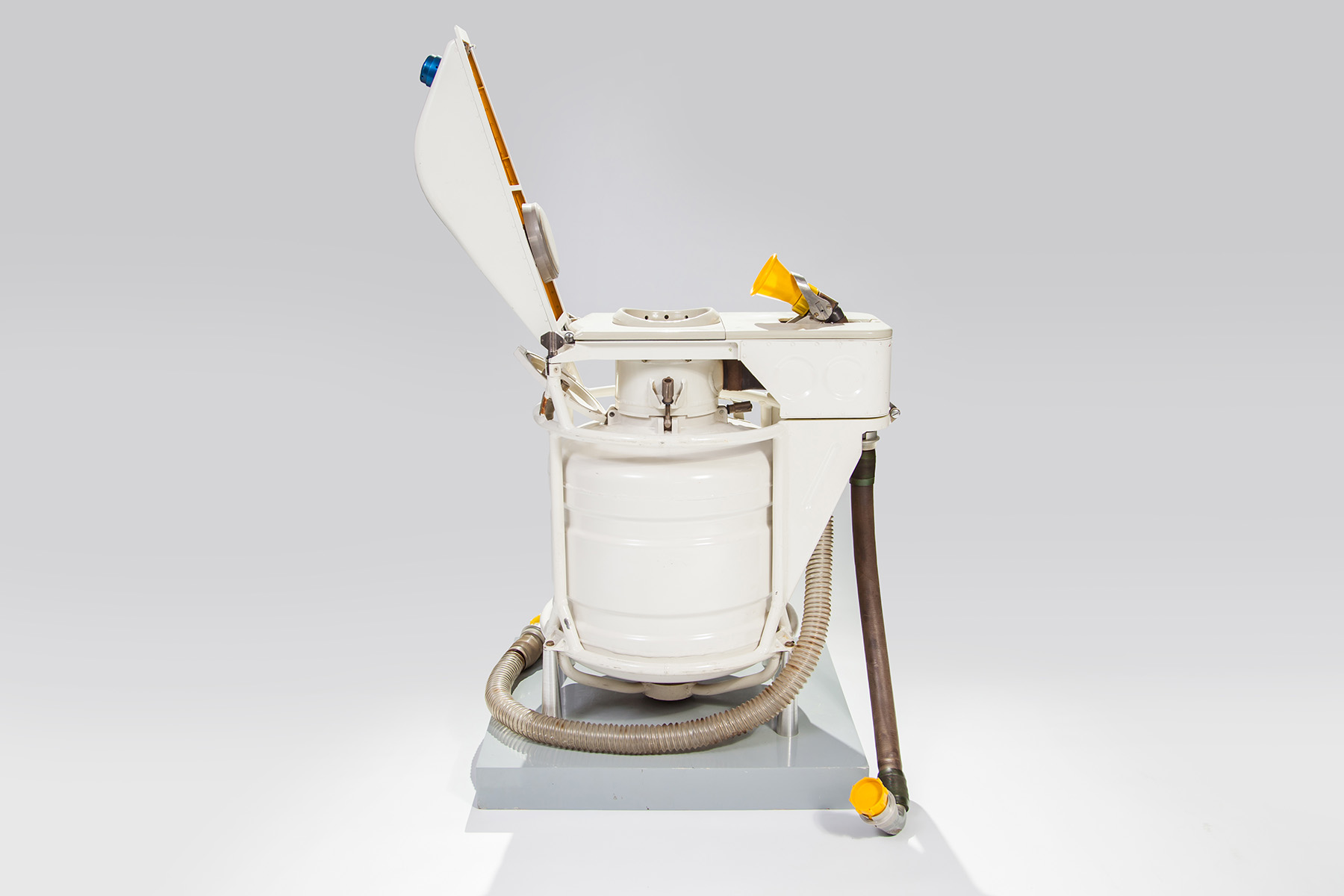
America’s Skylab space station made the toilet facilities yet more airline-like – including their size, metallic appearance and noisy gurgling sound. There was even a toilet seat and a private booth.
Toilets now began to employ air pumps to suck urine through a hose and place faeces into a holding tank, while filters removed odours. Another vital advancement was the addition of straps and handles to keep toilet-goers firmly on the throne.
Long-term thinking
As missions became longer, the need to develop better toilets intensified.
When NASA began developing the Space Shuttle, astronaut Mike Mullane recalled NASA staff capable of pooping at will who happily partook in trials testing its facilities. They “volunteered to do some pretty raw things to make it more comfortable for us,” said Mullane. “I’ll sure buy them a beer someday.”
The shuttle’s toilet – described as “a one-hole outhouse with a vacuum cleaner attached”, by astronaut Jerry Ross – had a 10cm (4in) opening in its seat, activated charcoal filters for better odour and bacteria control, and accordion-like curtains to allow the occupant some privacy. Its loud suction fans also camouflaged any embarrassing sounds emanating from the loo.
But still the process proved time-consuming. “Not all astronauts are successful on their first try,” wrote shuttle and Mir astronaut Jerry Linenger. “Because of the rather strange environment and also perhaps because the bowel does not at first function normally with the intestines floating inside the weightless astronaut, many come out of the middeck toilet area mumbling, ‘another misfire‘.”
Yet despite these discomforts, off-colour toilet humour to lighten the mood was never far away. One morning after breakfast, Bill Shepherd sneaked a sausage into the toilet, then impishly set it free to float in the shuttle’s cockpit. “As panicked crew members ricocheted from wall to wall,” wrote Mullane, “Bill chased after it with a piece of toilet tissue. He finally grabbed it and then, to the horror of all, he ate it.”
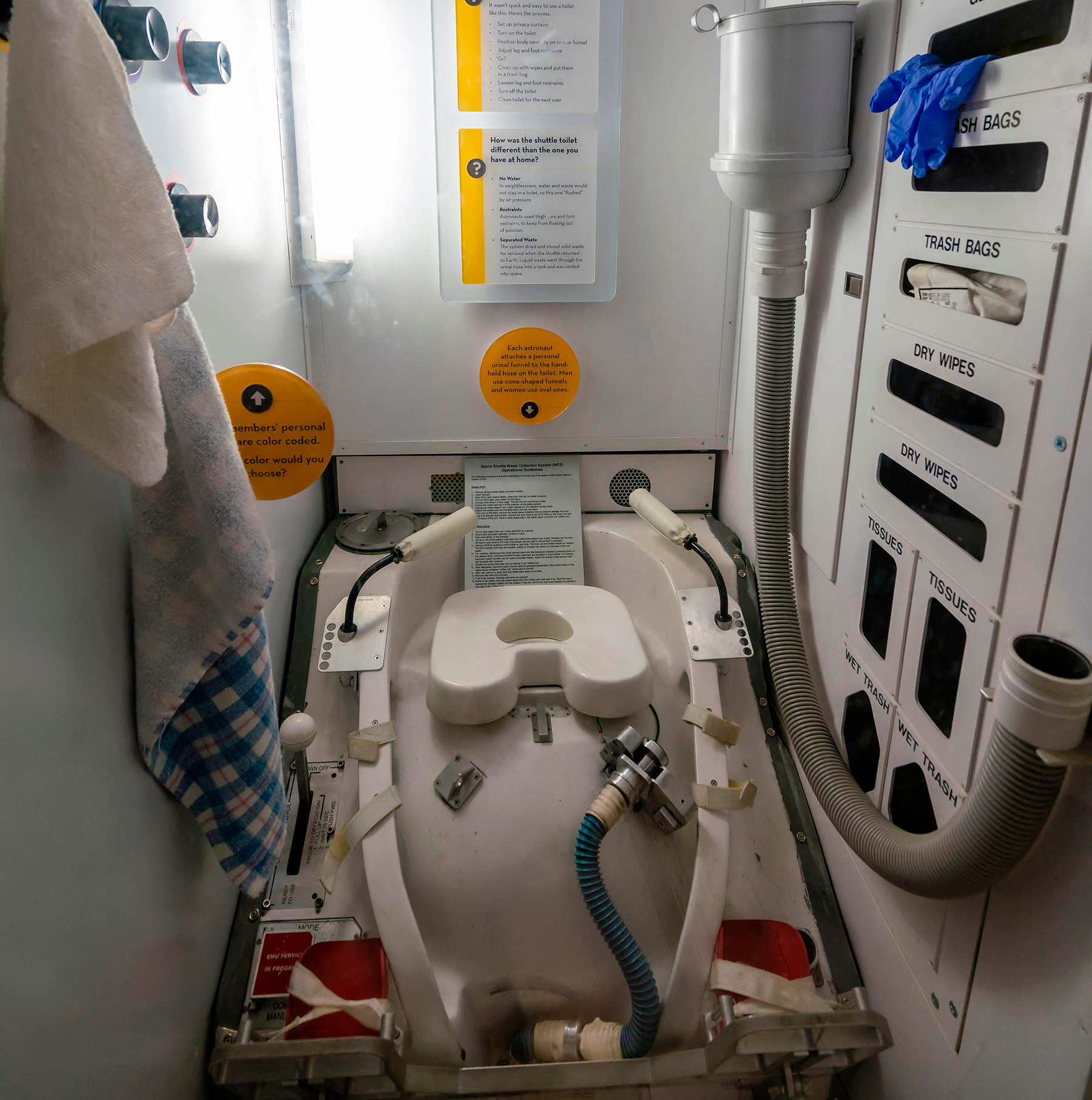
But the shuttle’s loo was far from fault-free. The complexity of the system meant there were a great many things that could (and did) go wrong.
On one mission, the astronauts were forced to revert to using urine bags. It made for a messy few days as they stuffed dirty socks, underwear and towels into the bags to soak up the pee. After they landed, according to shuttle pilot Mike Coats, the ground crew wondered why they were all wearing yellow socks.
Read more:
- These are the 6 worst poops you’ll ever do – and how to cope with them, according to a Harvard doctor
- The 5 absolute best space images of 2026 (so far)
- 15 of the world's weirdest-ever inventions
Doubling up
With the creation of the International Space Station (ISS), astronauts could now spend even longer off-planet, adapting to living and working in space, with the eventual goal of completing a mission to Mars.
But when the first three-person crew arrived in 2000, the ISS had just one toilet in Russia’s Zvezda module. That worked adequately until crew changeovers temporarily doubled the number of people on board. “It was quite a line at the toilet,” said astronaut Suni Williams, “when you’re waiting for the morning rush to get there with only one toilet.”
Even after decades of work honing it, the ISS toilet has been far from problem-free. In 2007, it went briefly out of order following a sensor malfunction.
Then a pump failure in 2008 required a replacement to be hurriedly dispatched from Russia in a diplomatic pouch for delivery to a soon-to-be-launched shuttle. It was lucky that a mission was almost ready to go when the ISS pump failure occurred – otherwise it could have been weeks or months before a replacement could be sent.
Such quick-turnaround deliveries would not be possible on a Mars voyage, making reliability and fixability a much bigger priority.
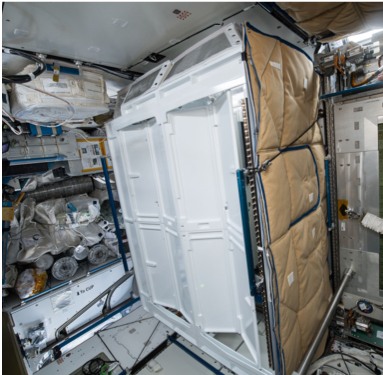
In 2008, as the ISS crew size doubled to six, a second toilet was added. By 2010, it was moved to the Tranquillity module, at the station’s opposite end from Zvezda. “When one toilet goes down,” said Williams, “you have to take the long trip down to the other end of the space station to the other toilet. It’s a little bit of a pain.”
Located in a white booth, the second loo afforded more privacy than earlier ones. Functionally, it worked like a terrestrial toilet, said Italian astronaut, Samantha Cristoforetti, “as long as you don’t pay any attention to the two panels with warning lights and switches that betray the presence of a jumble of pipes, pumps, fans, tanks and filters hidden inside the rack”.
Every so often, an unlucky toilet-goer won the ‘Red Light Lottery’ – when the red Waste Tank Full bulb illuminated. “In my experience, the light tends to show itself in the middle of the night,” explained astronaut Scott Kelly. “Replacing the tank is a pain…especially for a half-asleep handyman, but it’s not an option to leave it for the morning. The first person to get up won’t be able to pee, which isn’t good space station etiquette.”
Kelly was more keenly aware of the importance of staying on top of the tanks than most. One day, while he was exercising, a crewmate accidentally opened a poop-filled storage canister – the stench almost knocked Kelly off his treadmill.
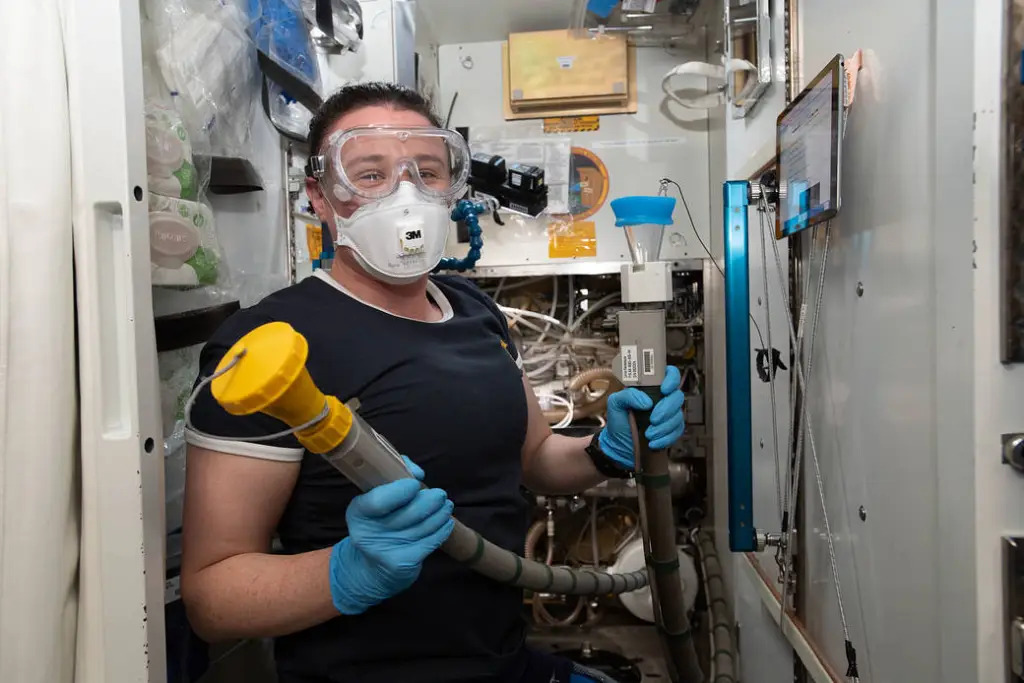
Toilet etiquette also requires the urine funnel to be cleaned and sanitised regularly. Astronaut Tracy Dyson once posted a helpfully inspirational message on the toilet wall: Blessed Are Those Who Wipe the Funnel.
The problem with poop
Humour aside, such toilet etiquette will be hugely important to maintain hygiene, privacy and sanitation in a closed environment during a mission to Mars.
Human waste contaminants can enter the body via the eyes, nose, mouth, ears and cuts to the skin, risking illnesses and infections. Strong odours can negatively impact appetites and even among the most harmonious of crews can quickly fray tempers – particularly when the toilet sits immediately adjacent to a food preparation area.
Such episodes might easily render a crewmember seriously ill and risk incapacitating others.
On the ISS, a sick or injured crewmember can return to Earth for medical attention within days. On the long voyage to Mars, this would not be an option. Far better to ensure the crew doesn’t get sick in the first place.
There has also, historically, been another major problem for space toilets. The earliest space toilets were from an era when only men were astronauts, and later models added female functionality as an afterthought.
While building their most recent iteration of the space toilet, the Universal Waste Management System (UWMS), NASA aimed to address that. Engineers took feedback from several female astronauts, such as ensuring it was possible to use both funnel and seat simultaneously.
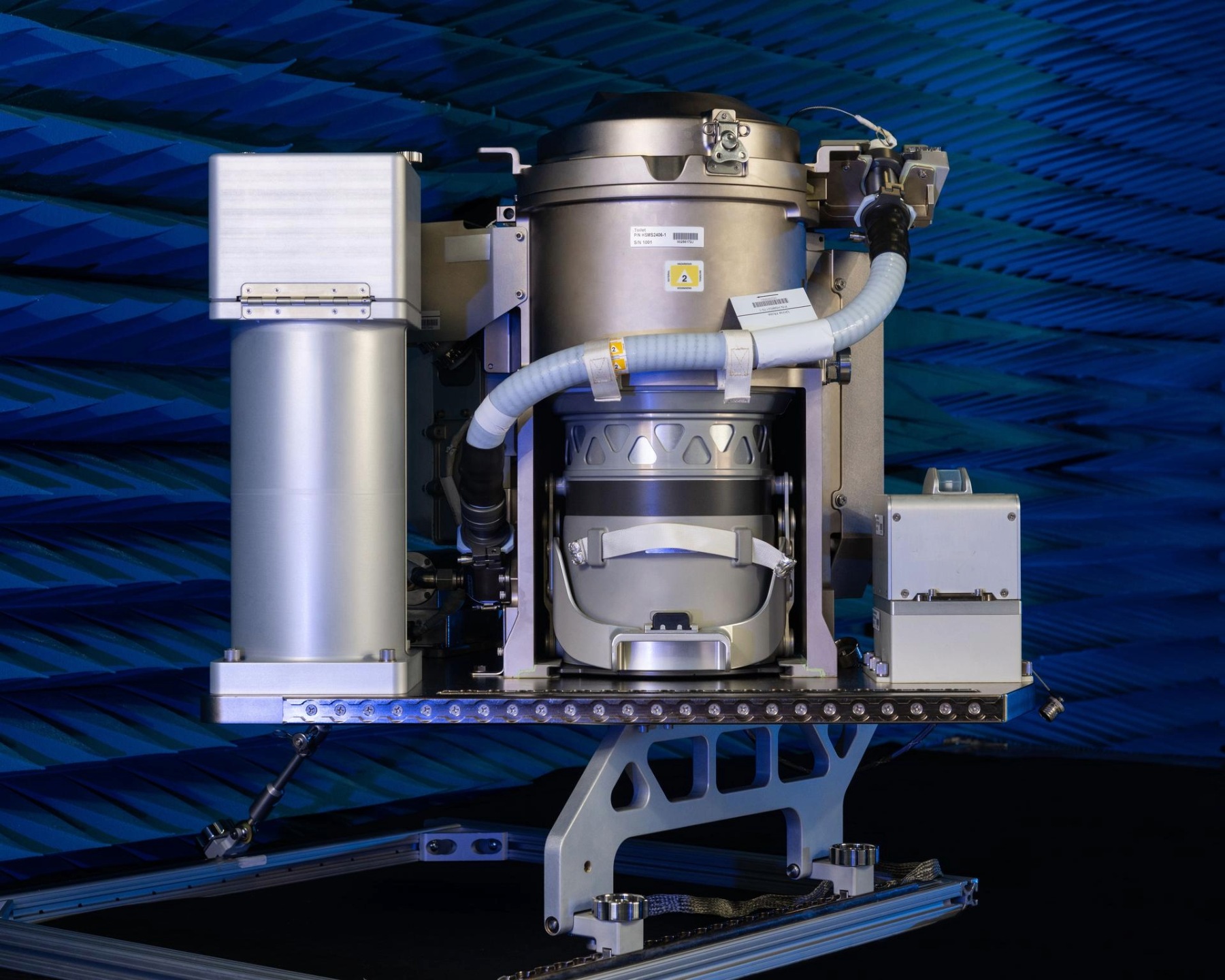
The UWMS is designed with the Artemis Moon landing missions, as well as future Mars voyages, in mind, though a tech demo has been installed on the ISS since 2020.
The $23 million system is 65 per cent smaller and 40 per cent lighter than the shuttle’s lavatory, making it straightforward to integrate into Orion deep-space capsules. The UWMS is fully automated, quieter, lighter, more reliable, more hygienic and more compact than its predecessors.
But while it may be better than previous versions, it’s still noisy and has had several glitches. A UWMS flew on Artemis II to the Moon in 2026 but frozen urine in its vent line briefly prevented it from dumping overboard. The urine was eventually melted, but not before crew members had been forced to use bags for several days while the world looked on.
Where do you put it all?
So, after more than half a century of trying to build a functional and sanitary toilet that affords its user a reasonable amount of dignity, space agencies are still struggling. And this doesn’t touch on the much thornier problem of what to do with all that waste.
A seven-person ISS crew produces around 4,400kg (9,600lb) of annual waste, including urine, faeces and other refuse. About 93 per cent of secreted or excreted water (including pee and sweat) is currently recycled into clean water.
“When it comes to our urine on ISS,” said astronaut Jessica Meir, “today’s coffee is tomorrow’s coffee!”
Meanwhile, solid human waste – bagged and stored in aluminium containers like the one whose stink nearly ended Scott Kelly’s treadmill session – is loaded aboard departing cargo ships for incineration during re-entry.
But that won’t be an option for the three-year-plus round trip to Mars. It will need to be discarded, recycled or reused.
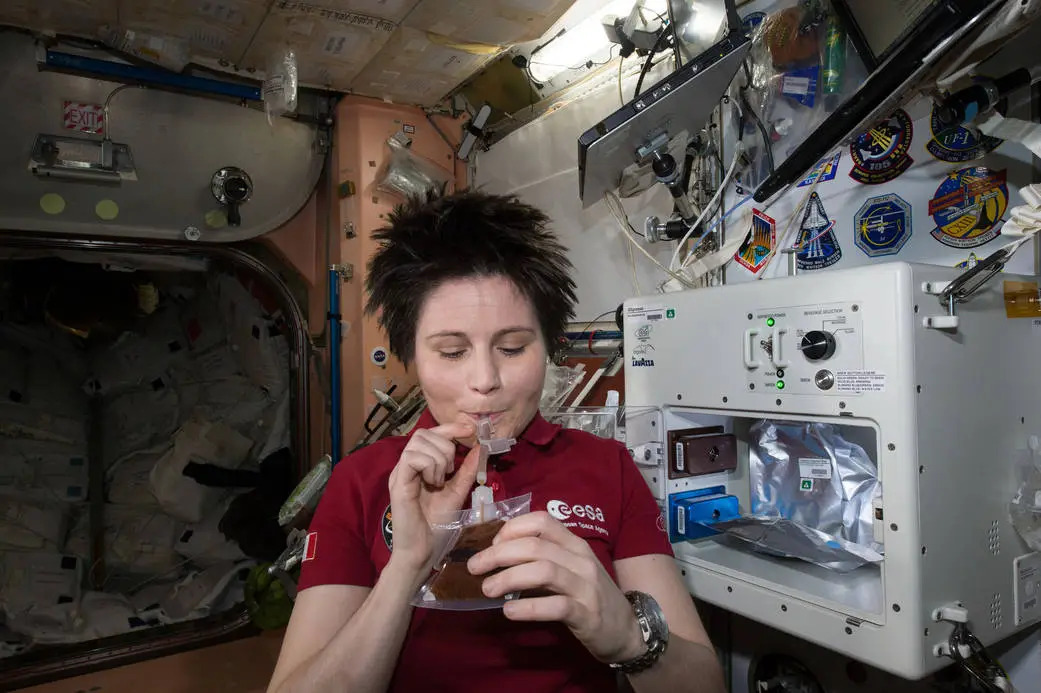
A single astronaut can produce up to 82kg (180lb) of poop annually. Options for dealing with this frightening amount of excrement include lining the spacecraft’s walls for radiation shielding and processing it into gases for venting overboard, or recycling it back into clean water and fertiliser to grow food.
NASA’s current goal is to achieve a 98 per cent recycling rate before the first human mission departs for the Red Planet sometime in the 2030s or after. The closed-loop water reclamation system on the ISS is a crucial first step.
But a secondary facet of this need for improved self-sufficiency in deep space is to limit the reliance of future astronauts on resupply from Earth – including growing their food, recycling their water and dealing with their waste.
“We spend a lot of time relying on the ground,” admitted NASA astronaut Suni Williams. “The space station will allow us to … start taking those steps, getting a little more divorced from the ground and coming up with systems and processes like water reclamation or changing drinking water. All of that has to be able to be solved up in space.”
On Mars, treated human waste might someday be used to grow crops in alien soil, as happened in Andy Weir’s novel The Martian. The survival of the next generation of astronauts – the first ‘true’ Martians – will depend upon reclaimed water from their own pee and nutrients from their own excrement.
“For future Mars folks,” wrote astronaut Cady Coleman, “you’ll be keeping those cans of poop.”
Read more:
